

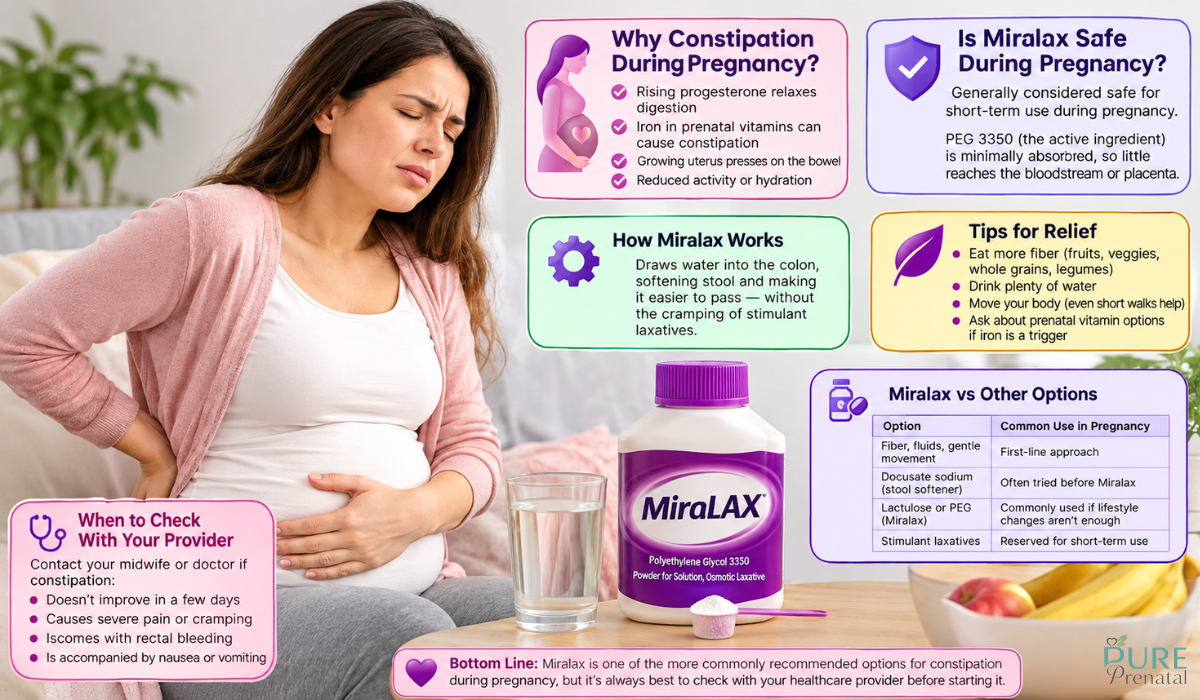
If you’re pregnant and constipation has suddenly become a daily struggle, you’re not imagining it, and you’re not alone. Somewhere between the hormones, the prenatal vitamins, and a uterus that keeps growing, your digestion can slow to a crawl. So it makes sense that one of the first questions many women ask their pharmacist or midwife is whether it’s safe to reach for Miralax.
The short answer: Miralax, whose active ingredient is polyethylene glycol 3350 (PEG 3350), is generally considered safe for short-term use during pregnancy, and it’s often one of the first over-the-counter options a doctor or midwife will suggest. That said, “generally safe” isn’t the same as “use freely without asking anyone,” so it’s worth understanding how it works, why it’s usually preferred over other laxatives, and when it’s better to check in with your healthcare provider first.
Why Constipation During Pregnancy Is So Common
Constipation during pregnancy is one of those symptoms almost nobody warns you about until it happens to you, and then suddenly it’s all you can think about.
A few things are working against your digestion at once:
- Rising progesterone relaxes smooth muscle throughout your body, including the muscles that normally keep food moving through your intestines.
- Iron in prenatal vitamins is notoriously constipating and is one of the most common triggers women report.
- A growing uterus physically presses on the bowel as pregnancy progresses, especially in the second and third trimesters, slowing things down even further.
- Reduced activity or hydration, which can happen naturally as you get more tired or nauseated, can make everything worse.
Put those together, and it’s easy to see why constipation relief during pregnancy is one of the most searched pregnancy symptoms out there.
What Is Miralax and How Does It Work?
Miralax is the brand name for polyethylene glycol 3350, an osmotic laxative. Rather than stimulating the bowel wall to contract the way stimulant laxatives do, it works by drawing water into the colon. That extra water softens the stool and makes it easier to pass, without the cramping that stimulant laxatives can sometimes cause.
This is really the key point when people ask is Miralax safe for pregnancy, or whether it’s safe when pregnant: PEG 3350 is only minimally absorbed into the bloodstream. Most of it stays in the gut and is passed out in the stool rather than being taken up systemically, which is a large part of why it’s considered a reasonable option compared with medications that circulate through your body and reach the placenta.
Is Miralax Safe During Pregnancy?
This is the question most women actually want answered, and here’s the honest picture.
Miralax pregnancy safety hasn’t been studied in large, dedicated clinical trials the way some other medications have, simply because pregnant women are often excluded from drug trials for ethical reasons. That said, the available evidence and long clinical experience with PEG 3350 in pregnancy has been reassuring. Because so little of the drug is absorbed, healthcare providers commonly reach for it before other options when constipation isn’t responding to diet and lifestyle changes alone.
It’s also worth mentioning that Miralax used to carry an older FDA pregnancy category labeling system (Category C), which reflected limited human data rather than any specific known harm. The FDA has since moved away from that lettered category system in favor of more descriptive labeling, but you may still see the old “Category C” reference on some websites or product information.
None of this means Miralax is automatically the right choice for every pregnant woman in every situation. If you’re wondering can you take Miralax while pregnant in your specific case, particularly if you have a complicated pregnancy history, ongoing digestive issues, or you’re already taking other medications, it’s still worth running it past your midwife, GP, obstetrician, or pharmacist first. This applies whether you’re asking about Miralax while pregnant in the first trimester or later in pregnancy, since the digestive changes and the general safety profile don’t differ dramatically by trimester.
Miralax vs Other Stool Softeners and Laxatives in Pregnancy
Constipation relief in pregnancy usually follows a stepped approach. Most healthcare providers will suggest starting with the simplest, least medicated options first, and only moving to something like Miralax if those don’t help.
| Option | Type | Common Use in Pregnancy |
|---|---|---|
| Increased fiber, fluids, and gentle movement | Lifestyle | First-line approach for most women |
| Docusate sodium (a stool softener) | Stool softener | Often tried before osmotic laxatives |
| Lactulose or polyethylene glycol (Miralax) | Osmotic laxative | Commonly used when lifestyle changes aren’t enough |
| Fiber supplements (psyllium, ispaghula) | Bulk-forming laxative | Can help but needs adequate fluid intake |
| Stimulant laxatives (senna, bisacodyl) | Stimulant laxative | Usually reserved for short-term, occasional use if other options fail |
A stool softener while pregnant, such as docusate sodium, works differently from Miralax. Docusate simply makes the stool easier to pass by allowing more water and fat to mix into it, whereas Miralax draws in a larger volume of water and has a stronger osmotic effect. Many women ask whether they should try a stool softener or Miralax for constipation while pregnant, and the honest answer is that it often depends on how severe the constipation is and what your provider recommends trying first.
If you’re asking what stool softener is safe during pregnancy more broadly, docusate sodium and PEG 3350 are both commonly recommended, along with lactulose. Stimulant laxatives can be used occasionally too, but they’re generally not the first choice because they can cause more cramping and are typically saved for short-term, as-needed use.
Tips for Managing Constipation Before Reaching for Medication
Before turning to any laxative, including Miralax, a few simple changes can make a real difference:
- Increase fiber gradually through fruit, vegetables, whole grains, and legumes.
- Drink more water throughout the day, aiming for consistent hydration rather than large amounts all at once.
- Move your body when you can, even a short daily walk helps stimulate bowel activity.
- Ask your provider whether switching to a different prenatal vitamin formulation might help if iron seems to be a major trigger.
When to Contact Your Midwife or Doctor
Occasional constipation is common and usually nothing to worry about, but you should reach out to your midwife, GP, or obstetrician if you experience:
- Constipation that doesn’t improve after a few days of using a stool softener or laxative as directed
- Severe abdominal pain or cramping
- Rectal bleeding or blood in your stool
- Nausea and vomiting alongside an inability to pass stool or gas
- Any new or worsening symptoms that feel out of the ordinary for you
These symptoms don’t necessarily mean anything serious is happening, but they’re worth getting checked rather than managing on your own.
FAQs
Can I take Miralax every day while pregnant? Miralax is generally intended for short-term use unless your provider has specifically told you otherwise. If you find you need it most days for more than a week or two, it’s worth mentioning to your midwife or doctor rather than continuing indefinitely on your own.
Is Miralax safe in the first trimester? There’s nothing about early pregnancy specifically that changes the safety profile of PEG 3350. Many women take it in the first trimester without issue, though as always, checking with your provider first is a reasonable precaution.
What stool softener is safe for pregnancy if I don’t want to use Miralax? Docusate sodium is a commonly recommended stool softener during pregnancy and works through a gentler mechanism than an osmotic laxative like Miralax. Lactulose is another option some providers suggest.
Are laxatives safe during pregnancy in general? Many are, particularly osmotic laxatives and stool softeners. Stimulant laxatives are typically used more cautiously and only for occasional, short-term relief rather than daily use.
Does Miralax cross the placenta? Because polyethylene glycol 3350 is poorly absorbed from the gut into the bloodstream, only a very small amount is thought to reach systemic circulation, which is part of why it’s considered a reasonable option in pregnancy compared with medications that are more fully absorbed.
The Bottom Line
Constipation during pregnancy is uncomfortable, common, and almost never a sign of anything serious on its own. Miralax, thanks to how little of it the body actually absorbs, has become one of the more commonly recommended options when diet and lifestyle changes aren’t cutting it. Still, “commonly recommended” isn’t the same as “one-size-fits-all,” so it’s worth a quick conversation with your midwife, GP, or pharmacist before starting it, especially if your constipation is severe, persistent, or accompanied by other symptoms.

Dr. Tania Adib is a Board Certified OB/GYN based in the northern suburbs of Chicago. She earned her undergraduate degree from the University of Notre Dame and her medical degree from Georgetown University in Washington, D.C., before completing her residency in Obstetrics and Gynecology at Magee-Womens Hospital, University of Pittsburgh Medical Center. Her clinical interests include full-spectrum obstetrics and gynecology, from the first period through the menopausal years, contraception, and abnormal bleeding.