
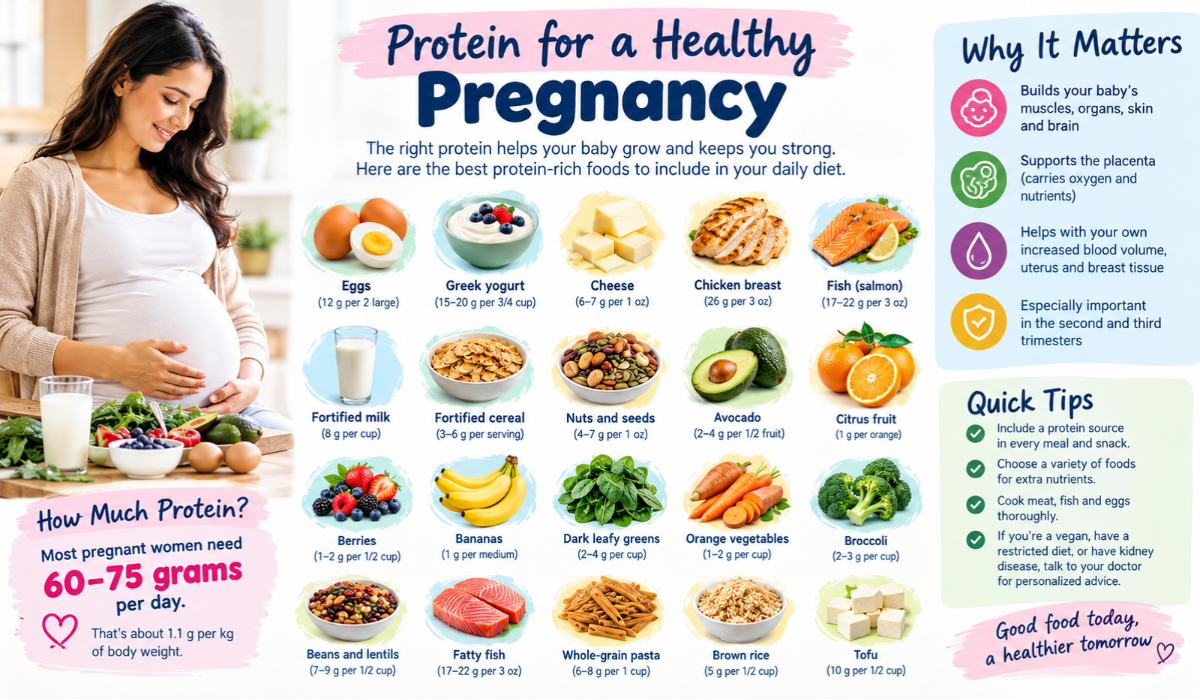
Most pregnant women need somewhere around 60 to 75 grams of protein a day. The simplest way to get there is to stop thinking about grams and put a real protein source in every meal and snack: eggs, Greek yogurt, lentils, well-cooked chicken or fish, tofu, a spoonful of peanut butter. That covers most people.
Below, I’ll walk through why the number goes up, how to work out your own, which protein rich foods for pregnant women are worth keeping on repeat, and where a little food-safety care applies.
Why is protein important during pregnancy?
Your body is building a person, and protein is the material it builds with. Your baby’s muscles, organs, skin and brain all start as amino acids. So does the placenta, the organ that carries oxygen and nutrients across to your baby. And you’re growing too: more blood, a bigger uterus, changing breast tissue.
That’s really the whole answer to why protein is needed during pregnancy. Your baby can’t make any of it from nothing, so it comes off your plate.
The demand isn’t steady, either. Growth speeds up in the second and third trimesters, so protein while pregnant matters most in the second half. If your first trimester is mostly saltines and dread, don’t panic. Your body isn’t asking for much extra yet.
How much protein should a pregnant woman eat a day?
Here’s the number people are usually hunting for. Before pregnancy, the standard recommendation is 0.8 grams of protein per kilogram of body weight. In pregnancy, the reference figure moves up to about 1.1 grams per kilogram. For an average woman, that lands near 71 grams a day, roughly 25 grams more than usual.
Because it’s tied to body weight, your own number may be a little different:
| Your weight | Approximate daily protein (at 1.1 g/kg) |
|---|---|
| 120 lb (54 kg) | about 60 g |
| 150 lb (68 kg) | about 75 g |
| 180 lb (82 kg) | about 90 g |
Some prenatal guides break it out by trimester, around 60 grams in the first, 70 in the second and 75 in the third. That’s a fair picture of the gradual climb, and it sits inside the same range.
If you’ve ever typed “how much protein pregnant” or “protein needs pregnancy” into a search bar late at night, you’ve seen figures from 46 grams to well over 100. They don’t agree because they’re answering different questions. Some are minimums, some are targets for very active women, and some are selling a product. For a healthy woman, aiming for 60 to 75 grams is well supported, and ACOG’s patient guidance is in the same neighborhood.
A few situations push the protein requirement in pregnancy higher, and they’re worth raising at a prenatal visit:
- Twins or more
- Hard daily exercise or a physically demanding job
- A vegan or heavily restricted diet
- Being underweight before pregnancy
If you have kidney disease, go the other direction. Don’t raise your protein on your own, and get individual guidance first.
Do you have to count grams?
Not really. Plenty of people meet their protein intake in pregnancy without tracking anything, and the Linus Pauling Institute’s pregnancy handout points out that many women already eat close to the extra amount.
If you like data, track for three or four days and see where you land. If counting makes you miserable, use a rougher rule: a palm-sized portion of protein at each meal, plus one or two snacks that contain some. It’s not precise, but it works.
Best protein when pregnant: what to actually eat
There’s no single best protein when pregnant. Variety is what matters, because different foods bring different extras. Eggs bring choline. Salmon brings omega-3 fats. Beans bring fiber and folate. Dairy brings calcium. A mix covers more than any one hero food.
Amounts below are approximate and shift by brand and preparation.
| Food | Typical portion | Approx. protein | Worth knowing |
|---|---|---|---|
| Eggs | 2 large | 12 g | Cook until yolk and white are firm; good choline source |
| Plain Greek yogurt | 3/4 cup | 15 to 20 g | Pasteurized only; calcium comes along |
| Cottage cheese | 1/2 cup | 12 to 14 g | Check the label for pasteurized milk |
| Chicken breast | 3 oz cooked | about 26 g | Cook to 165°F |
| Lean ground turkey or beef | 3 oz cooked | 20 to 22 g | Beef also brings iron |
| Salmon | 3 oz cooked | about 17 to 22 g | Lower in mercury; omega-3s for baby’s brain and eyes |
| Canned light tuna | 3 oz | 17 to 20 g | Counts toward your weekly fish limit |
| Lentils | 1 cup cooked | about 18 g | Fiber and folate too |
| Chickpeas | 1 cup cooked | about 14 g | Roast them, mash them, or blend into hummus |
| Edamame (shelled) | 1 cup | about 17 g | Buy pre-cooked and heat until hot |
| Tofu | 1/2 cup | 10 to 20 g | Firmer tofu packs more per scoop |
| Peanut butter | 2 tbsp | 7 to 8 g | Easy on toast or fruit |
| Milk or fortified soy milk | 1 cup | 7 to 8 g | Soy milk is the closest plant match |
| Quinoa | 1 cup cooked | about 8 g | A complete plant protein |
Think of that table as your list of good sources of protein for pregnant women, and pick whatever you’ll really eat. A protein you can’t stomach this week isn’t doing anyone any favors.
Lean proteins for pregnancy
When people ask about lean protein for pregnancy, they usually mean skinless chicken and turkey, white fish, eggs, low-fat dairy, beans and tofu. Lean proteins for pregnancy deliver the protein without a heavy dose of saturated fat, which can help if heartburn is already turning dinner into a negotiation.
But lean isn’t a virtue on its own. Salmon isn’t lean, and it’s one of the best things on the list.
About protein enriched foods for pregnancy
Grocery stores are full of protein enriched foods for pregnancy that have nothing to do with pregnancy: bars, cereals, pastas, waffles. A few are fine as a backup. A lot of them are candy bars in gym clothes, with more added sugar than you’d guess. Read the label, and treat them as a convenience, not the plan.
Protein rich foods pregnancy-friendly if you don’t eat meat
A vegetarian pregnancy is completely doable. The catch is that a plate of pasta or rice with vegetables can look substantial and still be low in protein, so you need a little intention.
Reliable choices are eggs and dairy if you eat them, plus lentils, beans, chickpeas, tofu, tempeh, edamame, nuts, seeds and soy milk. Pairing grains with legumes, like rice and beans or hummus with whole-grain pita, gives you a full amino acid range over the day. They don’t have to be in the same bite.
If you’re vegan, have that conversation with your provider or a dietitian early. Protein is usually manageable, but B12, iron, choline and omega-3s take some planning, and a prenatal vitamin alone won’t always cover them.
Protein foods for pregnancy that need a safety check
Most of the protein rich foods for pregnancy above are safe as long as you handle them right. It’s the preparation that matters, not the food itself.
Cook it through. Poultry should reach 165°F. Eggs should be firm, no runny yolks. Skip rare meat and raw or undercooked seafood, including sushi made with raw fish.
Heat the deli meat. Cold cuts, hot dogs and dry sausages can carry listeria, which is uncommon but can be serious in pregnancy. Heating them until steaming hot takes care of it. Premade deli salads, like egg or tuna salad, are best skipped.
Pasteurized only. That covers milk, yogurt, soft cheeses, juice and cider. Double-check the label on feta, queso fresco and brie.
Mind the mercury. Fish is a great protein source, but the FDA suggests sticking to its “Best Choices” list, such as salmon, sardines, shrimp, cod and canned light tuna, and skipping shark, swordfish, king mackerel and tilefish. The guidance is two to three servings a week of lower-mercury fish.
Cook your sprouts. Raw sprouts are a known food-safety risk in pregnancy. Cooked ones are fine.
What about protein powders and shakes?
Ask your provider before you start one. Supplements aren’t reviewed by the FDA for safety or purity before they’re sold, so what’s in the tub may not match the label perfectly. Some powders also contain herbs, caffeine or other ingredients nobody has studied in pregnancy.
Food is cheaper and comes with nutrients a powder doesn’t. If nausea or a very limited diet means you truly can’t get enough, your provider or a dietitian can point you to a specific product. That call should come from them, not from a promo code.
What a high protein diet for pregnant women looks like in real life
A high protein diet for pregnant days, when you’re tired and not in the mood to cook, doesn’t need to be fancy. Here’s roughly 80 grams from ordinary food:
- Breakfast: two eggs on whole-grain toast (about 15 g)
- Snack: 3/4 cup plain Greek yogurt with berries (about 17 g)
- Lunch: a cup of lentil soup with a slice of toast (about 20 g)
- Snack: an apple with 2 tablespoons of peanut butter (about 8 g)
- Dinner: 3 ounces of baked chicken or salmon with roasted vegetables and rice (about 22 to 26 g)
Nothing exotic there. If you don’t eat meat, swap in a tofu scramble, edamame, a bean-based dinner and soy milk, and you end up in the same place.
When nausea makes protein hard
A very common thing, especially early on, is that meat suddenly smells wrong. It’s normal and it usually passes.
In the meantime, cold and bland tends to go down easier: yogurt, cottage cheese, milk, nut butter on crackers, cheese cubes, hummus, hard-boiled eggs. Small portions every couple of hours often work better than three big meals. ACOG has noted that eating enough protein may help with morning sickness for some women. It’s not a cure, but it’s worth trying.
Can you eat too much?
For most people eating real food, no. It’s hard to overdo it on chicken and lentils. The concern is mostly concentrated supplements and very high-protein plans that crowd out everything else, so fiber, folate and iron slip. Aim for balance: protein at each meal, without giving up vegetables, whole grains, fruit and healthy fats.
When to talk to your provider
Bring it up at your next visit if:
- You’re vomiting often enough that you can’t keep much food down
- You’re carrying twins or more
- You’re vegan, or a food allergy removes major protein sources
- You have diabetes, kidney disease or another condition that affects how you should eat
- You’re not sure your diet is covering your needs
Call sooner if you can’t keep any food or fluid down for a day, or you’re losing weight instead of gaining.
FAQs
How much protein should I eat while pregnant?
Most healthy women do well with about 60 to 75 grams a day, or roughly 1.1 grams per kilogram of body weight. If you’re asking how much protein do I need while pregnant with twins or a very active lifestyle, your provider can adjust that number.
What is the ACOG pregnancy protein needs grams per day figure?
ACOG’s patient education describes protein as a nutrient that increases in pregnancy and points to roughly 70 to 75 grams a day as a general target. Your own provider may give you something more specific.
How much protein per day for pregnancy in the first trimester?
Often a bit less than later on, around 60 grams. Many women can’t eat much in the first trimester anyway, and that’s okay. Focus on whatever protein you can tolerate.
Is a high protein diet safe when pregnant?
Generous protein from whole foods is safe for most people. Be more careful with a very high-protein plan built on powders, or one that pushes out other food groups. If you have kidney problems, check with your provider first.
What’s the best protein for a vegetarian pregnant woman?
Lentils, beans, tofu, tempeh, edamame, eggs, dairy, nuts and seeds. Spread them across the day and you’ll cover your amino acid needs.
Can I eat tuna?
Canned light tuna is a lower-mercury option and fits within the FDA’s weekly fish guidance. Albacore and bigeye tuna are higher in mercury, so limit or avoid them.
How many eggs can I eat?
Eggs are an excellent source of protein and choline, and most pregnant women can eat them regularly as long as they’re fully cooked. If you have high cholesterol or another condition, ask your provider what’s right for you.
Do I need more protein if I exercise?
Possibly. Active women often need more than the average recommendation, and a dietitian can help set a target that matches your training.
Bottom line
Protein is one of the easier pregnancy nutrients to get right. Aim for roughly 60 to 75 grams a day, put a protein source in every meal and snack, and rotate through eggs, dairy, lean meat, fish, beans, lentils, tofu and nuts. Cook animal foods thoroughly, choose pasteurized dairy and lower-mercury fish, and skip supplements unless your provider recommends one.
On the days your appetite is unreliable, do what you can. A few spoonfuls of yogurt, an egg or a smear of peanut butter still counts.

Dr. Tania Adib is a Board Certified OB/GYN based in the northern suburbs of Chicago. She earned her undergraduate degree from the University of Notre Dame and her medical degree from Georgetown University in Washington, D.C., before completing her residency in Obstetrics and Gynecology at Magee-Womens Hospital, University of Pittsburgh Medical Center. Her clinical interests include full-spectrum obstetrics and gynecology, from the first period through the menopausal years, contraception, and abnormal bleeding.