

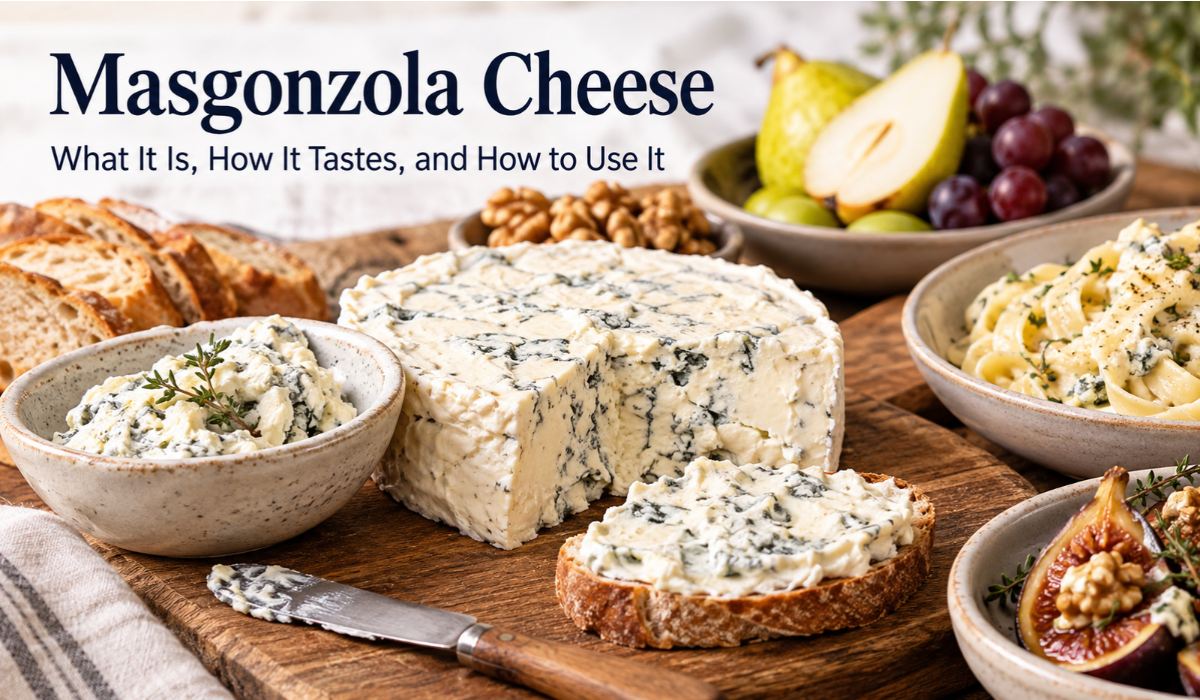
The name threw me for a second. Masgonzola sounds like something a nonna has been tucking away in a cellar since before the war. It’s not. It’s a lot simpler than that, and honestly I like it more for it.
Masgonzola is Gorgonzola folded together with mascarpone. That’s the whole idea. The Gorgonzola keeps its tang and funk, and the mascarpone rounds off the sharp corners. If you’ve ever bitten into a wedge of blue cheese and quietly reached for a glass of water, this one’s for you.
So what is it, exactly?
The name is just two cheeses smushed together: “mas” from mascarpone, “gonzola” from Gorgonzola. One is salty, tangy, and a bit punchy. The other is soft, buttery, and rich. Mix them and you get something spreadable that still tastes like blue cheese, only gentler.
There’s no official recipe, which is where it gets interesting. Some producers blend the two until smooth. Others layer them, so you see a white band of mascarpone sitting right next to the blue-veined Gorgonzola. One commercial product is a straight 50/50 split, but plenty of others use different amounts. That means one tub can taste mild and creamy while another bites back.
A practical tip: you probably won’t find the word “masgonzola” on the package. Try looking for Gorgonzola e Mascarpone, Gorgonzola with Mascarpone, or Gorgonzola-Mascarpone.
Is it a real Italian cheese?
The product is real. The legend you’ll see on some sites isn’t.
A few pages describe masgonzola as an ancient artisanal cheese with its own aging methods and generations of history. I couldn’t find anything solid to back that up. It has no PDO status of its own, no official production rules, and nobody seems to know who came up with the name or when. The fairest description is a modern, commercial name for a Gorgonzola and mascarpone pairing.
Gorgonzola, on the other hand, has the pedigree. It’s believed to date back to around the 9th century and takes its name from a town in Lombardy. Since 1996 it has carried EU Protected Designation of Origin status, so it can only be made in certain parts of Piedmont and Lombardy. It’s made from unskimmed cow’s milk and aged for around three to four months. During aging, makers pierce it with metal rods so air can get in, and that’s what grows the blue-green veins.
So masgonzola borrows a famous name’s good reputation without being a heritage cheese itself. I don’t think that’s a problem. Good combinations don’t need a backstory.
What does it taste like?
Imagine blue cheese with the volume turned down a few notches. The Gorgonzola still brings salt, tang, and an earthy depth, but the mascarpone wraps around it with a mellow, buttery richness.
How strong it ends up depends on the ratio. More mascarpone gives you something softer and creamier. More Gorgonzola pushes it saltier and sharper.
The texture is half the appeal. It spreads easily, no wrestling with crumbles. Layered versions can taste a little different from one bite to the next, depending on how much of each cheese ends up on your knife.
Masgonzola vs. Gorgonzola
They’re related, but you can’t swap one for the other without noticing.
| Masgonzola | Gorgonzola | |
|---|---|---|
| Made from | Gorgonzola and mascarpone | Gorgonzola cheese |
| Texture | Very soft and creamy | Creamy to firm and crumbly |
| Flavor | Mild, buttery, tangy | Stronger blue-cheese flavor |
| Spreadability | Usually very easy | Depends on the type |
| PDO status | No separate PDO | Yes |
| Best for | Sauces, spreads, pasta, risotto | Cheese boards, sauces, pasta, salads |
Gorgonzola also comes in two styles: dolce, which is delicate and buttery, and piccante, which is sharper and firmer. If you want a proper blue-cheese punch, go for Gorgonzola, especially piccante. If you’d rather ease in, masgonzola is the friendlier choice.
Masgonzola Nutrition
Since there’s no standard recipe, there’s no standard nutrition label either. It all depends on how much Gorgonzola and mascarpone are in your particular product.
For a sense of scale, one documented 50/50 commercial product has roughly this per 100 grams:
- Calories: 369 kcal
- Total fat: 35 g (23 g saturated)
- Carbohydrates: 1.5 g
- Protein: 12 g
- Salt: 0.7 g
A 30-gram serving comes to about 111 calories, 10.5 g of fat, 3.6 g of protein, and 0.21 g of salt. Please treat this as one example, not a promise about every brand. Mascarpone is very rich, so adding it usually pushes up the fat and calories compared with plain Gorgonzola, while protein and salt per 100 grams can drop in some blends.
The takeaway: it’s a rich cheese, and a little goes a long way. If you’re keeping an eye on calories, saturated fat, or salt, read the label on whatever you buy.
Is masgonzola lactose-free?
I wouldn’t assume so. The Gorgonzola PDO consortium reports that real Gorgonzola is naturally very low in lactose, under 0.1 g per 100 g. But the mascarpone changes that, and the final amount varies between products. If lactose is a problem for you, read the label or contact the maker.
It also contains milk proteins, so it’s off the table for anyone with a milk allergy.
How to use it
Because it’s so soft, masgonzola is easy to work with. You can eat it cold, spread it on bread, or melt it into something warm. My one piece of advice is to start with less than you think you need. It gets rich fast, and you can always add more after tasting.
In pasta, stir small pieces into hot noodles until they melt, then loosen with a splash of pasta water. You end up with a glossy, creamy blue-cheese sauce without making a cream base. It works nicely with pappardelle, gnocchi, ravioli, or any short shape that holds sauce.
In risotto, fold it in toward the end of cooking. It melts into the rice and adds creaminess with a little tang.
On bread and crackers, it’s wonderful on toasted baguette, crostini, or plain crackers. Keep the rest simple so the cheese can do the talking.
On pizza or flatbread, dot small pieces over the top with mushrooms, onions, pumpkin, pear, or walnuts. It bakes into a creamy, tangy layer.
As an appetizer, try stuffing dates with it and topping with a walnut. Sweet fruit against salty cheese is hard to beat. On a cheese board, it’s a good soft option beside the sharper stuff.
It also works in mashed potatoes, salads, and stuffed mushrooms.
What goes with it?
Sweet things are the natural partner, since sweetness tames the salt. Pears, figs, apples, grapes, dates, and a drizzle of honey all work, and walnuts or hazelnuts add crunch. On the savory side, think mushrooms, onions, pumpkin, leafy greens, pasta, and good bread.
Can you make it at home?
Yes, and it takes about two minutes. Since there’s no official formula, you make the rules.
Start with equal parts softened mascarpone and mild Gorgonzola. Mix gently with a fork. Stop early if you like a marbled look, or keep going for a smooth blend. Then taste it. Want it milder? Add more mascarpone. Want more bite? Add more Gorgonzola. A little honey, cracked black pepper, or chopped walnuts on top is a nice finish.
Storing it
It’s a soft dairy product, so it lives in the fridge. Storage instructions differ by brand, so go with the package. One commercial Gorgonzola-mascarpone product asks for no more than 5°C (41°F). Once it’s open, keep it well covered and don’t leave it on the counter longer than you need to.
There’s no universal shelf life after opening, since the recipe, packaging, and production method all play a part. Follow the use-by date and the maker’s advice. If the smell, color, or texture seems off for that product, don’t risk it. The blue-green veins themselves are normal and aren’t a sign it’s gone bad.
Where to find it
Searching for the exact word might get you nowhere. Look for Gorgonzola and Mascarpone or Gorgonzola e Mascarpone at supermarkets, Italian grocers, specialty cheese shops, or online. Check the ingredients, and the ratio if it’s listed. It’s also worth noticing whether the cheese is blended or layered, because that changes both the texture and how each bite tastes.
The takeaway
Masgonzola isn’t an ancient protected cheese with a secret history. It’s a smart pairing of two Italian favorites that makes blue cheese friendlier. It’s a good starting point if blue cheese makes you nervous, and a handy shortcut when you want rich, tangy flavor in a pasta, a risotto, or on a board.
Just keep in mind that flavor, nutrition, texture, and lactose content all vary by product. Read the label, start small, and enjoy it in moderation.
Quick FAQs
Is masgonzola a real cheese?
Gorgonzola-and-mascarpone products are real, but masgonzola isn’t a separately verified PDO variety.
What’s it made from?
Gorgonzola and mascarpone, in varying proportions. Some products are 50/50.
Is it strong?
Usually not. Mascarpone softens the sharpness, though more Gorgonzola means a stronger taste.
Can you cook with it?
Yes. It melts well into pasta, risotto, sauces, and pizza, and it’s a great spread.
What else is it called?
Gorgonzola e Mascarpone, Gorgonzola with Mascarpone, or Gorgonzola-Mascarpone.

Dr. Tania Adib is a Board Certified OB/GYN based in the northern suburbs of Chicago. She earned her undergraduate degree from the University of Notre Dame and her medical degree from Georgetown University in Washington, D.C., before completing her residency in Obstetrics and Gynecology at Magee-Womens Hospital, University of Pittsburgh Medical Center. Her clinical interests include full-spectrum obstetrics and gynecology, from the first period through the menopausal years, contraception, and abnormal bleeding.