

Constipation is one of those pregnancy symptoms nobody warns you about until you’re standing in the pharmacy aisle, staring at two boxes, wondering which one is actually safe. If you’ve typed “colace vs miralax” into a search bar at 2am, you’re not alone. Rising progesterone slows down digestion, your growing uterus puts pressure on the bowel, and prenatal iron can make things worse. So the question of colace vs miralax pregnancy safety comes up constantly, and it deserves a proper answer rather than a quick guess.
The short version: both Colace (docusate sodium) and Miralax (polyethylene glycol 3350) are generally considered safe stool softeners and laxatives to use during pregnancy, but they work in different ways and are typically recommended for slightly different situations. Below is a full breakdown of how they compare, when each one might be used, and when it’s worth checking in with your midwife, GP, or pharmacist before starting either one.
Is Colace Safe During Pregnancy?
Colace safe for pregnancy is one of the most searched versions of this question, and for good reason. Docusate sodium, the active ingredient in Colace, is a stool softener rather than a stimulant laxative. It works by drawing water into the stool, making it softer and easier to pass without straining. It doesn’t force the bowel to contract the way stimulant laxatives do.
Is colace safe during pregnancy? Based on how long it has been used clinically and its mechanism of action, docusate sodium is generally regarded as low risk in pregnancy and is one of the more commonly recommended options for pregnancy-related constipation. It isn’t significantly absorbed into the bloodstream in meaningful amounts, which is part of why it’s often reached for first. That said, “generally considered safe” isn’t the same as “appropriate for everyone,” so it’s still worth mentioning to your maternity team, especially if you have any underlying bowel conditions or are taking other medications.
So if you’re wondering can you take colace while pregnant, or can i take colace while pregnant, the answer for most pregnant women is yes, under normal use and typically at doses around colace 100mg once or twice daily, though your provider may suggest a different dose based on your history.
Is Miralax Safe for Pregnancy?
Miralax works differently. Is miralax a stool softener, or is it something else entirely? Technically, Miralax is an osmotic laxative, not a stool softener. Its active ingredient, polyethylene glycol 3350 (often shortened to PEG 3350), pulls water into the colon to soften stool and increase the frequency of bowel movements. So the honest answer to “is miralax a stool softener or a laxative” is that it’s a laxative that happens to soften stool as a side effect of how it works, which is a subtle but real distinction from docusate sodium.
Is miralax safe for pregnancy? PEG 3350 is minimally absorbed by the body, which is one reason it’s often used for constipation in pregnancy when dietary changes and docusate alone aren’t cutting it. Many maternity care providers consider it a reasonable option, particularly for constipation that hasn’t responded to gentler measures. As with any medication in pregnancy, “generally safe” still comes with the caveat that you should check with your own provider before starting it, since individual circumstances can change what’s appropriate.
Colace vs Miralax: What’s the Real Difference?
The difference between colace and miralax comes down to how each one works on the bowel, not just how effective they are.
- Colace (docusate sodium) is a stool softener. It doesn’t stimulate bowel movements, it simply makes the stool easier to pass by softening it. It tends to work gradually, often over 1 to 3 days, though some people notice an effect sooner.
- Miralax (PEG 3350) is an osmotic laxative. It draws water into the bowel and can produce a bowel movement within 1 to 3 days as well, but it’s generally considered slightly more effective for constipation that involves infrequent bowel movements rather than just hard stool.
So which is better, colace or miralax? It genuinely depends on what’s causing the constipation. If stools are hard but bowel movements are still relatively regular, a stool softener like Colace is often tried first. If bowel movements have become infrequent or the constipation is more stubborn, an osmotic laxative like Miralax may be more effective. Many pregnant women end up trying one, then switching to or combining with the other under guidance from their provider.
Can You Take Colace and Miralax Together?
This comes up a lot, especially with more persistent constipation. Can you take colace and miralax, or colace and miralax together? In many cases, yes, since they work through different mechanisms and are often used together for constipation that hasn’t improved with just one product. That said, this isn’t a decision to make entirely on your own during pregnancy. Combining medications, even generally low-risk ones, is something your midwife, GP, or pharmacist should weigh in on first, particularly to rule out other causes of constipation and to confirm dosing that’s appropriate for you.
What About Dulcolax?
Colace vs dulcolax is a slightly different comparison, because Dulcolax (bisacodyl) is a stimulant laxative. It works by directly stimulating the muscles of the bowel to contract, which is a more forceful mechanism than either docusate or PEG 3350. Stimulant laxatives are sometimes used in pregnancy for short-term, occasional constipation, but they’re generally not the first choice, and providers often prefer gentler options like Colace or Miralax before reaching for a stimulant laxative. If you’re comparing dulcolax vs colace vs miralax, the general order of preference in pregnancy tends to start with stool softeners and osmotic laxatives, with stimulant laxatives reserved for cases that haven’t responded to those.
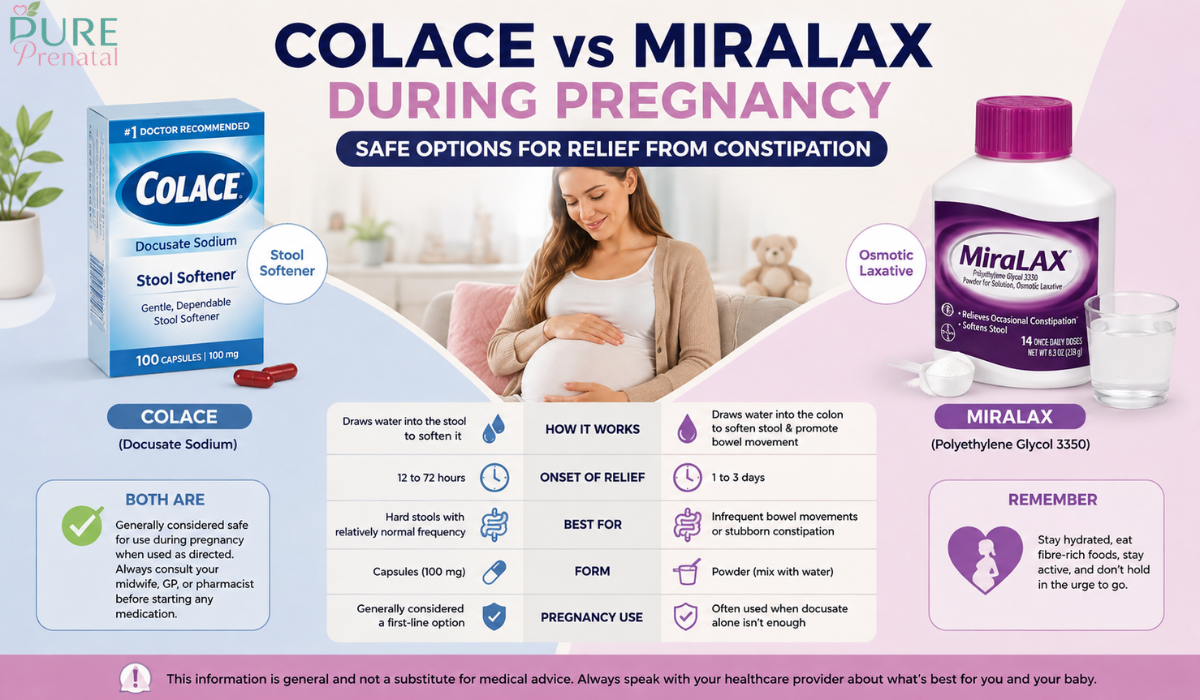
Comparing Colace and Miralax at a Glance
| Colace (docusate sodium) | Miralax (PEG 3350) | |
|---|---|---|
| Type | Stool softener | Osmotic laxative |
| How it works | Draws water into the stool to soften it | Draws water into the colon to soften stool and stimulate a bowel movement |
| Typical onset | 12 to 72 hours | 1 to 3 days |
| Best suited for | Hard stools with relatively normal frequency | Infrequent bowel movements or more stubborn constipation |
| Common form | Capsules, often 100mg | Powder dissolved in water |
| Pregnancy use | Generally considered a first-line option | Often used when docusate alone isn’t enough |
This table is a general overview, not a substitute for personalised advice. Your own suitability for either option can depend on your medical history, other medications, and how your pregnancy is progressing.
Practical Steps Before Reaching for Either One
Before starting any stool softener or laxative, it’s worth trying a few non-medication approaches first, since they can sometimes resolve mild constipation on their own:
- Increase fibre gradually through fruits, vegetables, whole grains, and legumes
- Drink more water throughout the day, since fibre without enough fluid can worsen constipation
- Stay as physically active as your pregnancy allows, even gentle walking helps
- Review your prenatal vitamin with your provider if prenatal iron seems to be a major contributor
- Avoid holding in the urge to go, and try not to strain excessively
If these steps don’t bring enough relief within a few days, that’s a reasonable point to ask your midwife, GP, or pharmacist which stool softener for pregnant women might suit your situation, whether that’s docusate sodium, PEG 3350, or something else entirely.
When to Contact Your Midwife or Doctor
Occasional constipation is extremely common in pregnancy and usually not a cause for concern. However, it’s worth reaching out to your maternity team if you experience:
- Constipation alongside severe abdominal pain
- Rectal bleeding that’s more than a small amount or doesn’t resolve
- No bowel movement for several days despite trying softeners or laxatives
- Signs of a bowel obstruction, such as persistent vomiting, bloating, and inability to pass gas
- Constipation that doesn’t improve despite trying the steps above
These symptoms can have several possible causes and don’t automatically mean something serious is happening, but they’re worth having assessed rather than managed alone.
Colace and Miralax After Birth
It’s also worth knowing that both options are commonly recommended in the postpartum period, not just during pregnancy. A stool softener for postpartum recovery is often suggested after vaginal delivery, especially with perineal tearing or stitches, or after a caesarean birth, since straining can be uncomfortable and sometimes risky for healing tissue. Many providers will recommend continuing docusate sodium or PEG 3350 for a period after birth for exactly this reason.
Frequently Asked Questions
Is colace safe to take during pregnancy? Docusate sodium is generally considered a low-risk option for constipation in pregnancy, but it’s still worth mentioning to your midwife or GP, particularly if you have other health conditions or are taking additional medications.
Is miralax safe to take while pregnant? PEG 3350 is generally considered appropriate for use in pregnancy for constipation that hasn’t responded to lifestyle changes, though your own provider should confirm it’s suitable for your individual circumstances.
What is a good stool softener while pregnant if Colace isn’t working? If docusate sodium alone isn’t providing enough relief, an osmotic laxative such as Miralax is often the next step, sometimes used alongside Colace under medical guidance.
How long does Colace take to work? Colace typically takes anywhere from 12 hours to a few days to soften stool, though this varies by person.
Is docusate sodium the same as Miralax? No. Docusate sodium (Colace) is a stool softener, while PEG 3350 (Miralax) is an osmotic laxative. They work differently, even though both are commonly used for constipation.
What is similar to Miralax in pill form? There isn’t a direct pill equivalent that works identically to PEG 3350, since Miralax is typically taken as a powder dissolved in liquid. Docusate sodium capsules like Colace are a common pill-based alternative, though they work through a different mechanism.
Can pregnant women take stool softeners regularly, or only occasionally? Both short-term and, when needed, longer-term use are common in pregnancy, but ongoing use is best guided by your midwife, GP, or pharmacist rather than self-managed indefinitely.
The Bottom Line
Choosing between Colace and Miralax during pregnancy usually isn’t about one being universally “better” than the other. It’s about matching the option to what your constipation actually looks like, hard stools versus infrequent ones, and how your body responds. Both are widely used and generally considered reasonable choices for pregnancy-related constipation, but starting with lifestyle changes, keeping your maternity team in the loop, and knowing which warning signs deserve attention will serve you better than guessing which product to grab off the shelf.

Dr. Tania Adib is a Board Certified OB/GYN based in the northern suburbs of Chicago. She earned her undergraduate degree from the University of Notre Dame and her medical degree from Georgetown University in Washington, D.C., before completing her residency in Obstetrics and Gynecology at Magee-Womens Hospital, University of Pittsburgh Medical Center. Her clinical interests include full-spectrum obstetrics and gynecology, from the first period through the menopausal years, contraception, and abnormal bleeding.