

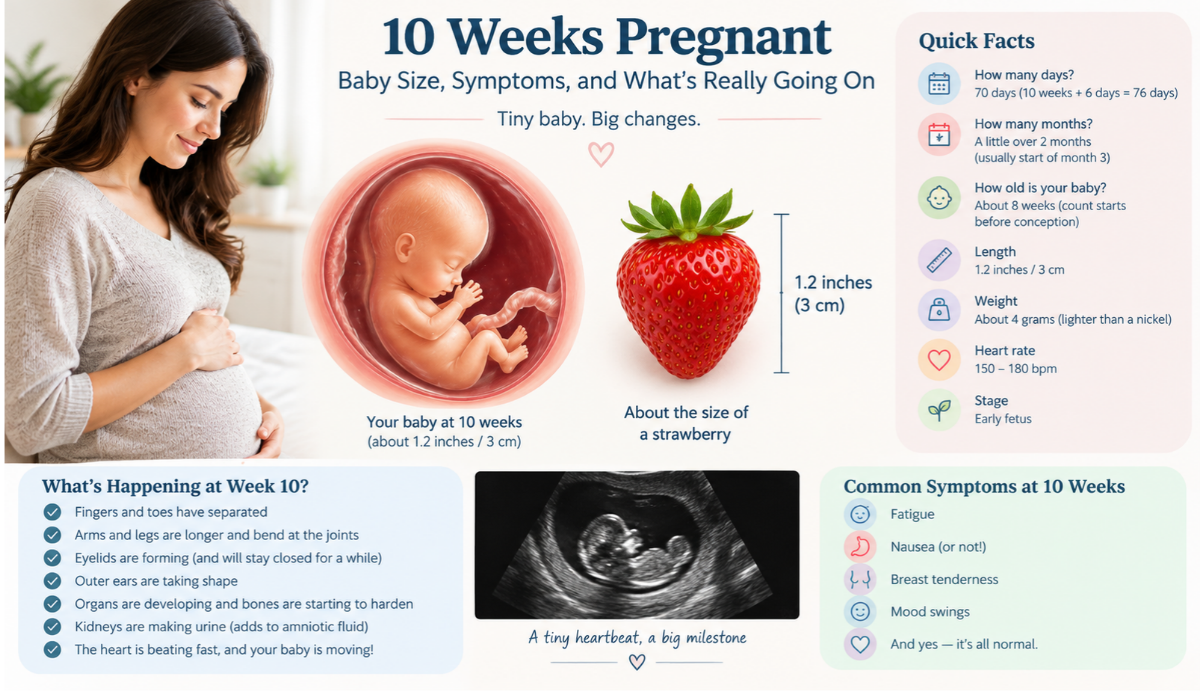
If you’re 10 weeks pregnant, your baby is about 1.2 inches long, roughly the size of a strawberry, and has just made one of the biggest jumps in early development: from embryo to fetus.
You might be feeling it or you might not. Some people hit week 10 of pregnancy exhausted, queasy, and wondering when the second trimester will finally show up. Others feel almost normal and spend the week quietly worrying that they should feel worse. Both are common. Let’s go through what’s actually happening.
The quick answers first
Most people searching this just want a number, so here they are.
- How many days is 10 weeks pregnant? Seventy days, counted from the first day of your last period. Ten weeks and 6 days is day 76.
- How long is 10 weeks in months? A little over two months. Most monthly calendars put you at the start of month three.
- How old is 10 weeks, really? Your baby is closer to 8 weeks old, because the count starts before conception. More on that below.
- How big is my baby at 10 weeks? About 1.2 inches (3 cm) from head to bottom, and around 4 grams. That’s lighter than a nickel.
- How far along is that? You’ve got about 30 weeks to go if you deliver at 40.
Why the numbers never seem to match
This one confuses nearly everyone, so it’s worth a minute.
Providers date a pregnancy from the first day of your last menstrual period, not from conception. You didn’t conceive on that day, of course. Ovulation usually happens about two weeks later. So when someone says “10 weeks gestation pregnancy,” they mean ten weeks on the pregnancy calendar. The 10 week old embryo you may be picturing has actually been developing for about eight.
Neither number is wrong. They just start the clock at different moments. Your due date, your ultrasound, and everything in this article use the pregnancy calendar.
What happens at week 10 of pregnancy
Here’s the short version: the building phase is mostly done, and the growing phase is starting.
For the first stretch, the embryo at 10 weeks (or just before) has been laying down the basics: heart, brain, spine, limbs, the beginnings of every major organ. Around now, doctors stop calling it an embryo and start calling it a fetus. Nothing changes overnight. It’s a label that marks a shift in the job from “construction” to “expansion and fine-tuning.”
Fetal development at 10 weeks
A lot of the visible progress is in the details:
Fingers and toes have separated, so the little webbed paddles are gone. Arms and legs are longer, and the elbows and knees bend. Eyelids are forming and will stay fused shut for a while. Outer ears are taking shape. The tail-like bump from early development has disappeared. Bones are starting to harden, and tiny tooth buds are forming under the gums.
The kidneys are gearing up to make urine, which will eventually add to the amniotic fluid. And the heart, now with four chambers, is beating fast, often somewhere between 150 and 180 beats per minute. If you hear it on a Doppler or ultrasound, it sounds more like a galloping horse than anything you’d expect to come from something the size of a strawberry.
Your baby is also moving. Stretching, jerking, wiggling. You just won’t feel any of it yet, because there isn’t enough of them to feel.
How big is a fetus at 10 weeks?
Sizes vary a little from baby to baby, but here’s the typical picture.
| Measurement | Approximate size at 10 weeks |
|---|---|
| Length (crown to rump) | 1.2 inches / 3 cm |
| Weight | About 0.14 oz / 4 g |
| Fruit comparison | Strawberry or kumquat |
| Heart rate | Roughly 150 to 180 bpm |
| Stage | Early fetus |
If you’re wondering what size a 10 week old fetus is compared with last week, the answer is “noticeably bigger.” Growth right now is fast. That’s also why an early ultrasound is such a good way to check your due date. In the first trimester, crown-rump length is more accurate for dating than at any later point, so a few days’ difference in size can shift your estimated due date.
If your measurement comes out a few days off from what you expected, that’s usually just a dating adjustment, not a red flag.
What does a fetus look like at 10 weeks?
Small, and surprisingly human.
The head is still huge compared with the body, about half the total length. A nose, mouth, and eye sockets are in place. The skin is thin enough that you could see blood vessels through it, if you could see it at all. On an ultrasound this week, you’d most likely see a curled little shape with a big head, small limbs, and a heartbeat that flickers on the screen. Sometimes the baby waves an arm or does a tiny somersault while you watch.
Some people cry at that moment. Others feel oddly detached, like they’re looking at someone else’s scan. Both reactions are normal.
The sex of the baby can’t be seen yet, even though the genitals are developing. That reveal is still a few weeks off.
Where is the fetus located at 10 weeks?
In the uterus, floating in a fluid-filled sac. Your uterus has grown from about the size of a pear to something closer to a grapefruit, but it’s still sitting low, tucked behind your pubic bone. That’s why your provider usually can’t feel it from the outside yet.
The placenta is busy too. It’s taking over hormone production from the corpus luteum, a temporary structure in your ovary that has been supporting the pregnancy until now. That handoff usually happens somewhere between weeks 8 and 12. Some people notice their nausea easing around the time it finishes. Others don’t notice any link at all.
Your pregnant stomach at 10 weeks
You probably don’t look pregnant yet. Not in a way a stranger would notice, anyway.
But your stomach may feel like it belongs to someone else. Progesterone slows digestion, so bloating and gas are almost guaranteed, and that’s often what people are feeling at 10 weeks, not the baby. It’s the most common reason your jeans stop closing while nobody else can tell anything’s changed.
If this is your first pregnancy, you may stay flat for a good while longer. If it’s not, your abdominal muscles may relax sooner and a small bump can appear early. Neither one says anything about how your baby is doing.
Ten weeks pregnant: what to expect in your body
Symptoms tend to peak somewhere around weeks 8 to 11. So if you feel rough, you’re right on schedule. The good news is that many people start turning a corner soon after.
The usual ten weeks pregnancy symptoms include nausea (with or without vomiting, and not always in the morning, whatever the name says), deep fatigue, sore or heavy breasts, frequent peeing, constipation, food aversions, and mood swings that can feel out of proportion. You may also get mild cramping or a pulling sensation on the sides of your lower belly. That’s often ligaments stretching to make room for your uterus, and short, mild twinges are typically nothing to worry about.
Headaches and lightheadedness show up for plenty of people, partly because blood pressure often dips in early pregnancy. Stand up slowly. A milky, mild-smelling discharge is also common.
And if you have almost no symptoms? That happens. Feeling fine at 10 weeks doesn’t mean something’s wrong. Symptom intensity isn’t a reliable measure of how a pregnancy is going, even though it’s tempting to treat it like one.
Day by day: 10 weeks 1 day through 10 weeks 6 days
A lot of people track by the day and search for exact stops like “10 weeks and 2 days pregnant” or “10 weeks 5 days pregnant.” Fair enough. Here’s how the days line up.
| Your stage | Days since LMP | What’s going on |
|---|---|---|
| 10 weeks | Day 70 | You’ve entered the tenth week of pregnancy |
| 10 weeks 1 day pregnant | Day 71 | Baby still about strawberry-sized |
| 10 weeks and 2 days pregnant | Day 72 | Limbs keep lengthening and bending |
| 10 weeks and 3 days pregnant | Day 73 | A common time for a first prenatal visit |
| 10 weeks and 4 days pregnant | Day 74 | Nausea often still going strong |
| 10 weeks and 5 days pregnant | Day 75 | Getting close to week 11 |
| 10 weeks 6 days pregnant | Day 76 | Last day before you start week 11 |
Honestly, not much changes between ten weeks 4 days pregnant and ten weeks 5 days pregnant. Growth is gradual. Your baby gets a little bigger every day, and you get a little more used to the whole thing, or at least you hope so.
Prenatal care around 10 weeks
If you haven’t had a first prenatal appointment yet, this is a common window for it. Some practices see you at 8 weeks, some at 10, some a bit later.
Expect questions about your medical and family history, a physical exam, and blood and urine tests to check things like your blood type, iron levels, and immunity to certain infections. Some practices do a dating ultrasound at this visit. You’ll also talk about prenatal vitamins, medications, and food safety.
Genetic screening options open up around now, too. Cell-free DNA screening (NIPT) can be done from about 10 weeks. Chorionic villus sampling (CVS), a diagnostic test that samples placental tissue, is usually offered between 10 and 13 weeks. The standard first-trimester screen, a blood test plus an ultrasound measurement, typically happens between 11 and 14 weeks. Whether you want any of these is your decision. It’s completely fine to ask your provider what each test can and can’t tell you before you choose.
Eating, drinking, and moving at 10 weeks
Keep it simple. Take your prenatal vitamin with folic acid, drink water, and eat what you can tolerate. Small, frequent meals often work better than big ones when you’re nauseated. Crackers, ginger, cold foods, and protein snacks are the usual survivors. Nobody expects a perfect diet from someone who’s been throwing up since Tuesday.
Food safety still matters, especially with raw or undercooked animal foods. Since people do ask: octopus during pregnancy is generally considered fine when it’s fully cooked and eaten in moderation. Raw octopus, including sashimi or live preparations like sannakji, is best skipped because of the risk of foodborne illness. For general seafood choices, the FDA and EPA publish a chart of lower-mercury fish that’s worth a look.
Gentle movement like walking, prenatal yoga, or swimming is usually fine unless your provider has told you otherwise. If you’re wiped out, rest counts as taking care of yourself.
When to call your provider
Most of what you feel this week is ordinary pregnancy. But a few things deserve a call rather than a wait-and-see.
Call promptly if you have bleeding heavier than spotting, or bleeding with clots. The same goes for severe or one-sided abdominal pain, pain that won’t ease, fever, or burning with urination. Also call if you can’t keep fluids down for a full day, or if you notice signs of dehydration like very dark urine, dizziness, or a racing heartbeat.
Light spotting can happen in early pregnancy and doesn’t always mean a problem, but mention it to your provider so they can guide you. If you’re unsure, call. It’s what the office line is for.
Go to the emergency department for heavy bleeding, severe pain, fainting, or shoulder-tip pain along with abdominal pain.
Frequently asked questions
How many weeks is 10 weeks pregnant?
Ten weeks counted from the first day of your last period, which is 70 days. Since conception usually happens about two weeks after that, your baby is developmentally around 8 weeks old.
How much is 10 weeks in months?
Just over two months. Pregnancy is easier to track in weeks, since months vary in length and don’t line up neatly.
What size is a 10 week old fetus?
About 1.2 inches long and about 4 grams. Think strawberry.
Is a human fetus at 10 weeks a “baby” yet?
Medically, it’s a fetus. Plenty of people call it a baby, and providers often do too in conversation. Both are fine.
Can I feel my baby move at 10 weeks?
No. Your baby is moving, but you likely won’t feel it until somewhere between 16 and 25 weeks, sometimes later in a first pregnancy.
Is it normal to have no symptoms at 10 weeks?
Yes. Some people barely notice they’re pregnant at this point. If it worries you, bring it up at your next visit.
Should I have a bump by now?
Not necessarily. Many people don’t show until 12 to 16 weeks, and some later. Bloating can make you feel bigger than you look.
Is 10 weeks too early to announce?
That’s up to you. Some people wait until after the first trimester, around 12 weeks. Others tell close family right away so they have support. There’s no rule.
The bottom line
At 10 weeks, your baby has every major structure in place and has officially become a fetus. The next stretch is mostly about growth, and for many people the symptoms start easing as the second trimester gets closer.

Dr. Tania Adib is a Board Certified OB/GYN based in the northern suburbs of Chicago. She earned her undergraduate degree from the University of Notre Dame and her medical degree from Georgetown University in Washington, D.C., before completing her residency in Obstetrics and Gynecology at Magee-Womens Hospital, University of Pittsburgh Medical Center. Her clinical interests include full-spectrum obstetrics and gynecology, from the first period through the menopausal years, contraception, and abnormal bleeding.