

There’s a particular moment almost every pregnant woman goes through standing sideways in front of a mirror, poking at her stomach, wondering if that’s a bump or just lunch. It’s such a common experience that it’s almost a rite of passage. And the honest truth is, there’s no single right answer for when it should happen. Every pregnant belly moves through its stages on its own schedule.
This guide walks through the pregnancy belly stages, both month by month and week by week, and gets into what’s actually going on beneath the surface. It also tackles the questions women tend to ask quietly — in a search bar at 11pm, not out loud to their doctor — about belly shape, size, and timing.
Why Every Pregnancy Bump Looks Different
Here’s something worth getting out of the way early: comparing your belly to someone else’s is a bit like comparing two different rivers and expecting them to look the same just because they’re both water. Body type, muscle tone, whether it’s your first pregnancy or your third, where your uterus happens to sit — all of it plays a role in when your bump shows up and what shape it takes.
Women who’ve been pregnant before usually show sooner. That’s not a coincidence — abdominal muscles and uterine ligaments that have already stretched once simply give way more easily the second time around. Taller women sometimes carry “in” for longer, since there’s more vertical room before the uterus has anywhere to go but out. Shorter or petite frames often show earlier for the opposite reason.
None of this is a verdict on whether anything’s wrong. It’s just biology doing its own thing, on its own timeline.
What’s Actually Happening Inside
The visible bump is really just the tip of the iceberg. In early pregnancy, the uterus is tucked down in the pelvis, not much bigger than a pear. As weeks pass, it rises, the placenta forms, amniotic fluid builds up, and the skin and muscles slowly give way to make room. By the third trimester, that same organ has climbed almost to the ribcage — which is really the whole story of why a belly goes from unnoticeable to unmissable over nine months.
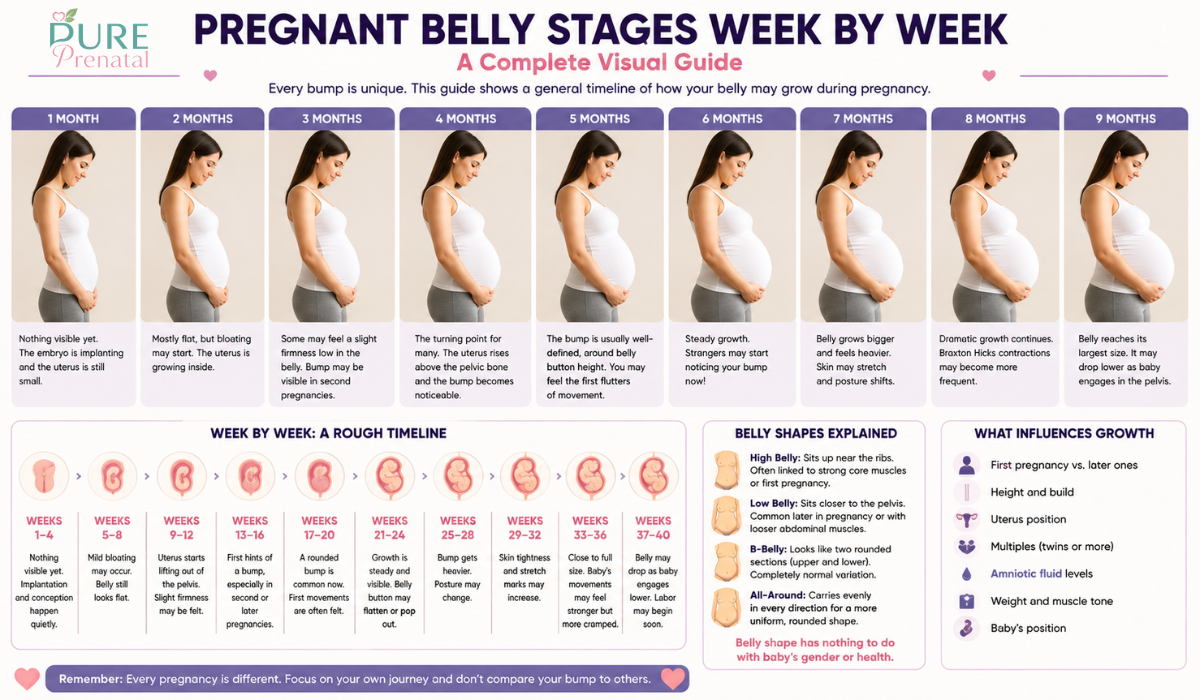
Pregnant Belly Stages, Month by Month
1 Month.
Honestly? Nothing to see here. The embryo is just implanting, the uterus is still roughly fist-sized, and most women’s stomachs look exactly like they did the week before. Some bloating shows up thanks to hormones, and it’s easy to mistake that for the start of a bump — but it isn’t. It’s digestion, not baby.
2 Months.
Still mostly flat on the outside, though plenty is happening underneath. Bloating tends to be more noticeable now, and looser clothes start feeling like a relief rather than an overreaction. People often ask whether the belly shows at two months — for the vast majority, no, not yet, unless it’s a second pregnancy or twins.
3 Months.
This is where things start getting individual. Some women feel a slight firmness low in the belly by the end of the day; others notice absolutely nothing. If it’s not your first pregnancy, you might already have a small, visible curve. If it is, don’t be surprised if there’s still nothing to show for it.
4 Months.
For a lot of women, this is the turning point — the belly finally looks pregnant instead of just “a bit fuller than usual.” The uterus has climbed above the pelvic bone by now, and there’s often a real sense of relief, or excitement, at finally having something to show. Size varies a lot here, but a soft, rounded curve is typical.
5 Months.
The bump is usually well-defined by now, sitting around belly-button height. This is often when the first flutters of movement become noticeable — that strange, unmistakable feeling people describe as butterflies or popcorn popping. Skin starts to feel tighter, and the belly button may begin to flatten out.
6 Months.
Growth keeps climbing steadily. This tends to be the stage where strangers start commenting — in the grocery line, at work, wherever — because the bump is now impossible to miss.
7 Months.
Things speed up here. The belly gets noticeably bigger and starts to feel genuinely heavy by the end of the day. If stretch marks are going to show up, this is often around when they do.
8 Months.
Probably the most dramatic stretch of visible growth — high, round, and hard to get comfortable around. Braxton Hicks contractions, that odd tightening-then-releasing sensation, tend to show up more often now.
9 Months.
The belly usually reaches its biggest size here, though some women notice it drop lower in the final weeks as the baby settles down into the pelvis — a shift often called lightening, and one of the body’s last steps before labor.
Week by Week: A Rough Timeline
Doctors track pregnancy in weeks, not months, so it’s worth having a week-by-week sense of things too — even though, again, this is a rough sketch rather than a rulebook.
- Weeks 1–4: Nothing visible yet. Conception and implantation are happening quietly, out of sight.
- Weeks 5–8: Mild bloating, maybe. The belly itself still looks flat.
- Weeks 9–12: The uterus starts lifting out of the pelvis; a slight firmness might be felt low down.
- Weeks 13–16: First real hints of a bump, especially for anyone who’s been pregnant before.
- Weeks 17–20: A rounded bump is common now, and first movements are often felt around here too.
- Weeks 21–24: Growth is steady and visible; the belly button may start to flatten or poke out.
- Weeks 25–28: The bump gets heavier, and posture often shifts to compensate.
- Weeks 29–32: Skin tightness and stretch marks tend to increase.
- Weeks 33–36: Close to full size, and movement can start to feel a bit cramped.
- Weeks 37–40: The belly may drop as the baby engages lower — one of the clearest late-pregnancy signs that labor isn’t far off.
So, When Does the Belly Actually Start Showing?
This is probably the single most-asked question on the topic, and for good reason — everyone wants to know if they’re “normal.” For a first pregnancy, most women start showing somewhere between weeks 12 and 16, though anywhere up to 20 weeks is still completely ordinary. Second or third pregnancies tend to show sooner, sometimes as early as 8 to 10 weeks, simply because the body’s already done this before.
Carrying twins changes the timeline too — the belly usually shows earlier and grows faster than in a singleton pregnancy, thanks to the combined size of two babies plus extra fluid and placental tissue. If you’re wondering exactly when you should start showing, the frustrating-but-true answer is: there’s a wide window, and most of it counts as normal.
Why Does My Belly Feel Hard?
This one catches a lot of women off guard. Early on, any firmness is usually just bloating — nothing more dramatic than that. Later, once the uterus has risen out of the pelvis (typically from the second trimester onward), the lower belly starts to feel genuinely firm, because there’s now a solid, growing uterus sitting where soft tissue used to be.
Toward the third trimester, the belly can also tighten on its own for a minute or two — that’s Braxton Hicks, the body’s practice run for labor. Usually painless, or just mildly uncomfortable. If it comes with real pain, shows up on a regular rhythm, or happens before 37 weeks, it’s worth a call to your provider.
Not All Bumps Look the Same: Belly Shapes Explained
High belly: Sits up near the ribs. Often linked to strong core muscle tone, or simply a first pregnancy. It has nothing to do with the baby’s sex, whatever old wives’ tales might claim.
Low belly: Sits closer to the pelvis. Common later in pregnancy, or when the baby is positioned lower, or just down to looser abdominal muscles.
B-belly: A shape where the bump looks almost like it’s split into two rounded sections — one lower, one upper, near the belly button. It’s a totally normal variation tied to how the uterus sits relative to muscle and fat, and it means nothing beyond that.
All-around: Some women carry evenly in every direction, giving a more uniform, rounded shape from any angle.
None of these shapes say anything about how healthy the pregnancy is. They’re just anatomy doing its own thing.
What Influences How Fast (or Slow) It Grows
A handful of factors tend to come up again and again:
- First pregnancy vs. later ones: Muscles that have stretched before give way faster.
- Height and build: More torso room can mean a later-showing bump.
- Uterus position: A tilted uterus can shift the timing.
- Multiples: Twins or more almost always mean earlier, faster growth.
- Amniotic fluid: More fluid can make a belly look bigger than the baby alone would suggest.
- Weight and muscle tone: These affect how visible early changes are.
- Baby’s position: Can subtly change the belly’s shape as pregnancy goes on.
Early on, There’s Often Not Much to Look At
In the very first weeks, the belly usually looks exactly the way it always has. Some women notice a kind of internal fullness or looseness low in the abdomen before anything’s visible from the outside; others notice nothing at all until well into the second trimester. Both are completely normal — the early pregnancy belly is more about how things feel than how they look.
Twins Change the Timeline
Carrying more than one baby tends to speed everything up. A twin pregnancy belly often shows weeks earlier than a singleton one, and by the third trimester the difference in size is usually obvious. That’s simply down to two babies, extra placental tissue, and more amniotic fluid all needing room. If your bump seems bigger than a friend’s who’s further along but only carrying one baby, this is almost always why.
When It’s Worth Mentioning to Your Doctor
Every belly grows on its own schedule, but a few things are worth flagging at a checkup: a sudden, dramatic change in size, a belly that seems way off from what’s expected at your stage, or growth that seems to stall out completely. None of these automatically mean something’s wrong — but getting it checked rules out things like restricted growth or excess fluid, and either way, it’s peace of mind.
The Bottom Line
Tracking your belly’s changes, week by week or month by month, can be a genuinely nice way to feel connected to the pregnancy. But try not to lean too hard on comparison — your bump is following its own path, shaped by your body and this particular baby. High, low, round, B-shaped, early, late — it’s all just your body doing exactly what it needs to.
Frequently Asked Questions
When does a pregnant belly usually start to show?
Most first-time mothers start showing between 12 and 16 weeks, though anywhere from 10 to 20 weeks is still normal depending on body type and other factors.
Does the belly show earlier in a second pregnancy?
Generally, yes. Once the abdominal muscles and ligaments have stretched once, they tend to give way faster the next time around.
Why does my belly feel hard sometimes?
Usually it’s the uterus tightening — either Braxton Hicks contractions or simply the growing uterus pressing outward. It becomes more common in the second and third trimesters.
Is it normal for my belly to look different in shape from other pregnant women?
Completely. High, low, rounded, or B-shaped bumps are all just variations in muscle tone, uterus position, and body type — not signs of anything about the baby.
Does belly size tell you how big the baby is?
Not really. Amniotic fluid levels and muscle tone affect belly size just as much as the baby does, so it’s not a reliable way to estimate size. An ultrasound is far more accurate.
When does the bump grow the fastest?
Usually from around week 20 onward, through the second and third trimesters, as the uterus expands more rapidly.
What does a pregnant belly look like at two months?
For most women, still pretty much unchanged from before pregnancy — maybe some bloating, but rarely a visible bump yet.
How big is a belly at three months pregnant?
Still fairly subtle for most first-time mothers, though a small, firm curve can appear earlier in later pregnancies.
Why does my belly look different this pregnancy compared to my last one?
It’s common — muscle tone, the baby’s position, and fluid levels can all vary from one pregnancy to the next, changing both timing and shape.
When does the belly button change during pregnancy?
It often starts flattening in the second trimester and may poke outward by the third. It typically settles back to normal after delivery.

Dr. Tania Adib is a Board Certified OB/GYN based in the northern suburbs of Chicago. She earned her undergraduate degree from the University of Notre Dame and her medical degree from Georgetown University in Washington, D.C., before completing her residency in Obstetrics and Gynecology at Magee-Womens Hospital, University of Pittsburgh Medical Center. Her clinical interests include full-spectrum obstetrics and gynecology, from the first period through the menopausal years, contraception, and abnormal bleeding.