


So you’re 11 days past ovulation, you took the test, and it’s blank. Or maybe there’s a shadow of a line you’re not sure counts. Either way, a pregnancy test negative at 11 DPO does not mean you’re not pregnant. It might just mean you tested a few days too early. That’s the honest answer, not the reassuring-sounding one people give when they haven’t actually looked at the timeline.
Why 11 DPO is such an awkward day to test
Here’s the thing about DPO as a measurement: it’s more useful than counting from your missed period, but it’s still not exact. Ovulation doesn’t fall on the same cycle day every month, not even close for a lot of people, so “11 days past ovulation” can land anywhere in a fairly wide window depending on when implantation actually happens.
And implantation is the part that matters here, not ovulation itself. That’s when the embryo attaches to the uterine lining and hCG production starts. It can happen anywhere from about day 6 to day 12 past ovulation. Six days of spread. If you implanted early, on day 6 or 7, you’ve had four or five days of hCG building up by the time you test on day 11. A sensitive test has a decent shot at picking that up. If you implanted on day 11 or 12, though? You might have almost nothing in your urine yet, even though you are, in fact, pregnant.
Same pregnancy. Same test. Same day of the cycle. Wildly different result, just because of when one cell decided to burrow into the uterine lining.
I’ve had patients treat a negative at this point like a verdict, and I get it, waiting is miserable. But at 11 DPO you’re often measuring implantation timing more than you’re measuring whether you’re pregnant.
What hCG is doing behind the scenes
Quick refresher: hCG, or human chorionic gonadotropin, is the hormone every home test is built to detect. It comes from the cells that eventually become the placenta. It doesn’t appear the moment conception happens — it only starts after implantation, and then it roughly doubles every two to three days in early pregnancy.
That doubling curve is steep. Which means the gap between “no line at all” and “faint but visible line” can be a single day. Sometimes less.
One more wrinkle: urine hCG runs a bit behind blood hCG, by about a day or two, and it’s most concentrated first thing in the morning before you’ve had anything to drink. So “test with your first urine of the day” isn’t some old wives’ tale your aunt told you. It’s a real, measurable difference in how much hormone is actually in the sample.
Detection odds by day past ovulation
| DPO | What’s likely happening | Odds a home test picks it up |
|---|---|---|
| 7-8 DPO | Implantation just starting, for some | Low — most tests still negative here |
| 9-10 DPO | hCG beginning to climb for early implanters | Low to moderate |
| 11-12 DPO | Common day for that first faint line | Moderate |
| 13-14 DPO, around when your period’s due | hCG has had more time in the system | High for most sensitive tests |
| 3-5 days after a missed period | hCG well established | Very high |
None of this is a promise. Cycle length, when you actually ovulated, and which brand of test is in your hand all move these numbers around.
Does the test brand actually matter this early?
A little, yes. Sensitivity varies — most tests need somewhere between 10 and 25 mIU/mL of hCG to show anything at all. That’s a real gap. A test that only needs 10 mIU/mL will catch a pregnancy days before one that needs 25. If you’re testing this early on purpose, an early-detection or “high sensitivity” test is worth the extra couple of dollars.
What to actually do with a negative at 11 DPO
Give it two or three days before you test again. That’s genuinely the single most useful thing you can do here — it gives hCG time to climb past whatever threshold your test needs. Testing every morning in between mostly just adds stress, not information.
Use first-morning urine when you do retest. Same reasoning as above: less diluted, better shot at catching a faint line.
Watch the calendar more than the test strip. If your period shows up, you have your answer, no test needed. If it doesn’t arrive within a few days of when it was supposed to, that’s a much better reason to retest than the DPO number by itself.
And don’t spiral over an evaporation line. If there’s actual color within the read window printed on the box, even faint, that generally counts as positive. A colorless indent, or a line that shows up an hour after you were supposed to check it, usually doesn’t count. When in doubt, test again the next morning — it almost always settles the question.
What if negatives keep showing up past 14 DPO?
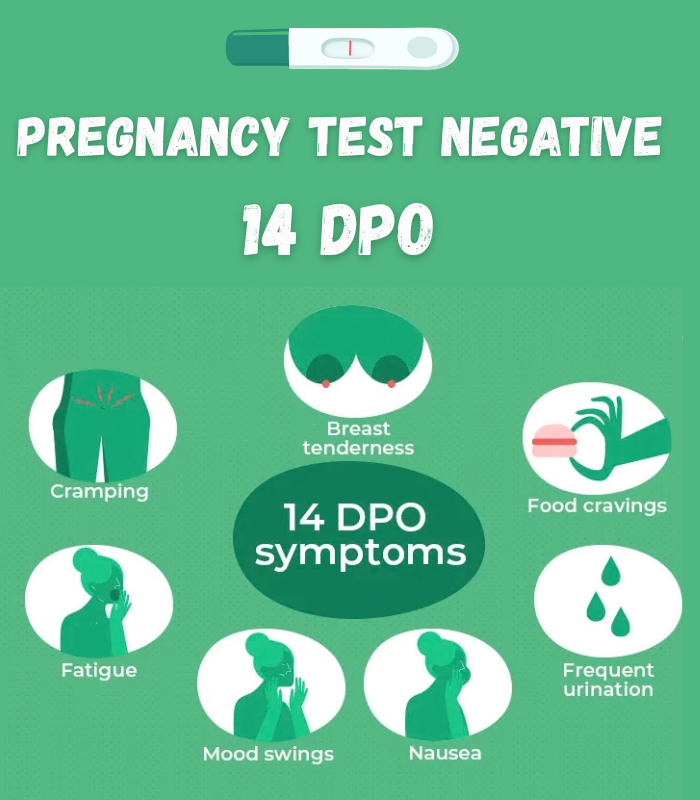
This is where a negative test starts carrying more weight. If your period’s noticeably late and you’re still getting negatives, it’s reasonable to call your provider. Pregnancy isn’t the only thing that delays a period — stress, illness, a big shift in weight or exercise, thyroid problems, and, depending on your age, perimenopause can all push things off schedule. Worth ruling those in or out rather than assuming.
When to actually contact your provider
Call sooner, not later, if a late period comes with pelvic pain, unusual bleeding, or dizziness. Those can occasionally point toward an ectopic pregnancy, even with a negative urine test. It’s not common, but it’s not something to wait out either.
Also reach out if your cycles have been irregular or absent for a few months running, or if you’ve had repeated negatives alongside a missed period and just want an actual number. A blood hCG test picks up pregnancy earlier than urine and gives your provider something concrete to track, rather than a line that’s either there or isn’t.
FAQ
Can I still be pregnant with a negative test at 11 DPO?
Yes, and it’s genuinely one of the more common days for a false negative. Implantation can land anywhere between day 6 and day 12, so plenty of pregnant people are still testing negative at this point simply because hCG hasn’t caught up yet.
Should I test again later the same day?
Not really worth it. hCG builds over 48 to 72 hours, so a same-day retest is unlikely to show anything different. Give it two or three days instead.
Is a faint line at 11 DPO probably real?
If there’s actual color within the test’s read window, yes, that usually counts as a positive, even a light one. Retesting the next morning with more concentrated urine tends to make it clearer either way.
Does a short luteal phase mess with the timing?
It can. A short luteal phase shifts when implantation happens relative to your expected period, which affects test accuracy for the same reasons ovulation-day variation does. Stress doesn’t touch hCG production directly, but it can delay ovulation, which shifts everything downstream.
Is a blood test more accurate than a home test at this stage?
Home tests are reliable once hCG has actually reached a detectable level in urine. A blood test just gets there a few days sooner and gives an exact number instead of a line, which matters more if your provider is tracking whether hCG is rising the way it should.
Bottom line
A negative test at 11 DPO tells you hCG hasn’t hit a detectable level yet — it doesn’t tell you you’re not pregnant. Implantation timing varies too much for this to be a reliable testing day for everyone. If your period’s late, wait a couple of days and retest with first-morning urine. If negatives keep coming past when your period was due, call your provider or ask about a blood test to get a real answer instead of guessing.

Dr. Tania Adib is a Board Certified OB/GYN based in the northern suburbs of Chicago. She earned her undergraduate degree from the University of Notre Dame and her medical degree from Georgetown University in Washington, D.C., before completing her residency in Obstetrics and Gynecology at Magee-Womens Hospital, University of Pittsburgh Medical Center. Her clinical interests include full-spectrum obstetrics and gynecology, from the first period through the menopausal years, contraception, and abnormal bleeding.