

You’ve noticed a bit of spotting, and now you’re wondering if it means anything. Maybe you’ve already Googled “implantation bleeding” three times today, cross-referenced the colour against your usual period, and are now staring at a pregnancy test box trying to decide whether it’s too soon to open it.
It’s a fair place to be stuck. Testing too early is probably the single biggest reason people end up disappointed by a negative result that later turns positive, so the timing question really does matter.
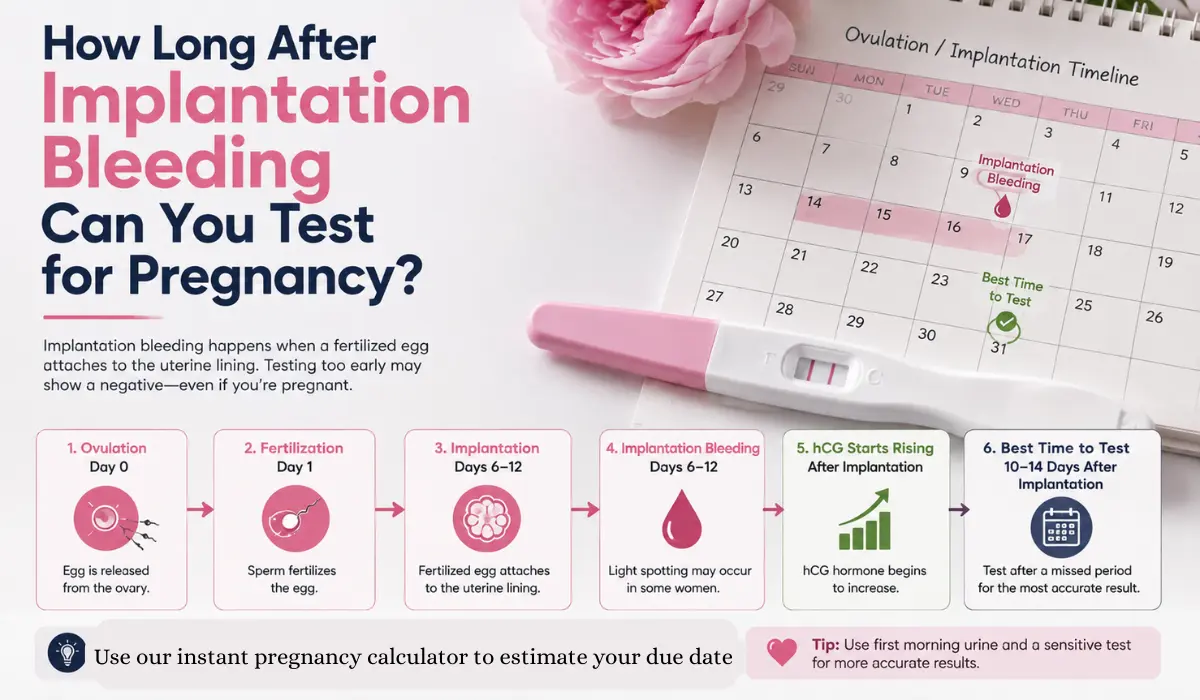
Here’s the short version: implantation, if it happens, usually takes place somewhere between 6 and 12 days after conception. Your body then needs a bit of time to start producing enough of the pregnancy hormone hCG for a home test to actually pick it up. So while you technically can test the same day you notice spotting, most people won’t get a reliable answer until several days later, often around the time their period would normally arrive.
Below is a proper breakdown of the timing, what implantation bleeding tends to look like, and what to do if a test comes back negative when you were half expecting otherwise.
So, When Should You Actually Test?
If you want the most trustworthy result, wait until the day your period is due, or a few days after that if you can stand it. By this point, hCG levels have usually climbed high enough for a standard test to detect it without much ambiguity.
If patience isn’t really an option (and let’s be honest, it rarely is), a sensitive early-detection test taken around 3 to 4 days after the spotting has stopped will give you better odds than testing on day one. Even then, don’t read too much into a negative at this stage. It’s genuinely common for a very early test to say no when the honest answer is “not yet detectable,” rather than “not pregnant.”
What Implantation Bleeding Actually Is
When a fertilised egg burrows into the lining of the uterus, it can disturb some of the small blood vessels there. That’s what causes the light spotting some people associate with implantation. Plenty of people never notice it at all, which is completely normal too. Its absence doesn’t mean anything has gone wrong.
Here’s the tricky bit, though: this kind of spotting isn’t exclusive to implantation. Ovulation spotting, hormonal shifts, or the very start of a period can all look similar, and there’s no way to tell them apart just by looking. Testing at the right time is really the only way to know for sure.
What tends to set implantation spotting apart, when people do notice it:
- The colour usually leans pink, light red, or brown rather than the deeper red of a typical period
- It’s light. Often just a trace on tissue or underwear, not enough to need a pad
- Mild cramping sometimes tags along, though not for everyone
- It tends to ease off rather than build up, unlike a period which often gets heavier before it settles
How Long Does It Actually Last?
Usually not long at all. Most people who experience implantation bleeding describe it lasting anywhere from a few hours up to about three days at most, and it’s typically far lighter than a period from start to finish. If bleeding sticks around for four or more days, becomes heavier than light spotting, or comes with real pain, that’s outside the usual pattern and worth flagging to a GP or midwife rather than waiting it out.
The Actual Sequence: Sex, Implantation, hCG, and Testing
A lot of the confusion around testing comes down to mixing up “conception” and “implantation.” They’re not the same moment, and the gap between them is exactly why testing too early leads people astray.
Roughly, here’s how it unfolds:
- Ovulation happens, and if sperm meets egg, fertilisation follows within about a day
- The fertilised egg then spends several days travelling toward the uterus
- Implantation occurs once it attaches to the uterine lining, typically 6 to 12 days after fertilisation
- hCG production kicks off around implantation and rises steadily from there
- A test becomes genuinely reliable once hCG has climbed high enough, which for most people lines up roughly with the time of a missed period
That gap between implantation and detectable hCG is the whole reason a test taken the same day as spotting, or even a day or two later, so often comes back negative even in a real pregnancy. The hormone just hasn’t had time to build up yet.
A Rough Testing Timeline
| Time since implantation bleeding | What you can expect |
|---|---|
| Same day as spotting | Almost certainly negative, even if you are pregnant |
| 1 to 2 days after | Still probably too early for most standard tests |
| 3 to 4 days after | A sensitive early-detection test might catch a faint line |
| Around your missed period | The most dependable window for a standard test |
| A few days past a missed period | hCG is usually well established by now, so results tend to be more reliable |
If your cycle isn’t especially regular, “missed period” is a shaky marker to go by. In that case, counting around two weeks from your best estimate of ovulation is a more useful guide than counting from the spotting itself.
Can You Test While You’re Still Spotting?
Yes, and it won’t skew the result. Home pregnancy tests measure hCG in urine, not blood, so a small amount of blood on a pad or in the toilet bowl doesn’t interfere with how the test works. The real limiting factor was never whether you’re bleeding, it’s simply whether enough hCG has accumulated yet.
Got a Negative Test After Spotting? Here’s What Might Be Going On
A negative result right after implantation bleeding, or even up to a couple of weeks later, doesn’t automatically rule out pregnancy. A few common explanations:
- You tested before hCG had risen enough to be picked up
- Your urine was diluted, often from drinking a lot of fluid beforehand
- Your ovulation actually happened later than you’d estimated, throwing off your timing
- What you saw wasn’t implantation bleeding at all, but an early period or unrelated spotting
If your period doesn’t show up and the first test says no, it’s usually worth trying again in a few days, ideally using first-morning urine when hCG tends to be most concentrated. Still no period and still negative? A chat with a pharmacist or GP is a sensible next move.
When It’s Worth Contacting a Midwife or GP
Light spotting around implantation is common, and most of the time it’s nothing to worry about. That said, get in touch with a midwife, GP, or your local maternity unit if you notice:
- Bleeding heavy enough to need a pad, rather than light spotting
- Bleeding that carries on for more than a few days
- Severe or worsening pain in the abdomen
- Dizziness, fainting, or generally feeling unwell alongside the bleeding
- Any bleeding once you already know you’re pregnant
None of these automatically mean something’s wrong. But they sit outside the usual pattern of implantation bleeding, and getting a professional opinion beats guessing.
Frequently Asked Questions
How soon after implantation can I test and actually trust the result?
Most people get their clearest answer around the time their period is due, roughly a week or so after implantation. Testing earlier is possible, especially with a sensitive test, but the risk of a false negative goes up the earlier you go.
How many days after implantation bleeding can you get a positive test?
It genuinely varies. Some people see a faint positive from around 3 to 4 days after the spotting stops, while others don’t get a clear result for longer than that. hCG rises at a different pace from one pregnancy to the next.
Can a pregnancy test turn positive before implantation happens?
No. Tests detect hCG, and your body doesn’t start making it until implantation begins. A positive before implantation simply isn’t possible, physiologically speaking.
Is implantation spotting always pink or brown?
It’s commonly described that way, but colour on its own can’t confirm what kind of bleeding you’re dealing with. Any spotting that’s out of step with your normal cycle is worth keeping an eye on rather than diagnosing by shade.
Can implantation bleeding last four days or more?
It’s less typical. Implantation bleeding is usually short and light, so bleeding that runs several days is more often something else, like an early period. Worth mentioning to a GP if you’re not sure what you’re seeing.
How long after sex does implantation bleeding happen?
Implantation itself typically occurs 6 to 12 days after conception, which usually falls within a similar window after sex, assuming that’s when conception occurred. It’s not an exact science, since ovulation timing shifts from cycle to cycle.
Should I even bother testing the same day as the spotting?
You can, but don’t be surprised by a negative even if you’re pregnant. hCG simply hasn’t had time to build up yet at that point. Waiting a few more days usually gets you a more trustworthy answer.
The Bottom Line
Implantation bleeding tends to be light, brief, and easy to write off as nothing, and on its own, it can’t confirm a pregnancy either way. Your best shot at an accurate test result comes around the time of your missed period, once hCG has had a proper chance to build up. A negative test taken earlier than that doesn’t necessarily mean you’re not pregnant, it might just mean you asked the question a few days too soon. When in doubt, give it a few more days and test again, or check in with a pharmacist or GP if you’re still unsure.

Dr. Tania Adib is a Board Certified OB/GYN based in the northern suburbs of Chicago. She earned her undergraduate degree from the University of Notre Dame and her medical degree from Georgetown University in Washington, D.C., before completing her residency in Obstetrics and Gynecology at Magee-Womens Hospital, University of Pittsburgh Medical Center. Her clinical interests include full-spectrum obstetrics and gynecology, from the first period through the menopausal years, contraception, and abnormal bleeding.