

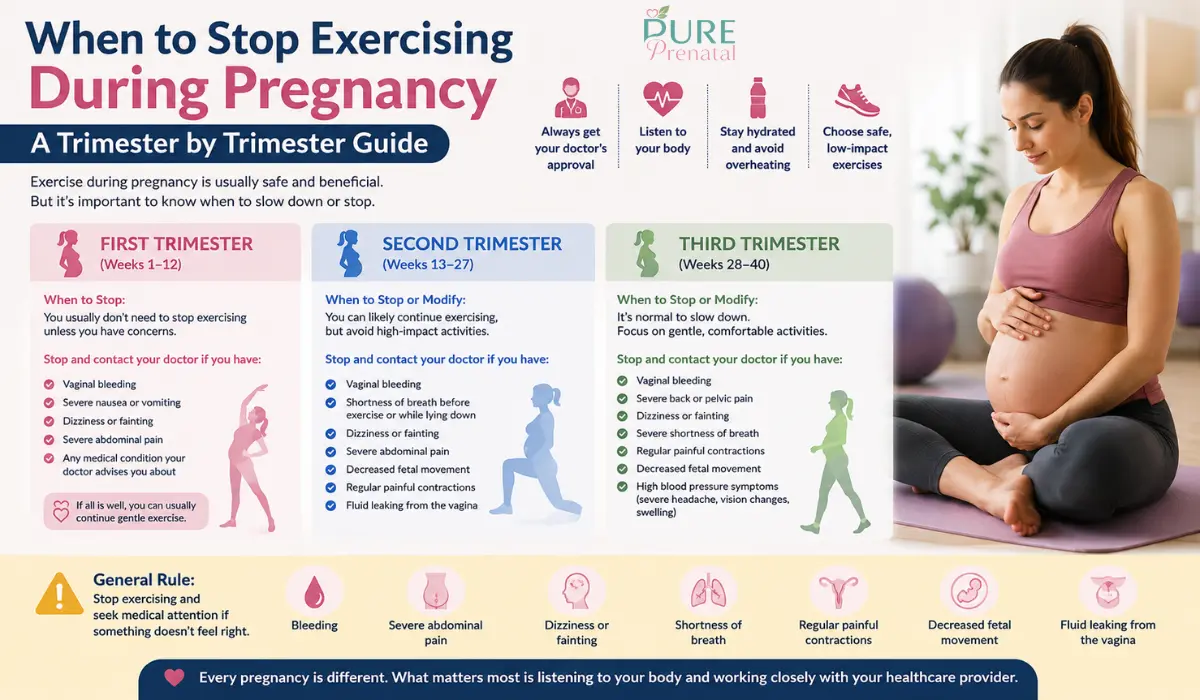
There isn’t a week circled on a calendar somewhere that says “stop now.” Most of the time, your body tells you before any guideline does. Plenty of women exercise right up until labour starts. Others scale back weeks or months earlier because of how their particular pregnancy is going. So the more useful question isn’t “when do I stop,” it’s “what signs actually mean I need to change what I’m doing.”
If you’re healthy and nothing complicated is going on, there’s no fixed cutoff point. What usually shifts is the type and intensity of what you’re doing, not whether you move at all. A lot of women keep up walking or prenatal yoga well into the third trimester, sometimes right up to their due date. Others get told to ease off or drop certain exercises earlier because of a specific symptom or condition. It genuinely comes down to your own pregnancy, not a general rule.
Signs You Should Stop and Rest
Some signals mean stop immediately, not “wait until the trimester changes.” If any of these turn up during or after exercise, stop and get in touch with your midwife or GP.
Vaginal bleeding or fluid leaking. Dizziness, feeling faint, or a headache that won’t ease off. Chest pain, or breathlessness that seems out of proportion to what you’re doing. Calf pain or swelling on just one side, which can point to a blood clot. Contractions before your due date. Reduced fetal movement in the second half of pregnancy. Muscle weakness affecting your balance.
None of these are the usual pregnancy aches you shrug off. They’re your body flagging something worth checking, so treat them that way.
What Changes Trimester by Trimester
First Trimester
Most women can keep doing more or less what they were already doing, assuming there’s no complication and their care provider hasn’t said otherwise. Fatigue and nausea tend to be the bigger factor here, honestly, they’ll slow you down more than any medical restriction will. It’s worth listening to that tiredness rather than pushing through it out of habit.
Second Trimester
For a lot of women this is the good stretch, more energy, fewer symptoms, a decent window to stay active. From around week 16, though, exercises that keep you flat on your back for long periods start getting discouraged, since the weight of the uterus can press on a major vein and cut blood flow. Your balance also starts changing as your centre of gravity shifts, so anything with a real fall risk, skiing, horse riding, is worth rethinking around this point.
Third Trimester
The bump changes your balance, and joints that are already looser than usual thanks to pregnancy hormones take on more strain. High-impact activity, contact sports, anything with a real risk of falling or taking a hit to the abdomen, generally gets dropped here. A lot of women naturally drift toward walking, swimming, and prenatal yoga in this stage, not because a rule says to, but because it just feels better. Some keep up moderate exercise right until labour, and that’s completely normal if the pregnancy is uncomplicated and you feel okay.
| Trimester | What’s usually fine | What to reconsider |
|---|---|---|
| First | Most pre-pregnancy activity, if already active | High-risk contact sports, activities with fall risk |
| Second | Walking, swimming, prenatal yoga, moderate strength training | Lying flat on back for long periods, high-altitude activity |
| Third | Walking, swimming, gentle strength work, prenatal yoga | High-impact cardio, contact sports, anything with fall risk |
Medical Reasons You May Need to Stop Earlier
Some pregnancy conditions mean exercise needs pausing or changing significantly, sometimes long before the third trimester even arrives. Placenta praevia after 26 weeks. Persistent vaginal bleeding. Preterm labour, or a history of it this pregnancy. Pre-eclampsia or pregnancy-induced high blood pressure. Certain heart or lung conditions. Cervical insufficiency, sometimes called a weakened cervix. A multiple pregnancy with extra risk factors involved.
If any of this applies to you, your midwife or obstetrician will usually give you guidance specific to your situation, and that should take priority over general advice you find online, including this article.
If You Feel Fine, Should You Keep Going?
If your pregnancy is uncomplicated and you’re feeling good, there’s rarely a medical reason to stop exercising just because you’ve reached a certain week. Both the broadly support staying active through a healthy pregnancy, adjusting intensity and type as things progress rather than cutting activity off entirely. What matters more than the date is checking in with yourself day to day. Some days you’ll want a full session, other days a short walk is genuinely enough, and both are fine.
When to Talk to a Professional
Bring up your exercise routine with your midwife or GP at your regular appointments, especially if you’re unsure whether something is still appropriate, if a complication develops, or if you’re a competitive athlete who needs more specific guidance than general advice can offer. It’s also worth checking in whenever a new symptom shows up rather than waiting until your next scheduled visit.
FAQs
Is it normal to stop exercising completely in the third trimester?
Not really. A lot of women keep up moderate activity like walking or swimming right up until labour. Complete rest tends to only be recommended for specific medical reasons, not simply because of how far along someone is.
Can exercising too late in pregnancy harm the baby?
For healthy, uncomplicated pregnancies, moderate exercise isn’t linked to harm and is generally encouraged. The concern tends to be about the type of exercise, avoiding high fall risk or contact activities, rather than the timing itself.
Should I stop running while pregnant?
Many women who ran regularly beforehand can keep running into the third trimester if they’re comfortable and there are no complications. Worth discussing with your midwife, particularly if you’re newer to running or dealing with any pelvic discomfort.
What if I wasn’t active before pregnancy?
Gentle movement, walking being the obvious one, is still a good idea once your care provider confirms it’s safe. It’s more about consistency and staying low intensity than jumping into something you’ve never done before.
Is walking safe until my due date?
Yes, for most healthy pregnancies. Walking stays one of the safest and most encouraged forms of exercise right through to labour.

Dr. Tania Adib is a Board Certified OB/GYN based in the northern suburbs of Chicago. She earned her undergraduate degree from the University of Notre Dame and her medical degree from Georgetown University in Washington, D.C., before completing her residency in Obstetrics and Gynecology at Magee-Womens Hospital, University of Pittsburgh Medical Center. Her clinical interests include full-spectrum obstetrics and gynecology, from the first period through the menopausal years, contraception, and abnormal bleeding.