

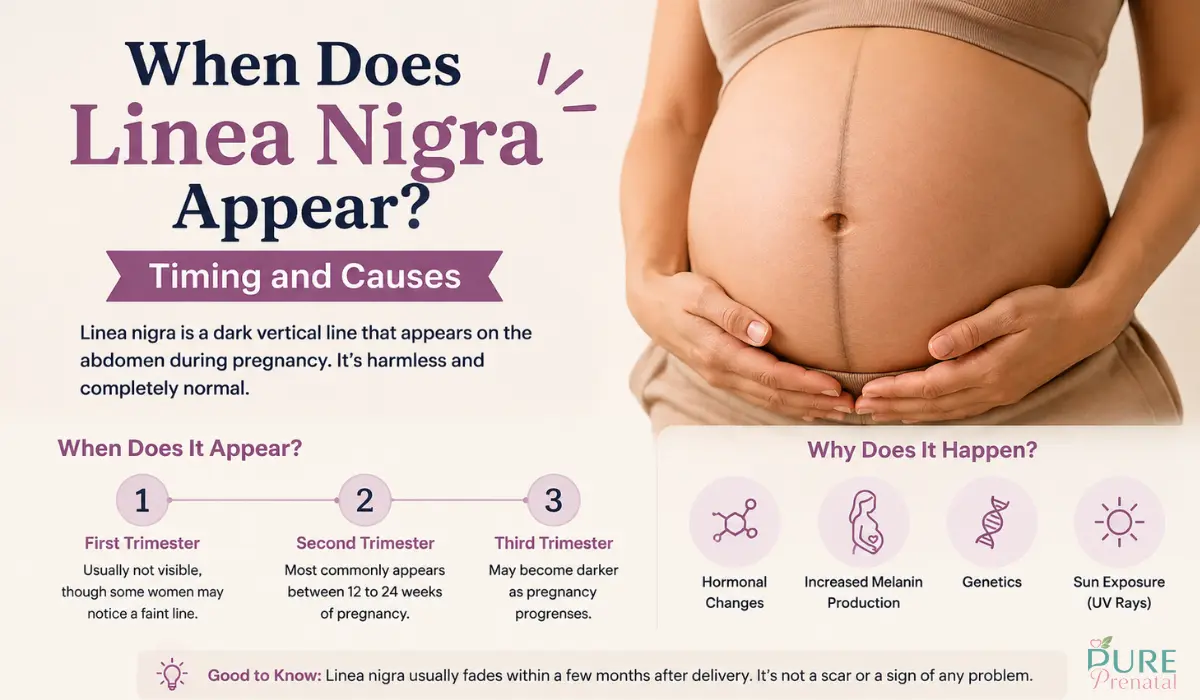
You’re getting out of the shower one day, or maybe just catching sight of yourself in the mirror while getting dressed, and there it is. A dark line, straight down the middle of your belly, that you’re pretty sure wasn’t there last week. If your immediate reaction was somewhere between “huh, that’s new” and mild panic, you’re not alone. It’s one of the questions that pops up constantly once women hit the second trimester, especially when does linea nigra appear?
That line has a name. It’s called linea nigra, and no, there’s nothing wrong with you.
If you just want the quick version: most women start noticing it somewhere between weeks 16 and 22. Right in that second trimester window. But treat that as a rough average rather than a deadline, because plenty of perfectly healthy pregnancies don’t stick to it.
The rest of this covers why the line shows up at all, what actually decides when you’ll see it, and the handful of situations where a skin change during pregnancy is worth an actual phone call to your midwife rather than a shrug.
What Is Linea Nigra, Anyway?
Translated from Latin, it literally means “black line,” though that’s a bit of an exaggeration. Most of the time it’s brown, sometimes lighter, sometimes darker, rarely anything close to black. It usually runs from around your belly button down toward your pubic bone. For some women it keeps going up toward the ribs too.
Here’s the part that tends to surprise people. You already have this line. It’s just been invisible your whole life. Before pregnancy, it’s called the linea alba, meaning “white line,” and it’s so pale it basically vanishes into the rest of your skin. What actually happens in pregnancy is that hormones darken this tissue that was already there. So technically nothing new is appearing. An old line is just finally becoming visible.
Okay, But When Does It Show Up?
There’s no set week where this is scheduled to happen, no matter how much some pregnancy tracking apps make it sound like clockwork. Most women see it start darkening sometime in the second trimester, commonly between 16 and 22 weeks. But again, average, not guarantee.
Some women notice a faint version of it early, even in the first trimester. Others don’t see anything until the third trimester is already underway. And a decent number of women, some of them on their second or third pregnancy, never get a visible line at all.
None of that variation means anything’s wrong. It just comes down to how differently everyone’s skin responds to the same hormonal changes.
Why Does This Even Happen?
Short answer: hormones. The longer answer has a couple of moving parts.
Estrogen and progesterone climb pretty steeply once you’re pregnant. Those hormones are thought to activate melanocytes, the cells in your skin that produce melanin, which is the pigment behind most colour changes in skin and hair.
There’s also a rise in melanocyte-stimulating hormone, usually shortened to MSH, which is part of that same hormonal wave responsible for other pigmentation changes a lot of women notice around the same time. Darker nipples, patches of melasma on the face, sometimes called the “mask of pregnancy” (a slightly dramatic name for something totally harmless).
Skin tone matters too. Women with naturally darker skin tend to get a more visible line, mostly because there’s just more baseline melanin for the hormones to act on. Genetics plays into it as well, so if your mum had a strong linea nigra, don’t be shocked if yours looks similar.
Is It Actually Nothing to Worry About?
Yes. Genuinely. Linea nigra says nothing about how your pregnancy is progressing. It’s not connected to the baby’s health, the placenta, or any complication whatsoever. It’s a cosmetic change, full stop, driven by hormones and nothing else.
It often shows up around the same time as other pigmentation changes, darker areolas, melasma, occasionally moles or freckles that look a shade deeper than usual. All of it comes from the same hormonal source, so if you’re noticing several of these at once, that’s completely expected rather than a red flag.
Does It Go Away Once the Baby’s Here?
For most women, yes, though don’t expect it to disappear overnight. As your hormones gradually drop back toward pre-pregnancy levels, the line tends to fade along with them.
| Timeframe After Birth | What You Might Notice |
|---|---|
| First few weeks | Usually still pretty visible |
| 3 to 6 months | Gradual lightening for most women |
| 6 to 12 months | Often mostly faded, sometimes completely gone |
| Beyond 12 months | A faint trace can linger, especially with darker skin tones |
Some women end up with a subtle permanent version, particularly after multiple pregnancies. That’s purely cosmetic at that point. Nothing medical about it.
Can You Speed This Up or Prevent It?
Not really, and that’s just how it is. Because linea nigra comes from something happening inside your body rather than on the surface of your skin, no cream or serum is going to reliably stop it or make it fade faster. A few things help a little around the edges though.
Sun protection is probably the most useful one on this list. UV exposure tends to make pigmentation more pronounced, linea nigra included, so a pregnancy-safe SPF on exposed skin can limit further darkening.
Keeping skin moisturised won’t touch your pigment levels, but it does support your skin barrier overall, which is never a bad thing during pregnancy.
And honestly, time does more work here than any product will. Most fading happens on its own once hormones settle after birth.
If you’re tempted by a skin-lightening product, run it past a pharmacist, midwife, or GP first. Not every ingredient is considered fine to use during pregnancy or while breastfeeding.
When Should You Actually Get This Looked At?
By itself, linea nigra never needs medical attention. But there are a few related situations worth mentioning to your midwife or GP.
If a dark line or patch shows up suddenly, especially alongside pain, swelling, or a rash, that’s worth flagging. Same story if a mole starts changing shape, colour, or size fairly fast. Severe itching, particularly on the palms and soles, combined with skin darkening can occasionally point to a liver-related condition in pregnancy, so that particular combination is worth a call. And if any pigmentation change is genuinely bothering you, even if you can’t quite explain why, that’s reason enough to ask someone.
These are the exceptions, not the rule. The overwhelming majority of dark lines down the belly are simply linea nigra doing exactly what it’s supposed to do. But if something feels different from a typical, gradual change, there’s no harm in getting it checked.
Frequently Asked Questions
Does every pregnant woman get linea nigra?
No, not even close. It’s common, but far from guaranteed. Some women get only the faintest hint of a line. Plenty don’t develop one at all.
Can it appear in the first trimester?
It’s not typical, but it happens. Some women notice subtle darkening before 12 weeks, though most don’t see a clear line until the second trimester.
Does the darkness of the line tell you the baby’s sex?
No, and this is one of those pregnancy myths that refuses to die. There’s zero science behind it. What actually determines how it looks is your hormones and your natural skin tone. Nothing to do with whether you’re having a boy or a girl.
Does it come back in a second pregnancy?
Usually, yes, and a lot of women say it shows up earlier or more noticeably the second time around. Like everything else here, it varies a fair bit person to person.
Is linea nigra basically the same thing as stretch marks?
No, completely different mechanisms. Stretch marks happen when skin stretches fast enough that the deeper layer tears slightly, leaving those streaky marks. Linea nigra is purely about pigment. No tearing involved at all.
The Bottom Line
Linea nigra is normal, it’s common, and it’s temporary. There’s no specific week it’s supposed to show up by, and whatever version you end up with, faint, obvious, or nonexistent, it says nothing about your health or your baby’s. If a skin change during pregnancy ever feels different from what’s described here, mention it at your next appointment. That’s literally what your midwife or GP is there for.

Dr. Tania Adib is a Board Certified OB/GYN based in the northern suburbs of Chicago. She earned her undergraduate degree from the University of Notre Dame and her medical degree from Georgetown University in Washington, D.C., before completing her residency in Obstetrics and Gynecology at Magee-Womens Hospital, University of Pittsburgh Medical Center. Her clinical interests include full-spectrum obstetrics and gynecology, from the first period through the menopausal years, contraception, and abnormal bleeding.