

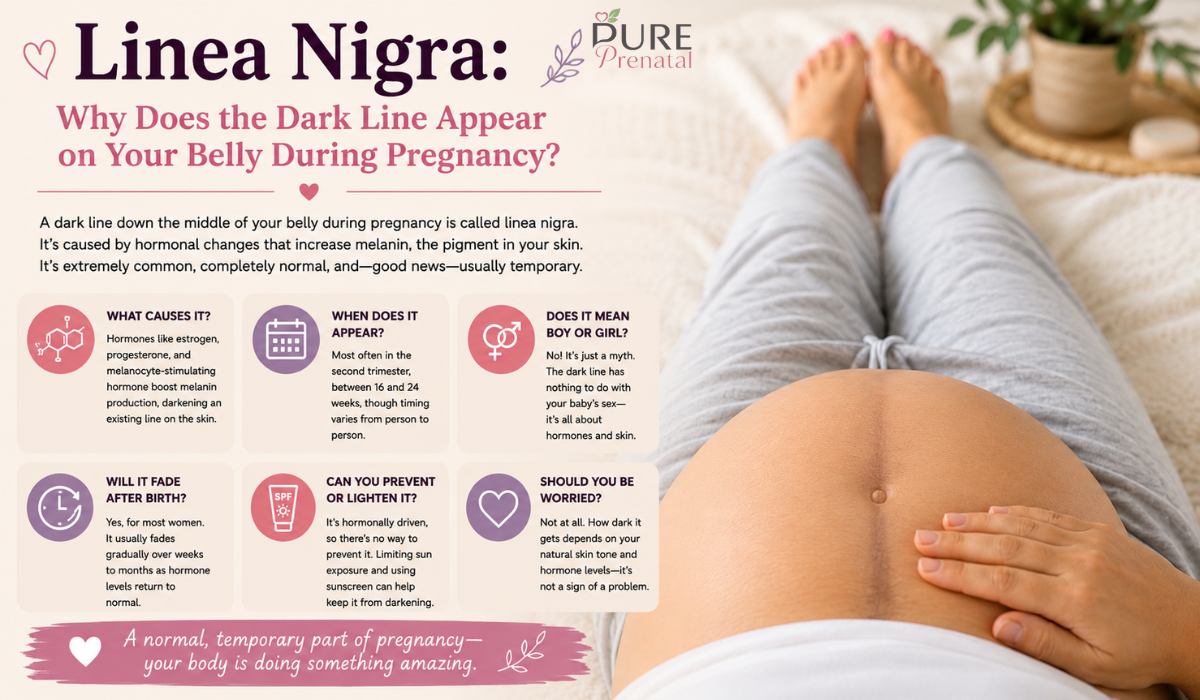
Somewhere around the middle of pregnancy, a lot of women glance down in the shower and notice something new: a dark line running straight down the belly, from around the belly button toward the pubic area, sometimes stretching even higher. If that’s you right now, take a breath — this is one of the more well-known and harmless quirks of pregnancy, even though almost nobody warns you about it ahead of time.
People call it a few different things. You might see it referred to as the nigra line, the pregnancy tummy line, or by its proper name, linea nigra. Whatever you call it, the questions tend to be the same: why is this happening, is it normal, and will it actually go away once the baby arrives? Let’s get into it.
What Exactly Is the Linea Nigra?
“Linea nigra” is Latin for “black line,” which is a pretty literal description of what you’re seeing. It’s a strip of darkened skin running down the center of the abdomen, and for most women it starts showing up sometime in the second trimester — though the exact week really does vary from person to person.
Here’s something a lot of people don’t realize: that line was already there before pregnancy. It’s just faint enough that most of us never notice it. Pregnancy hormones don’t create the line out of nowhere; they simply make an existing feature far more visible. So in a strange way, this line in pregnant belly skin isn’t new at all — it’s just finally getting some attention.
How common is it? Depending on which study you look at, estimates for how many pregnant women develop a noticeable line swing widely, anywhere from roughly a third to nearly all women, largely because skin tone and individual hormone sensitivity play such a big role. According to Cleveland Clinic, the line usually becomes visible around 20 weeks and tends to be more pronounced on darker skin tones.
Why Does the Line on the Belly During Pregnancy Show Up?
To make sense of this, it helps to know a little about how skin gets its color. Your skin tone comes down to melanin, a pigment made by cells called melanocytes that live in the outer layer of your skin.
During pregnancy, your hormone levels shift dramatically. Estrogen, progesterone, and something called melanocyte-stimulating hormone all rise — and all three, in different ways, push your melanocytes to work harder. The result is extra pigment showing up in certain spots on your body, and the abdominal line during pregnancy is one of the most visible examples.
Estrogen seems to do the heavy lifting here. It doesn’t just activate existing melanocytes — it appears to increase how many of them are working and how much pigment each one produces. Progesterone adds to the effect by making those cells more responsive overall. That’s also part of why other areas, like your nipples and areolas, tend to darken around the same time.
Skin tone matters too, and it’s worth saying plainly: if your line seems darker or more obvious than a friend’s, that’s not a red flag. Women with deeper skin tones generally have more active melanin production to begin with, so hormonal pigment changes — including this one — tend to stand out more. It’s biology, not a problem.
Why a Straight Line Down the Middle, Specifically?
It’s a fair question. Why doesn’t the pigment just spread evenly across your belly instead of forming this one distinct stripe?
The answer has to do with the anatomy underneath your skin. There’s a band of connective tissue running down the center of your abdomen — from roughly your breastbone down to your pubic bone — called the linea alba, or “white line.” It forms very early on, back when you were an embryo, at the point where the two sides of your body fused together. It’s made mostly of collagen, and structurally, it’s just different from the skin around it.
As your belly grows and that tissue stretches to accommodate your uterus, it reacts to hormonal changes a bit differently than the surrounding skin does. It tends to pick up pigment more readily. So when melanin production ramps up across your body, this particular strip darkens more noticeably than anything around it — and that’s what creates the line so many people search for information about, sometimes typing in things like “line of nigra” without even knowing the medical term for it.
Does This Line Tell You Anything About the Baby?
Short answer: no, but it’s a fun myth anyway, and you’ve probably heard it. The old wives’ tale goes that a line on stomach during pregnancy means boy or girl, depending on things like how dark it is, how far up it reaches, or whether it curves.
There’s no research backing this up. What determines the appearance of this line is hormone activity and your own skin biology — not the sex of your baby. It’s the kind of thing that’s genuinely fun to speculate about at a baby shower, just don’t put too much stock in it.
There’s a second myth floating around too: that this line, along with the darker areolas many women develop, somehow helps a newborn find their way to the breast after birth. Babies really do have a documented instinct for this — it’s sometimes called the “breast crawl” — but there isn’t solid evidence tying that instinct specifically to the visibility of this abdominal line.
When Does Linea Nigra Appear, Exactly?
If you’re wondering when does linea nigra appear, the honest answer is: it depends. Most women start to notice it sometime in the second trimester, often somewhere in the window between 16 and 24 weeks — if you’re not sure exactly which week you’re in, our pregnancy calculator can help you track that alongside your due date — though plenty of women see a faint version earlier or later than that.
What’s less common is seeing this kind of pigmentation change super early — say, in the first few weeks. If you’ve been searching for something like “1 week early pregnancy line on stomach,” it’s worth knowing that hormone-driven skin changes typically don’t show up that fast. Any marks or lines you notice that early are far more likely related to normal skin texture, bloating, or stretching than to actual pigmentation shifts.
Will This Dark Line Actually Fade After Birth?
This tends to be the question people care about most, and the reassuring answer is: yes, for the vast majority of women, it does. Once your baby is born and your hormone levels start settling back toward their pre-pregnancy baseline, melanin production slows down along with them.
That fading process usually isn’t instant — it happens gradually, over the course of several weeks to a few months postpartum. Bodies vary, so there’s no single guaranteed timeline. Occasionally, some residual pigment sticks around a bit longer than expected, but full disappearance without any treatment is the norm, not the exception.
Can You Prevent It or Make It Less Noticeable?
Since this whole process is driven by hormones your body needs during pregnancy, there’s really no way to stop the line from forming in the first place — the American Pregnancy Association confirms there’s no known method of prevention, since it’s simply a natural response to pregnancy hormones. That said, a few things do affect how visible it ends up being:
- Sun exposure. UV light triggers extra melanin production, which can deepen the color of an existing line on stomach during pregnancy. The good news is that this kind of sun-related darkening is temporary and only affects the surface — it doesn’t change how quickly the line fades after birth. Covering up or wearing sunscreen on your belly when you’re outside can help keep it from getting darker than it needs to.
- Folate and diet. You may have come across claims online suggesting folate or folic acid can lighten the line. Folate genuinely matters during pregnancy — it helps protect against neural tube defects, which is exactly why it’s in every prenatal vitamin — but there isn’t solid evidence connecting folate intake to how visible this particular line becomes. Eating folate-rich foods like leafy greens, lentils, or avocado is a good idea regardless, just not as a pigment-fading strategy.
- Cover-up options. If you’re feeling self-conscious in certain settings, makeup or concealer can hide the line temporarily. Plenty of women find, though, that once they understand what’s actually happening hormonally, the line starts to feel a lot less like something to hide.
A Normal, Temporary Part of Pregnancy
At the end of the day, a line in tummy during pregnancy is just one more example of your body doing exactly what it’s supposed to do to grow a baby. It can feel strange to watch your skin change in ways you never expected, but this particular change is well understood, extremely common, and — for nearly everyone — temporary.
Frequently Asked Questions
What causes the nigra line during pregnancy?
It comes down to hormones. Rising estrogen, progesterone, and melanocyte-stimulating hormone all boost melanin production, which darkens a strip of skin that was already faintly present before pregnancy.
When does the pregnancy line on stomach typically show up?
Most commonly during the second trimester, often between weeks 16 and 24, though timing varies quite a bit from one pregnancy to the next.
Does a line on stomach during pregnancy mean boy or girl?
No. That’s a popular myth, but there’s no scientific link between this pigmentation change and your baby’s sex.
Will the abdominal line during pregnancy fade after delivery?
For most women, yes. It typically fades gradually over weeks to months postpartum as hormone levels return to normal, usually without any treatment needed.
Is there a way to prevent or lighten the line while I’m still pregnant?
Not really, since it’s hormonally driven. Limiting sun exposure and using sunscreen on your belly can help keep it from darkening further.
Should I be worried if my line looks especially dark?
Not at all. How pronounced it gets varies a lot based on natural skin tone and individual hormone levels — a darker line isn’t a sign of a problem.

Dr. Tania Adib is a Board Certified OB/GYN based in the northern suburbs of Chicago. She earned her undergraduate degree from the University of Notre Dame and her medical degree from Georgetown University in Washington, D.C., before completing her residency in Obstetrics and Gynecology at Magee-Womens Hospital, University of Pittsburgh Medical Center. Her clinical interests include full-spectrum obstetrics and gynecology, from the first period through the menopausal years, contraception, and abnormal bleeding.