

You’ve probably come across “pravi celer” on a recipe blog or a wellness post and wondered two things. What is it, and can you eat it while pregnant?
It’s celery. Pravi celer is how Serbian, Croatian, and Bosnian speakers refer to Apium graveolens. The stalks, the root, and the leaves are all fine as food once they’re washed properly. What you’d want to hold off on is celery seed supplements, concentrated extracts, and big glasses of untreated raw juice.
So what does “pravi celer” mean?
Pravi means true or real, and celer is celery. The phrase turns up in older Balkan recipes, usually where a chunk of celery root goes into the broth and nobody thinks twice about it.
People don’t agree on the exact meaning. Some cooks use it for celeriac, the root. Others mean the whole plant. If a recipe calls for it, check which one before you shop.
There’s also the online version, where pravi celer is sold as an upgraded variety with a longer shelf life and a “superfood” badge. Those posts never name a cultivar or point to a single trial, so treat that as marketing. The name describes a way of cooking, not a special plant.
One species, three very different vegetables
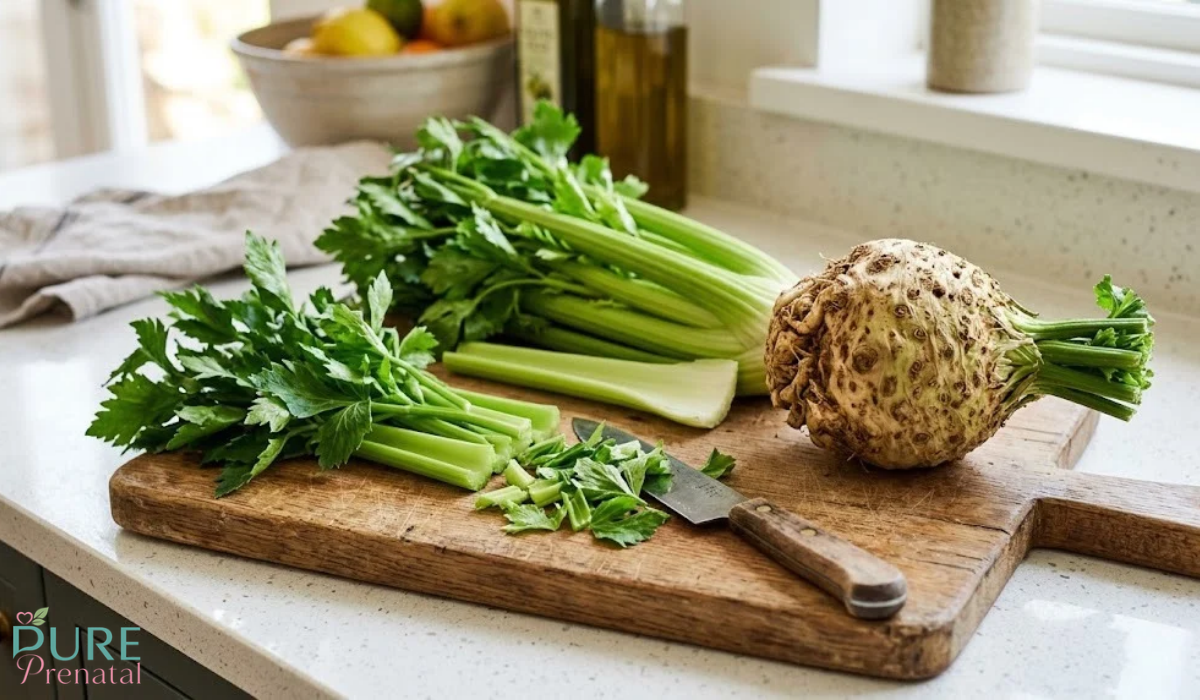
Celery has been bred for different parts of the plant, and the differences matter once you’re planning meals.
| Part | What it’s like | Pregnancy note | Common use |
|---|---|---|---|
| Stalks | Crisp, mild, mostly water | Very low in calories and carbohydrate. Wash well if raw. | Soups, salads, hummus dipper |
| Root (celeriac) | Dense, earthy, starchier | About triple the calories of stalks by weight. Counts as carbohydrate if you’re managing gestational diabetes. | Broth, stews, roasting, mash, grated raw |
| Leaves | Strong and herbal, sometimes bitter | Fine as a seasoning. Wash like any herb. | Chopped over dishes, dried for winter |
| Seeds and extracts | Concentrated and pungent | Not well studied in pregnancy. Skip the supplement forms. | Spice, stock, capsules, tinctures |
What you actually get from it
Celery stalks are about 95 percent water, according to USDA FoodData Central. A 100 gram serving, roughly two and a half medium stalks, comes to around 14 calories, 3 grams of carbohydrate, and 1.6 grams of fiber, with some potassium and vitamin K along for the ride.
So it’s an easy way to add fiber and fluid, which helps if constipation has settled in. Folate is a different story. That same serving covers only a small slice of the 600 micrograms recommended daily in pregnancy, so your prenatal vitamin is still doing the heavy lifting.
You’ll see apigenin and luteolin mentioned constantly online. Most of that research was done in labs and animals. Nobody has shown these compounds change anything in a pregnancy.
Is pravi celer safe to eat while pregnant?
As ordinary food, yes for most people. A few details are worth getting right.
Washing: Celery is usually eaten raw or barely cooked, and it has been linked to Listeria outbreaks in the past. Pregnancy makes you far more susceptible to listeriosis, so the extra minute at the sink counts. Rinse stalks and leaves under running water. Scrub celeriac before you peel it, otherwise the knife drags soil from the crevices through the flesh. Refrigerate anything you’ve cut within two hours.
Juice: The FDA advises pregnant people to avoid untreated juice. That covers juice-bar celery juice and cold-pressed bottles that haven’t been pasteurized or otherwise treated. Juicing well-washed celery at home carries less risk, but it’s a lot of celery in one glass, and juice doesn’t treat anything.
Seeds and extracts: A pinch of celery seed in a stock is one thing. Capsules and concentrated extracts sold for joints or blood pressure are another. Traditional herbal sources describe celery seed as something that brings on menstrual flow, and that’s the reason herbalists have long advised against it in pregnancy. Good human data is missing. Supplements also aren’t approved by the FDA before they reach the shelf, so what’s in the bottle can vary. Unless your provider has okayed it, leave the concentrated forms alone.
Your own situation. A few groups should check first.
- If you have a celery allergy, avoid it. Reactions can be severe, and celery allergy sometimes goes along with birch or mugwort pollen allergy.
- If you take warfarin, the vitamin K in celery matters, and steady intake is the goal.
- If you’ve been told to limit potassium because of kidney disease, ask how much celery and celeriac fit.
- If you have gestational diabetes, the stalks barely register but celeriac counts. Your care team can tell you how to fit it in.
Does celery lower blood pressure?
Folk wisdom says so, and celery does contain potassium. But eating it isn’t blood pressure treatment, and pregnancy is precisely when readings need proper monitoring. Rising blood pressure can signal preeclampsia. If you’re leaning on celery to keep a number down, that’s your cue to call your provider, not to buy more celery.
Ways to cook with it
Celeriac is the workhorse. It isn’t a beautiful vegetable, and it looks like something dug up after a long argument with the garden. But drop a chunk into a slow broth at the start and it gives the liquid a deep, musky base that stalks can’t match.
Dice it into stews, roast it until the edges brown, or mash it in with potato. Grated raw with lemon and olive oil, it makes a crunchy winter salad. Peel and wash it well first.
Stalks go into soups and sautés, or get cut raw for snacking. Chop the leaves like parsley and scatter them at the end, or dry them and crumble them into cooked dishes.
Celeriac keeps for several weeks in the refrigerator crisper. Stalks last a week or two if you keep them cold and dry.
When to contact your provider
Call your midwife, OB/GYN, or maternity unit if you notice any of these, whatever you’ve been eating.
- Severe or lasting headache, vision changes, or pain in the upper right abdomen
- Sudden swelling in your face or hands
- Vomiting or diarrhea that won’t settle, or fever and chills after eating raw produce
- Questions about whether a celery supplement or extract is okay for you
Hives, throat tightness, or swelling of the lips after eating celery can be an emergency, so seek urgent care.
FAQs
Is pravi celer the same as celeriac?
Sometimes. Many Balkan cooks mean the root, while other sources use it for the whole plant. Check what the recipe is asking for.
Can I eat celery every day while pregnant?
Stalks in normal food amounts are fine for most people. If you take medication or have a medical condition, ask your provider first.
Is celery juice safe?
Pasteurized or homemade juice from well-washed celery carries lower risk. Skip fresh untreated juice, and don’t count on it as a health fix.
Can celery cause a miscarriage?
Celery eaten as food hasn’t been shown to. The worry centers on concentrated seed products and extracts, where safety data is thin.
Is it healthier than regular celery?
There’s no evidence of a distinct, superior variety under that name. It’s a term for true celery and how it’s traditionally used.
Is celery allergy common?
Less than peanut or shellfish, but it can be serious. If you’ve reacted before, avoid it.
Bottom Line
Pravi celer is celery, and in Balkan cooking it usually means using the root and the leaves, not just the stalks. During pregnancy, everyday food amounts are fine when washed well. Skip untreated juice and leave seed extracts alone unless your provider says otherwise. It’s a good ingredient. It isn’t a superfood, and it won’t stand in for prenatal care.

Dr. Tania Adib is a Board Certified OB/GYN based in the northern suburbs of Chicago. She earned her undergraduate degree from the University of Notre Dame and her medical degree from Georgetown University in Washington, D.C., before completing her residency in Obstetrics and Gynecology at Magee-Womens Hospital, University of Pittsburgh Medical Center. Her clinical interests include full-spectrum obstetrics and gynecology, from the first period through the menopausal years, contraception, and abnormal bleeding.