

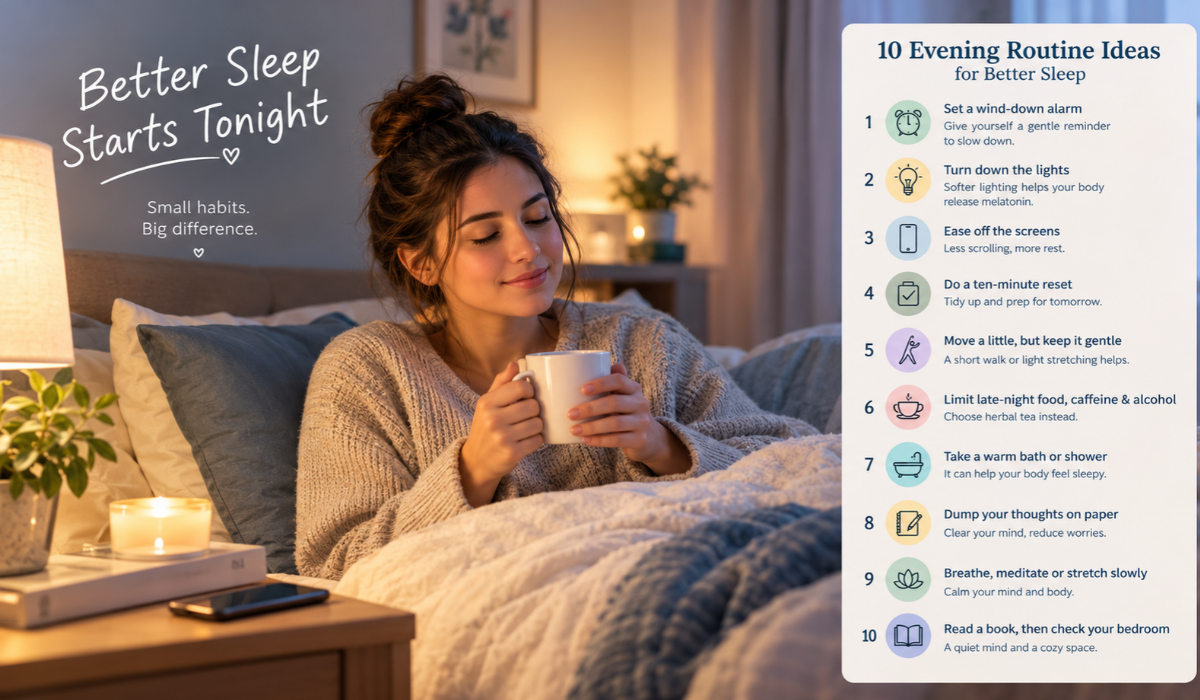
Let’s be real for a second. Most evenings don’t look like the calm, candle-lit scenes you see online. They look like this: you finally sit down at 9, grab your phone “just for a minute,” and next thing you know it’s almost midnight, your brain is buzzing, and you’re annoyed at yourself for the third night in a row.
Sound familiar? You’re definitely not alone.
The good news is that you don’t need a perfect routine or a fancy setup to fix it. A handful of small habits, done around the same time each night, can nudge your body toward sleep. That’s really all an evening routine is. Think of it as a gentle ramp down from a busy day instead of slamming on the brakes at bedtime.
Below are ten evening routine ideas worth trying. They come from what sleep experts and trusted health sources keep recommending, but I’ve kept them practical. And please, don’t try all ten at once. Pick one or two that feel easy and start there. You can always add more later.
So why does a bedtime routine even matter?
Sleep specialists have a name for the whole package of habits that help you sleep well: sleep hygiene. It covers your bedroom, your daytime habits, and yes, what you do in the hour or two before bed. Harvard Health lists a relaxing bedtime routine as one of the three big pillars, right next to a comfortable sleep environment and good daytime habits.
The CDC keeps its advice pretty straightforward. Go to bed and wake up at about the same time every day, even on weekends. Make your bedroom quiet, dark and comfortable. Keep screens out of it. Skip the huge dinners, late caffeine and alcohol near bedtime. Your nighttime routine is just the place where all of that comes together.
1. Give yourself a wind-down alarm
Funny thing: we all set alarms to wake up, but almost nobody sets one to stop. Try it. Pick a time about an hour to ninety minutes before you want to be asleep and set a soft reminder.
When it goes off, that’s your cue. Finish up, put the work away, and start slowing down. Without that nudge, “five more minutes” has a way of turning into an hour.
2. Turn down the lights
Bright light tells your brain it’s still daytime, which isn’t helpful when you’re trying to feel sleepy. About an hour before bed, flip off the harsh overhead lights and switch to lamps or warm bulbs.
GW Cancer Center recommends this because softer lighting supports your natural melatonin release, the hormone that helps you get drowsy. It’s one of the easiest changes on this list, and you’ll probably feel the difference within a few evenings. The room just gets cozier.
3. Ease off the screens
Yeah, I know. This is the one nobody wants to hear. But phones and laptops mess with your evening twice over: through the light they give off, and through all the stuff they pull you into, like emails, news and endless scrolling.
You don’t have to go cold turkey. Even a 30-minute break before bed helps. If that’s too much, dim the brightness and use night mode. Even better, charge your phone across the room so it’s not the last thing your thumbs touch. Harvard Health does say it’s fine to use a device if it’s just for calming music or a guided relaxation.
4. Do a ten-minute reset
Nothing kills a relaxing evening like a sink full of dishes and a bag you haven’t packed yet. Those little loose ends quietly nag at you.
Spend ten minutes clearing the obvious mess, then lay out what tomorrow needs: clothes, keys, lunch, whatever. It’s a kind thing to do for future-you. Plus it gets tomorrow’s to-do list out of your head, where it loves to hang out at 1 a.m.
5. Move a little, but keep it gentle
Exercise is great for sleep. Just don’t schedule a punishing workout right before bed, or you may end up wired instead of wiped. Save the hard stuff for earlier in the day.
In the evening, think easy: a stroll after dinner, a few stretches, a short yoga flow. The Sleep Foundation notes that regular yoga is linked to better sleep quality, and that stretching or a light massage before bed can help prevent muscle cramps.
6. Go easy on the late-night food, caffeine and alcohol
Big meals close to bedtime can leave you uncomfortable, and caffeine sticks around in your body for way longer than most of us think. The CDC and Mayo Clinic both suggest watching what you eat and drink in the evening, especially large meals, caffeine and alcohol near bedtime.
Alcohol is the sneaky one. A drink might make you feel sleepy at first, but Harvard Health points out it can cut into REM sleep, which matters for memory and mood. If you want something cozy in the evening, a caffeine-free herbal tea is a lovely swap. And honestly, the act of making it, kettle on, mug in hand, is a little ritual all by itself.
7. Take a warm bath or shower
Some classics are classics for a reason. Your body temperature naturally dips as you get ready for sleep, and the Sleep Foundation explains that a warm bath can mimic that drop, which may leave you feeling sleepy afterward. Healthline adds that a warm soak can soothe your nervous system and ease tension. Even a simple warm foot bath may help.
Don’t have a tub? A warm shower works fine. Add your usual evening skincare routine and you’ve covered getting clean and getting calm at the same time. Do it around the same time each night and your body starts to catch on: okay, bedtime is coming.
8. Dump your thoughts on paper
You know when you finally lie down and your brain suddenly remembers every awkward thing you said in 2014, plus everything on tomorrow’s list? Yeah. Try getting it all out before bed.
Grab a notebook and write down whatever’s swirling around: worries, ideas, errands, random stuff. Mayo Clinic lists managing worries as part of healthy sleep habits, and a quick brain dump is one of the simplest ways to do it. If you like, finish with a few lines of gratitude. A couple of things that went well, a person you’re thankful for. Five minutes, tops, and the day ends on a nicer note.
9. Breathe, meditate, or stretch slowly
Meditation can sound intimidating, but it doesn’t have to be a big thing. A few minutes of slow breathing or a short guided session can take the edge off a busy mind. Healthline notes that meditation may help reduce ruminating thoughts, lower blood pressure and heart rate, and may support the production of sleep-friendly hormones like melatonin and serotonin.
If sitting still makes you itchy, no problem. Do some slow stretches instead. Or try 4-7-8 breathing: breathe in for four counts, hold for seven, breathe out for eight. Nobody’s checking your form.
10. Read a book, then check your bedroom
Reading before bed is about as old-school as it gets, and it still works. A paper book (or an e-reader with a warm, dim light) gives your mind something engaging but calm to hold onto. The Sleep Foundation calls reading a common routine that can support healthy sleep well into adulthood.
Then take a quick look at your sleep space. Cool, dark and quiet is what you’re going for, and the CDC and Sleep Foundation both agree. Try to keep the bed for sleep. And if you’re lying there staring at the ceiling and getting frustrated, it’s okay to get up, do something quiet for a bit, and come back when you’re actually sleepy.
How to make it stick (without driving yourself crazy)
Here’s where most people trip up: they go all in on Monday, feel overwhelmed by Wednesday, and quit by the weekend. Let’s not do that.
- Start tiny. One or two habits, like a wind-down alarm and a warm shower. Add more once they feel automatic.
- Keep it short. A calming evening routine can take just 20 to 30 minutes. Showing up regularly beats doing it perfectly.
- Have a lazy-night version. Home late? Dim the lights, take three slow breaths, and call it a win.
- Keep your sleep schedule steady. The CDC recommends the same bed and wake times every day, weekends included. Your routine works best when it has that anchor.
- Pay attention to what’s not working. Still sleeping badly after a few weeks? Try a simple sleep diary, which Harvard Health suggests for spotting patterns.
A sample evening you can borrow
| Time before bed | What you might do |
|---|---|
| 2 to 3 hours | Finish dinner and any harder exercise |
| 90 minutes | Wind-down alarm, quick tidy, prep for tomorrow |
| 60 minutes | Dim the lights, herbal tea, easy walk or stretching |
| 30 to 45 minutes | Screens off, warm shower or bath, skincare |
| 15 to 20 minutes | Journal or gratitude, breathing or meditation |
| In bed | Read until sleepy, lights out |
Totally fine to tweak it. Your life, your schedule.
Quick questions people ask
How long should an evening routine be? Anywhere from 20 minutes to an hour works for most people. Lots of sleep experts suggest a 30 to 60 minute wind-down, but a shorter routine you’ll actually do beats a long one you’ll skip.
What’s the best evening routine for better sleep? There’s no single winner. The ones that work usually share a few things: softer lights, fewer screens, something calming like reading or stretching, and a regular bedtime. Build yours from the parts you enjoy.
Is it okay to use my phone before bed? Cutting back is ideal, especially in the last half hour. If you do use it, turn the brightness down and stick to soothing things like music or a guided relaxation.
What if I still can’t sleep? Give new habits a couple of weeks. If nothing’s changing, or you wonder about something like insomnia or sleep apnea, it’s worth talking to your doctor. A good routine helps a lot of people, but it’s not a substitute for medical advice.
One last thing
An evening routine isn’t about being perfect or having the prettiest nighttime setup. It’s about giving yourself a softer landing at the end of a long day. Dim the lights, put the phone down, do something that makes your shoulders drop, and let your body know it’s okay to rest.

Dr. Tania Adib is a Board Certified OB/GYN based in the northern suburbs of Chicago. She earned her undergraduate degree from the University of Notre Dame and her medical degree from Georgetown University in Washington, D.C., before completing her residency in Obstetrics and Gynecology at Magee-Womens Hospital, University of Pittsburgh Medical Center. Her clinical interests include full-spectrum obstetrics and gynecology, from the first period through the menopausal years, contraception, and abnormal bleeding.