

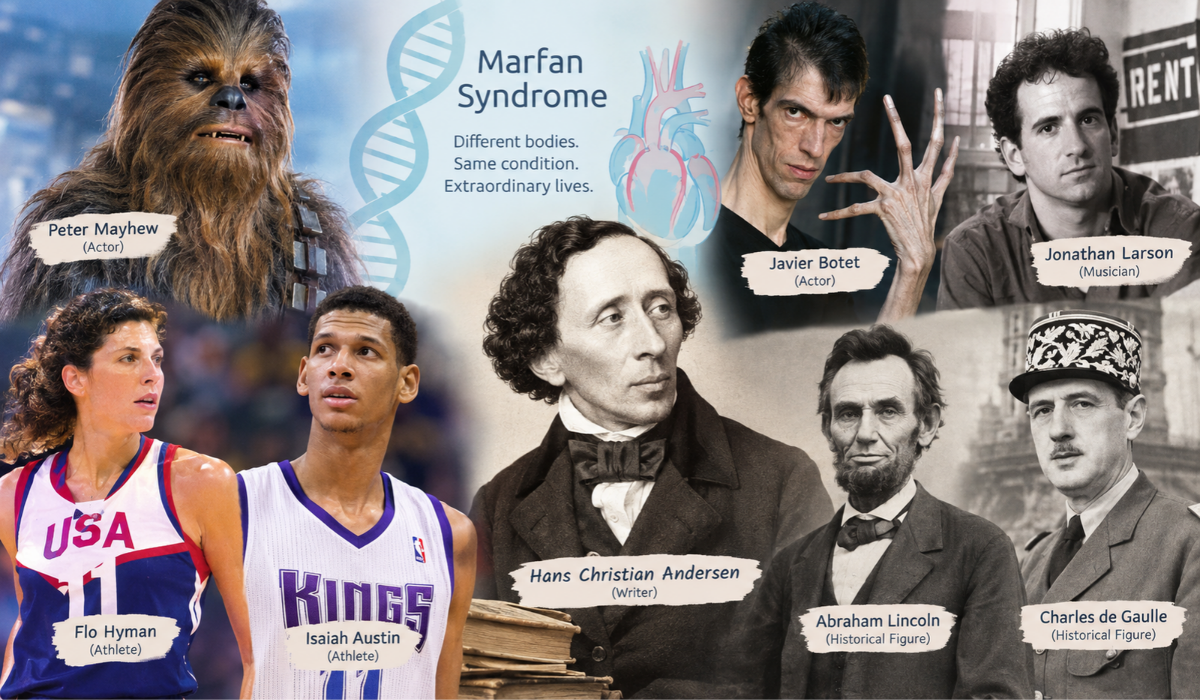
Hans Christian Andersen was a lonely boy in Odense, teased for being too tall and too thin. He grew up to write The Ugly Famous People With Marfan Syndrome: The Stories Behind the Names
Hans Christian Andersen was the tallest kid in his class, and he hated it. He was gangly, shy, and teased for being too thin. So he did what a lot of lonely kids do and escaped into his imagination, spinning stories for his classmates about outsiders who were secretly destined for greatness.
Years later, one of those stories became The Ugly Duckling. Some people now suspect Andersen had Marfan syndrome, which would make him the first of many well-known people linked to this rare genetic condition. Some were diagnosed and others are only educated guesses, but their stories are worth knowing, and not just as trivia. They show what this condition can do, and why catching it early matters so much.
First, What Is Marfan Syndrome?
Marfan syndrome affects connective tissue, the material that holds your body together, from your joints to your blood vessels. It’s caused by a change in the FBN1 gene, which your body uses to make a protein called fibrillin-1. When that process doesn’t work properly, the tissue is weaker and stretchier than it should be.
Since connective tissue is everywhere, the Marfan syndrome symptoms can be all over the place too. People often have:
- A tall, slim build with long arms, legs, and fingers
- Very flexible joints, and sometimes a curved spine
- Eye problems, like a lens that has slipped out of position
- Heart and blood vessel trouble, especially an aorta that widens over time
That last one is what doctors worry about most. A weakened aorta can develop an aneurysm, or tear in what’s called an aortic dissection, and that can be fatal. The encouraging part is that regular echocardiograms, medication, and preventive surgery have changed the outlook dramatically. There’s a catch, though: all of it depends on someone knowing they have the condition in the first place.
Actors and Entertainers
Peter Mayhew was 7 feet 2 inches tall, and that height, a result of Marfan syndrome, is a big reason he ended up in the Chewbacca suit. Not many people can say their body got them one of the most loved roles in movie history.
Javier Botet took a similar path in a very different genre. The Spanish actor is tall with extraordinarily long fingers, and horror directors love him for it. When they need a creature that looks unsettling, his frame does the work that would otherwise take a lot of special effects.
Vincent Schiavelli was one of those character actors whose face you’d know anywhere, even if his name escaped you. You can spot him in One Flew Over the Cuckoo’s Nest and Man on the Moon.
Jonathan Larson is the hardest story to tell. He created the musical Rent, and he died of an aortic aneurysm on the eve of its premiere. Nobody had diagnosed his Marfan syndrome. Rent went on to win the Pulitzer Prize, and he never got to see any of it. When people talk about why early diagnosis matters, his name comes up more than any other.
Musicians appear on these lists too. Bradford Cox of Deerhunter and Austin Carlile, formerly of Of Mice & Men, are both named among notable people with the condition.
Athletes
Height and long limbs are an obvious advantage in some sports, so it makes sense that a few elite athletes have had Marfan syndrome. But intense training puts real strain on an aorta that may already be fragile, which is what makes it risky.
Flo Hyman was an Olympic silver medalist in volleyball. In 1986, she collapsed during a match in Japan and died of an aortic dissection caused by Marfan syndrome. Her death introduced a lot of people to a condition they’d never heard of.
Isaiah Austin was on the verge of the NBA when doctors diagnosed him with Marfan syndrome in 2014, just before the draft. His basketball career was over, but he didn’t fade away. He became a voice for screening and awareness, and that may end up being his bigger legacy.
Historical Figures Who May Have Had It
A fair warning first: nobody can run a genetic test on someone who’s been dead for a century. Everything in this section is educated speculation.
Abraham Lincoln is the famous example. He was very tall and thin with long limbs, and some medical historians have wondered whether he had Marfan syndrome. People have argued about it for decades, and it’s still only a theory.
Charles de Gaulle, the French general and president, was also notably tall and stiff in his bearing. He gets mentioned as a possible case now and then, though nothing has been confirmed.
Hans Christian Andersen brings us back to the beginning. People who met him kept commenting on his body, describing him as “long, thin, fleshless, boneless” with “out-of-proportion arms and legs.” He never felt like he fit in, and he poured that feeling into his writing. The Ugly Duckling came out in 1843, and it was unusual for its time because it was an original story, not a retelling of folklore. It also gave him his life motto: “It matters nothing if one is born in a duck-yard, if one has lain in a swan’s egg.” Whether or not he had Marfan syndrome, it’s hard not to see him in that swan.
What These Stories Have in Common
Marfan syndrome looks different in every life. For Mayhew and Botet, it shaped a career. For Larson and Hyman, it ended things far too soon. For Austin, it shut one door and pushed him through another.
What ties them together is how easy it is to miss. Many people don’t learn they have it until something goes wrong, sometimes in an emergency room. But when it’s caught early, doctors can watch the heart, start medication, and plan surgery before the aorta reaches a dangerous point.
Final Thought
The list of famous people with Marfan syndrome is a mix of confirmed diagnoses and historical guesswork. What stays with me isn’t the fame, though. It’s that behind every name is someone whose life could have gone differently with the right information at the right time.

Dr. Tania Adib is a Board Certified OB/GYN based in the northern suburbs of Chicago. She earned her undergraduate degree from the University of Notre Dame and her medical degree from Georgetown University in Washington, D.C., before completing her residency in Obstetrics and Gynecology at Magee-Womens Hospital, University of Pittsburgh Medical Center. Her clinical interests include full-spectrum obstetrics and gynecology, from the first period through the menopausal years, contraception, and abnormal bleeding.