

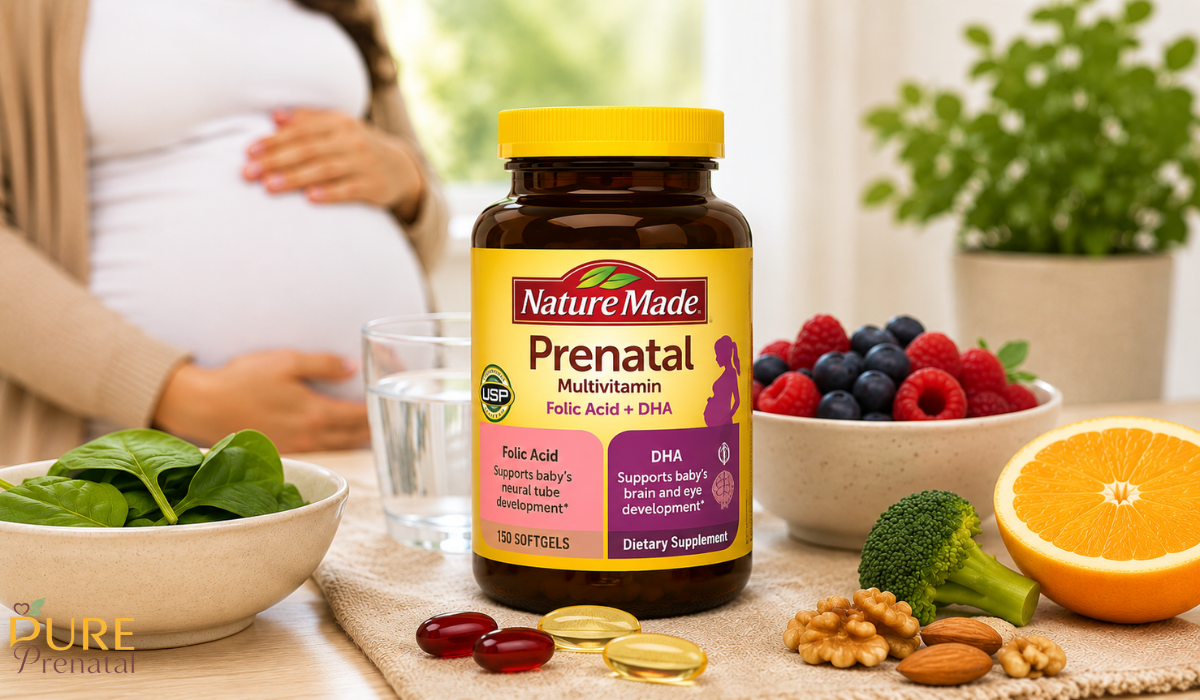
Pregnancy comes with a long list of decisions, and picking the right prenatal vitamin is one that tends to cause the most second-guessing. Stand in front of a pharmacy shelf and you’ll see a dozen different bottles, half of them making similar claims. So it’s a fair question to ask: does a formula like the Nature Made prenatal multivitamin folic acid + DHA actually give your body — and your baby — what it needs at this stage?
That’s what this article is trying to answer. We’ll look at what folic acid and DHA actually do during pregnancy, roughly how much of each you need, and a few things worth thinking through before deciding if this kind of combined formula makes sense for you. This isn’t meant to sell you on anything. It’s meant to give you enough clarity to have a more informed conversation with your own healthcare provider.
Why Folic Acid and DHA Matter During Pregnancy
Prenatal vitamins pack in a long list of nutrients, but if you ask most OBs or midwives which two matter most early on, folic acid and DHA usually top the list.
Folic acid is the synthetic form of folate, a B-vitamin that’s directly tied to how a baby’s neural tube develops — that’s the structure that eventually forms the brain and spinal cord. Here’s the tricky part: this development happens in the first few weeks of pregnancy, often before a person even realizes they’re pregnant. That’s exactly why doctors push folic acid before conception, not just after a positive test.
DHA works a bit differently. Short for docosahexaenoic acid, it’s an omega-3 fatty acid involved in brain and eye development. But unlike folic acid, its importance doesn’t taper off after the first trimester — it stays relevant right through the second and third trimesters, since the brain keeps developing the whole way. A lot of people simply don’t get enough DHA from food, especially if fatty fish isn’t a regular part of their diet, which is exactly why it ends up in most prenatal formulas.
Combine the two, and you get the logic behind something like a vitamin nature made prenatal multivitamin folic acid DHA formula: one pill, two jobs, less to keep track of. And honestly, when you’re already tired and juggling a dozen new habits, “less to keep track of” counts for a lot.
How Much Folic Acid Should My Prenatal Vitamin Have?
This comes up constantly when people compare prenatal brands, and honestly, the answer isn’t one-size-fits-all — it depends on your individual health history.
As a general rule, people of reproductive age who could become pregnant are advised to get around 400 micrograms (mcg) of folic acid a day, and that goes up to roughly 600 mcg once pregnancy is confirmed. If there’s a personal or family history of neural tube defects, a doctor might recommend a higher dose — but that’s a decision to make with a provider, not something to adjust on your own based on a label.
A good habit when reading a prenatal label: check the actual mcg amount rather than assuming a bigger number automatically means a better product. Taking excessive folic acid without medical guidance isn’t something health professionals typically recommend, so it really comes down to matching the dose to what your provider has advised.
How Much Folic Acid Is Required in Early Pregnancy?
Early pregnancy is where folic acid does the heavy lifting, since the neural tube usually finishes forming within the first month after conception — which, again, is often before a pregnancy test even shows a clear positive. That timing is exactly why so many providers recommend starting folic acid at least a month before trying to conceive, then continuing it through the first trimester.
For most people without added risk factors, 600 mcg a day is the commonly cited target during early pregnancy, counting both dietary folate and whatever comes from a supplement. Not sure if your diet covers it? Leafy greens, citrus, and fortified grains all contribute folate naturally, but a prenatal supplement is there to fill in the gaps — your provider can help confirm what’s right for you specifically.
What About DHA Intake During Pregnancy?
DHA guidelines aren’t quite as standardized as folic acid ones. Most health bodies land somewhere around 200 mg per day, with some pushing that up to 300 mg depending on how much fish is already in someone’s diet. And because DHA keeps mattering all the way through pregnancy — not just in the first few weeks like folic acid — staying consistent day to day matters more than obsessing over one exact number.
If salmon or sardines are already a regular part of your meals, you may need less from a supplement than someone who rarely eats fish. Worth bringing up with your provider, honestly, since everyone’s diet looks different.
What to Look for in a Combined Folic Acid + DHA Formula
A few things worth checking before settling on any prenatal, combined DHA formula or not:
- Clear labeling. The folic acid amount should be listed in micrograms and DHA in milligrams — not buried in a vague “proprietary blend.”
- Independent testing. Third-party quality testing adds some reassurance that what’s on the label matches what’s in the bottle.
- The rest of the nutrient list. Folic acid and DHA get the spotlight, but iron, calcium, vitamin D, and iodine all pull their own weight during pregnancy too.
- How your stomach handles it. First-trimester nausea is common, and some formulas sit easier than others. Softgels or smaller tablets tend to be more forgiving.
- Your actual diet. Someone eating fish twice a week and someone with a more restricted diet don’t need the same supplemental support.
There’s no single prenatal that’s objectively “the best” for everyone — it really comes down to your health history, your diet, and what your provider recommends. f you’re still comparing different options, our prenatal vitamin guide explains the key nutrients to look for and how to choose the best prenatal supplement for your needs.
Is a Combined Folic Acid + DHA Prenatal the Right Choice for You?
The pitch behind a combined formula is pretty simple: one bottle instead of two. No juggling a separate DHA capsule alongside your regular prenatal. For a lot of people, especially in those exhausted, nauseous early weeks, fewer pills to remember genuinely helps — and sticking with something consistently usually matters more than chasing the “perfect” dosage on paper.
But whether it’s actually worth it depends on where you’re starting from. Already taking a separate omega-3 supplement, or eating fish a few times a week? A combined formula might be giving you more than you need. Diet’s a little thin on omega-3s and you’d rather not manage two separate bottles? Then it starts to make more sense.
It’s also worth factoring in cost, how well your body tolerates it, and whether it clashes with anything else you’re taking. Your provider is really the best person to weigh all of that alongside your actual bloodwork and history — not just the label.
A Note on Availability in Different Regions
One thing that trips people up: prenatal formulations aren’t identical everywhere. Someone searching for nature made prenatal vitamins in the UK might notice the packaging, nutrient amounts, or labeling look a bit different from what’s sold in the US, simply because supplement regulations vary by country. If you’re pregnant and living somewhere other than where a product was made for, it’s worth a quick check with a local pharmacist to make sure the formulation lines up with regional prenatal guidance.
Final Thoughts
At the end of the day, picking a prenatal multivitamin isn’t really about brand recognition — it’s about knowing what your body needs right now and finding something you’ll actually take every day without fail. Folic acid and DHA both do genuinely important, well-documented work during pregnancy, and a combined formula can be a practical way to cover both, as long as the amounts line up with what your provider has advised for you.
The “best” prenatal, in the end, is the one that fits your health picture, doesn’t upset your stomach, and has been checked against anything else you’re already taking.
Frequently Asked Questions
1. How much folic acid should my prenatal vitamin have?
Around 400 mcg a day is the general guideline before pregnancy, moving up to about 600 mcg once you’re pregnant. But your own provider might land on a different number depending on your history — so treat this as a starting point, not a rule.
2. How much folic acid is required in early pregnancy specifically?
The first four weeks after conception is when it matters most, since that’s when the neural tube is forming. Most guidance points to around 600 mcg a day during this window.
3. Can I take folic acid and DHA as separate supplements instead of a combined formula?
Sure, plenty of people do. Some like controlling each dose separately; others just want one bottle to remember. Neither approach is “wrong” — it’s really a matter of what fits your routine, alongside what your provider suggests.
4. Is more DHA always better during pregnancy?
Not really. DHA supports brain and eye development, but that doesn’t mean piling on extra beyond the recommended range does anything more. If you’re considering a higher dose, that’s a conversation for your provider, not a guess.
5. Do prenatal vitamin formulas differ between countries?
They can, yes. Regulatory standards aren’t identical everywhere, so a formula sold in one country might look a little different — in dosage or labeling — from the same brand sold elsewhere.
6. When should I start taking a prenatal vitamin with folic acid and DHA?
Ideally, folic acid starts about a month before you begin trying to conceive, since neural tube development happens so early. DHA, on the other hand, is something you’d generally keep taking right through pregnancy.

Dr. Tania Adib is a Board Certified OB/GYN based in the northern suburbs of Chicago. She earned her undergraduate degree from the University of Notre Dame and her medical degree from Georgetown University in Washington, D.C., before completing her residency in Obstetrics and Gynecology at Magee-Womens Hospital, University of Pittsburgh Medical Center. Her clinical interests include full-spectrum obstetrics and gynecology, from the first period through the menopausal years, contraception, and abnormal bleeding.