

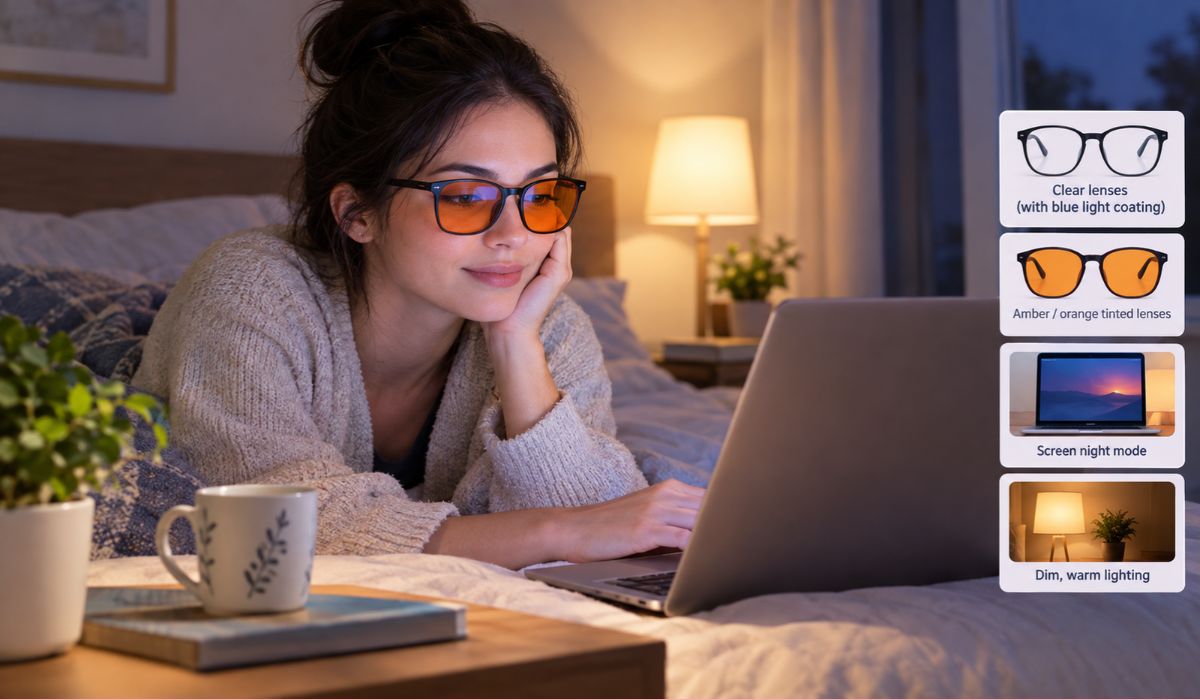
Sometimes. Blue light glasses may help you fall asleep more easily if the lenses filter a meaningful amount of light and you wear them in the evening. The clear “blue light” lenses many people wear at a desk all day are a weaker bet for sleep. So do blue light glasses help with sleep? It depends on the lens and, just as much, on when you wear it.
Key takeaways
- Evening light, especially bright and blue-rich light, can tell your brain it’s still daytime.
- “Blue-blocking” isn’t a regulated term. Filtering strength varies widely between products.
- Wearing strong filters during the day can work against you, since daytime light helps anchor your body clock.
- Dimmer lighting and a screen cutoff usually do more than glasses alone.
Why light affects sleep in the first place
Your eyes do two jobs. One is vision. The other is timekeeping, handled by a separate group of light-sensing cells containing a pigment called melanopsin. Those cells respond most strongly to light around 480 nanometers, at the blue-green end of the spectrum. They don’t help you see. They report how bright it is, and your brain uses that report to schedule alertness, sleepiness, and melatonin release.
That’s helpful at 9 a.m. It’s a nuisance at 10 p.m. Bright, blue-rich light late in the evening can delay sleepiness, so falling asleep takes longer.
Screens are one source, but not the only one. Overhead LEDs and a bright bathroom count too. Brightness and how close the light sits to your face matter as much as color.
Not all blue-blocking glasses are equal
A recent analysis in a vision science journal looked at 26 commercially available pairs and found their filtering strength varied enormously. The authors proposed a measure called melanopic daylight filtering density (mDFD), which estimates how much a lens reduces the light your melanopsin cells respond to. The scale is logarithmic, so a rating of 1 is roughly a tenfold reduction.
Only glasses rated at mDFD 1 or higher cut enough circadian-active light, in the authors’ view, to justify the “blue-blocking” label and its claims. In the intervention studies they reviewed, at least one sleep or circadian outcome improved. They also warned that the wrong filter, or the wrong timing, can make glasses ineffective or even counterproductive.
You won’t find an mDFD number on most packaging, so you’re left judging by clues. Strongly tinted amber or orange lenses generally filter far more short-wavelength light than clear lenses with a faint coating. The trade-off is color distortion, which makes them an evening tool, not something for driving or design work.
How the options compare
| Option | How much it filters | Best use | Main drawback |
|---|---|---|---|
| Clear lenses with a blue-light coating | Usually a small share, rarely stated | Comfort or glare preference at a screen | Little evidence it changes sleep |
| Amber or orange tinted glasses | Considerably more, varies by product | Evenings, a couple of hours before bed | Colors look off; not for daytime |
| Screen night modes (Night Shift, f.lux, similar) | Warms screen color | Any evening screen use | Doesn’t change room lighting or brightness |
| Dim, warm room lighting | Reduces total light reaching your eyes | The last few hours of the day | Needs a change in your setup |
When to wear them, and when to skip them
If you want to test a pair, the evening is where they belong. Put them on a couple of hours before bed and lower the room lights at the same time. Glasses can only filter what reaches them.
Daytime is different. Blue-rich light in the morning and afternoon supports alertness and helps set your body clock, so filtering it all day removes a signal you want. If your glasses mainly make screens feel easier on the eyes, that’s a comfort effect. The evidence that blue-filtering lenses reduce digital eye strain is thin, and ophthalmology groups don’t recommend them for that purpose. Regular breaks (look about 20 feet away for 20 seconds every 20 minutes) and an up-to-date prescription do more.
Daylight also earns its place here. Time outdoors or near a bright window gives your clock a strong anchor, which makes evening dimming work better.
What helps more than glasses alone
- Set a screen cutoff. Aim for one to two hours before bed. Even thirty minutes beats none.
- Turn the lights down. Use lamps and warmer bulbs in the evening, and lower screen brightness.
- Keep a steady schedule. Waking at the same time daily steadies your clock more than any accessory.
- Mind the content. A stressful email or a gripping show can keep you alert whatever the wavelength.
- Check caffeine and late meals. They’re often the real culprit when people blame screens.
If you’re pregnant
Sleep gets harder in pregnancy for plenty of reasons: hormone shifts, bathroom trips, heartburn, positions that stop being comfortable. Evening blue-blocking glasses are a passive, low-risk thing to try, since nothing is ingested. But they won’t fix physical causes. Restless legs, loud snoring, or waking up gasping are worth raising with your OB/GYN or midwife.
When to talk to your provider
Reach out if sleep has been poor for several weeks despite good habits, if daytime sleepiness affects your safety or work, or if you snore heavily or seem to stop breathing at night. Mention it too if poor sleep comes with persistent low mood or anxiety. If eye discomfort, headaches, or blurry vision continue, book a comprehensive eye exam.
FAQs
Do blue light glasses really improve sleep?
They can, if the lenses filter enough circadian-active light and you wear them in the evening. Weakly filtering lenses worn all day haven’t shown much benefit, and quality varies a lot between products.
Should I wear blue light glasses during the day?
For sleep, generally no. Daytime blue-rich light helps set your body clock and keeps you alert. Save stronger filters for the evening.
Are clear blue light lenses worth buying?
For sleep alone, probably not. If you sleep better after getting a pair, part of the credit may go to a corrected prescription and less eye strain.
Is my phone’s night mode enough?
It helps a little by warming the screen’s color. Room lighting and screen brightness still matter, and night mode doesn’t address either.
Are they safe to use in pregnancy?
Wearing them isn’t known to be risky. Ongoing sleep trouble in pregnancy is still worth mentioning to your provider.

Dr. Tania Adib is a Board Certified OB/GYN based in the northern suburbs of Chicago. She earned her undergraduate degree from the University of Notre Dame and her medical degree from Georgetown University in Washington, D.C., before completing her residency in Obstetrics and Gynecology at Magee-Womens Hospital, University of Pittsburgh Medical Center. Her clinical interests include full-spectrum obstetrics and gynecology, from the first period through the menopausal years, contraception, and abnormal bleeding.