

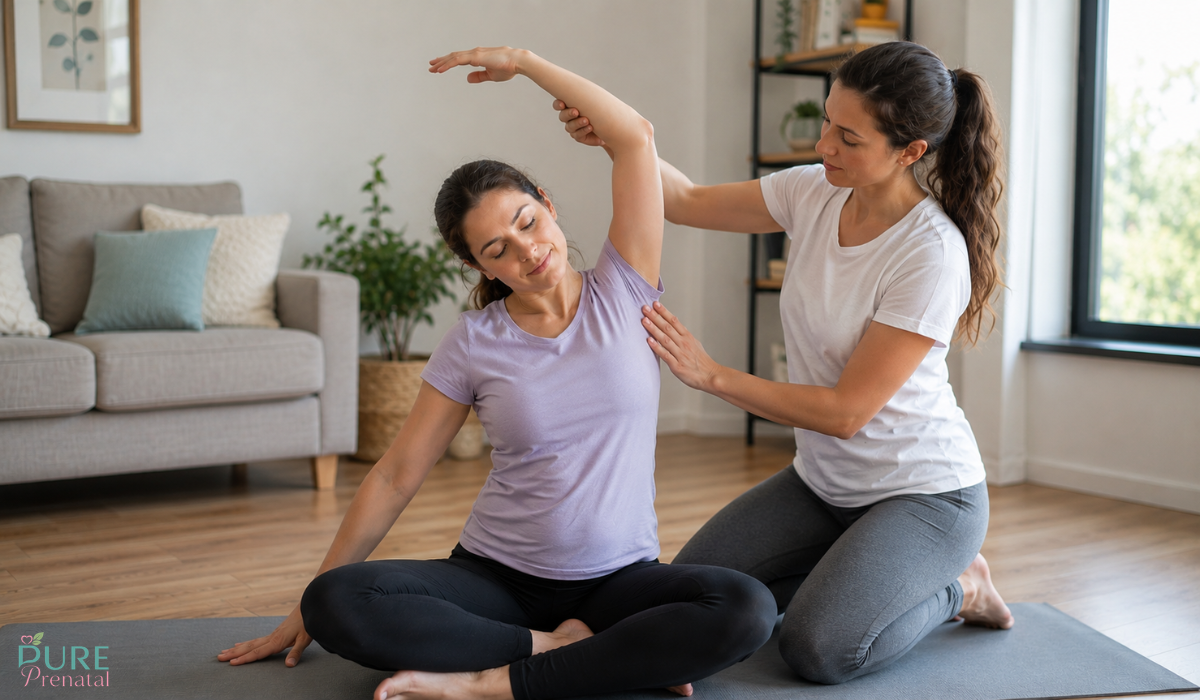
Nobody really tells you how much your body changes shape-wise until you’re a few months in and even walking to the kitchen leaves your hips aching. As pregnancy shifts your center of gravity, loosens your ligaments, and puts extra strain on your lower back, tightness can quickly become a daily reality for many expecting moms. That’s where assisted stretching comes in — and honestly, once you try it, you’ll probably wonder why you didn’t start sooner.
So what is it? Assisted stretching just means stretching with backup. A partner, a physical therapist, or even something as simple as a yoga strap helps guide your body through a stretch instead of you doing it entirely on your own. You get to actually relax into the movement, because someone (or something) else is handling balance and control.
That difference matters more than it sounds like it should during pregnancy. You’re not fighting to stay upright while also trying to release tension in your hips. You’re less likely to push a stretch too far, since there’s outside support keeping things in check. And frankly, it just feels better.
This guide walks through what assisted stretching looks like during pregnancy, which techniques tend to work best at each stage, what’s worth skipping altogether, and when it’s smarter to bring in a professional instead of figuring it out at home.
What Assisted Stretching Actually Means
Picture this: you’re lying on your back, knees bent, and your partner gently presses your leg toward your chest while you breathe through it. Or maybe a prenatal physical therapist is guiding your hip through a slow, controlled arc, checking in the whole time to see how it feels. Either way, you’re not doing all the work solo.
A few things make this especially useful right now:
- Balance isn’t what it used to be: As your belly grows, your center of gravity shifts forward. Standing stretches that felt effortless before pregnancy can suddenly feel wobbly.
- Joints are looser than normal: The hormone relaxin softens ligaments throughout the body. That’s helpful for labor eventually, but it also means overstretching can happen without you even noticing.
- Muscles are compensating differently: Your lower back, hips, and pelvic floor end up carrying extra load. That kind of tightness doesn’t always respond to stretching alone — sometimes it just needs a little outside help to actually let go.
Assisted stretching techniques address all three of these at once, which is really the whole point.
Is Stretching Even Safe During Pregnancy?
Short answer — yes, for most pregnancies. Gentle stretching is generally considered both safe and genuinely helpful, assuming there are no complications and your provider hasn’t flagged anything. It can ease lower back pain, loosen tight hips, cut down on swelling, and help you sleep a little better (which, let’s be real, most pregnant women could use more of).
That said, pregnancy stretching isn’t exactly the same as regular stretching. A few things change once you’re expecting:
| Situation | What to Do Instead |
|---|---|
| Lying flat on your back for long periods (after 1st trimester) | Prop up with pillows or a wedge, or stretch side-lying |
| Deep twists that compress the belly | Use gentle, open rotations instead |
| Pushing to the point of pain | Stop at mild tension, never past it |
| Stretching cold | Warm up for 5–10 minutes first |
| High-heat environments (hot yoga, etc.) | Stick to room temperature spaces |
Every pregnancy looks different, so it’s worth running any new stretching routine by your doctor or a certified prenatal fitness professional — especially if you’ve had preterm labor, placenta complications, or other high-risk factors in the past.
Trimester-by-Trimester: Safe Assisted Stretches Worth Trying
First Trimester: Easy, Partner-Guided Stretches
Early on, your body usually doesn’t need drastic changes, but this is a decent window to start building supportive habits before things get more physically demanding.
Seated forward fold, partner-assisted. Sit on the floor with your legs stretched out in front of you. Have your partner stand behind you and place light hands on your upper back, guiding a gentle forward lean — nothing forced, just enough to ease tension through the hamstrings and lower back.
Shoulder and neck release. Sit up tall while your partner gently tilts your head into a light side stretch, holding for a few slow breaths on each side. This one tends to help early, since posture starts shifting sooner than most people expect.
Second Trimester: Hip and Pelvic Support
This is usually when hip and pelvic discomfort ramps up, so it’s a good time to get more specific.
Butterfly stretch with light overpressure. Sit with the soles of your feet touching, knees relaxed outward. A partner kneels behind you and rests light hands on your knees — not pushing, just offering a touch of resistance while you control the depth.
Figure-four hip stretch, assisted. Lie back with knees bent (prop your torso up slightly with pillows instead of lying flat), cross one ankle over the opposite knee, and let your partner gently support the lifted leg while you breathe into it. Genuinely one of the better options for that sciatic-type ache so many women deal with mid-pregnancy.
Wall-supported calf stretch. Standing stretches get trickier once balance shifts, so lean on a wall or sturdy chair while your partner (or the wall itself) keeps you steady.
Third Trimester: Props and Professional Guidance
By the third trimester, comfort and stability matter more than depth. A lot of women find it genuinely worth working with a prenatal massage therapist or physical therapist who knows exactly how far is too far.
Birthing ball pelvic tilts. Sit on a stability ball and gently rock your hips forward and back, with a partner close by in case you need help balancing. Good for loosening the lower back and pelvic floor while your body preps for labor.
Side-lying hip opener. Lie on your side with a pillow between your knees, and have your partner gently guide your top leg into a light stretch. No belly pressure, and it stays comfortable well into the final weeks.
Assisted stretching during prenatal massage. Many licensed prenatal massage therapists build light assisted stretching right into sessions, using bolsters and side-lying positions to work through tension in the hips, shoulders, and lower back — without putting you flat on your back.
Quick Reference: Trimester and Technique
| Trimester | Best Assisted Stretches | Who Can Help |
|---|---|---|
| First | Seated forward fold, shoulder/neck release | Partner |
| Second | Butterfly stretch, figure-four hip stretch, wall-supported calf stretch | Partner or trainer |
| Third | Birthing ball pelvic tilts, side-lying hip opener | Partner, therapist, or prenatal massage professional |
Tools That Help When You Don’t Have a Stretching Partner
Not everyone has someone available every time, and that’s fine — a few props fill in nicely:
- Yoga straps hold a stretch position without you having to force the range yourself
- Birthing balls support gentle hip and pelvic movement
- Wedge pillows or bolsters keep you off your back for extended stretches
- Prenatal support belts add stability to your belly during movement
Handy for the days when a partner just isn’t around.
Things Worth Avoiding, Even With Assistance
Support helps, but it doesn’t make every stretch fair game. Watch out for:
- Deep backbends or spinal extensions, which strain an already tired lower back
- Overstretching thanks to relaxin — a partner should never push past mild tension, even if it “feels fine” in the moment
- Bouncing or jerky movements
- Long stretches of time flat on your back after the first trimester
- Overly hot environments, which can raise your core temperature more than is ideal
If a stretch ever brings on sharp pain, dizziness, numbness, or trouble breathing, stop right away and rest.
When to Check With Your Doctor First
Most stretching carries low risk, but a few situations call for a chat with your provider before starting anything new — a history of preterm labor or cervical insufficiency, placenta previa or other placental concerns, ongoing dizziness during movement, a high-risk pregnancy classification, or pain that feels sharp or unusual rather than a normal stretch sensation.
Your doctor knows your specific pregnancy better than any general guide ever could. When in doubt, just ask.
The Bottom Line
Assisted stretching isn’t about pushing your body harder. It’s about giving the stretches you’re already doing a safer, steadier environment to happen in. Whether that support comes from a partner’s steady hands, a prenatal therapist who knows what they’re doing, or something as simple as a morning yoga strap, it can genuinely ease pregnancy aches and help your body feel a little more prepared for labor.
At the end of the day, moderation and communication go a long way. Pay attention to how your body responds, keep your provider in the loop, and pick stretches that leave you feeling looser and calmer — never strained.
Frequently Asked Questions
Is assisted stretching safe throughout all three trimesters?
For most low-risk pregnancies, yes — though the specific stretches should shift a bit each trimester to account for balance changes and a growing belly.
How often should I fit in assisted stretching while pregnant?
Many women find 10 to 15 minutes, three or four times a week, works well — though it really depends on comfort level and provider recommendations.
Does my partner need training to help me stretch?
Not really. As long as they’re applying light pressure and never forcing a stretch further than it wants to go, they’re doing it right.
Can this kind of stretching help prepare my body for labor?
Some prenatal specialists think gentle hip-opening and pelvic stretches may support better mobility heading into labor, though it’s not a guaranteed way to influence how labor unfolds.
How is assisted stretching different from prenatal yoga?
Prenatal yoga usually involves some self-guided stretching within a class setting, while assisted stretching specifically means a partner or professional is actively supporting your body through each movement.
Should I see a professional instead of stretching at home?
A certified prenatal physical therapist or massage therapist can offer more targeted help, particularly for something specific like sciatica or pelvic girdle pain.

Dr. Tania Adib is a Board Certified OB/GYN based in the northern suburbs of Chicago. She earned her undergraduate degree from the University of Notre Dame and her medical degree from Georgetown University in Washington, D.C., before completing her residency in Obstetrics and Gynecology at Magee-Womens Hospital, University of Pittsburgh Medical Center. Her clinical interests include full-spectrum obstetrics and gynecology, from the first period through the menopausal years, contraception, and abnormal bleeding.