

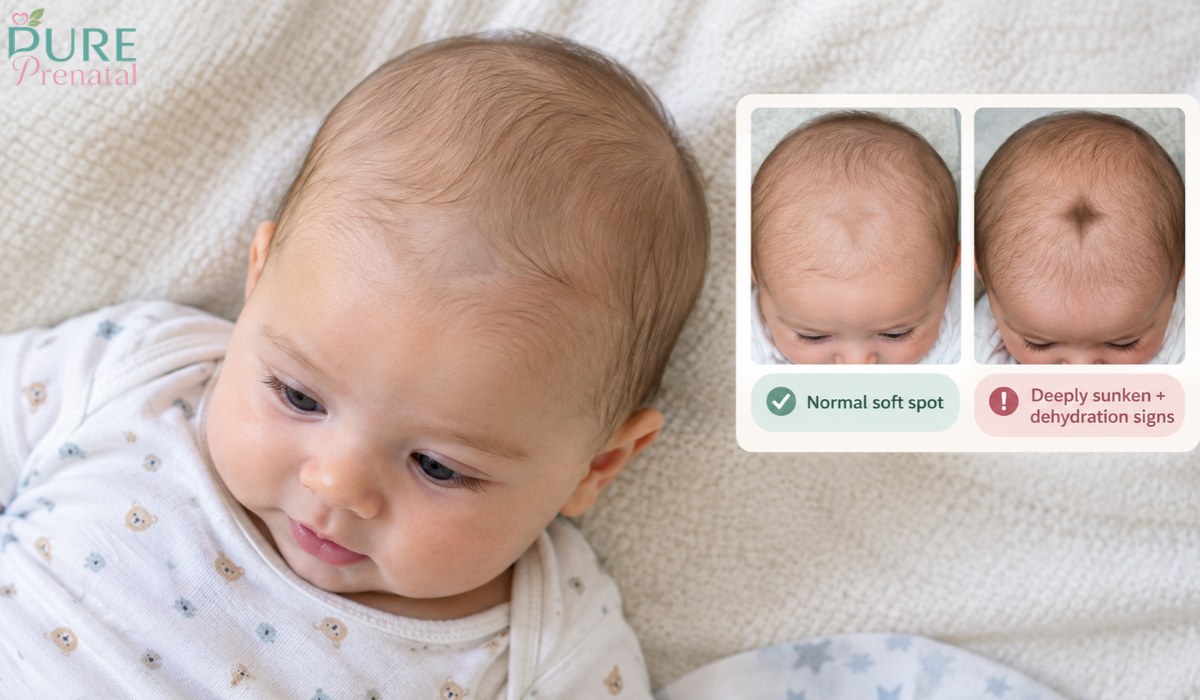
Often, yes. The soft spot on top of your baby’s head (the anterior fontanelle) is meant to sit flat or curve gently inward. A dip alone doesn’t mean your baby is dehydrated. What matters is whether the dip looks like your baby’s usual shape, and whether anything else is going on alongside it, like poor feeding, few wet diapers, or unusual sleepiness.
If the dip is new, deep, or comes with any of those signs, call your pediatrician. If it’s your baby’s normal shape and they’re feeding and peeing well, you can relax.
Why does the soft spot dip inward at all?
Your baby’s skull isn’t one solid piece yet. It’s several bony plates with gaps between them, held together by a tough membrane. The largest gap, the diamond-shaped one toward the front, is the soft spot most parents notice. That flexibility let the head compress during birth, and it leaves room for the brain to grow quickly during the first year.
A healthy fontanelle feels firm, not squishy. It usually sits level with the skull or curves slightly inward. So a soft spot that looks a little concave isn’t automatically a problem. It may just be how your baby’s head is built.
Babies vary a lot here. Some have a larger soft spot, some a smaller one, and some have very little hair, which makes every curve and pulse easy to see.
When does it look more sunken than usual?
Several ordinary things can change how the soft spot looks from one moment to the next.
- Sitting or being held upright: Gravity pulls fluid away from the top of the head, so the spot looks more dipped than when your baby lies flat.
- After a hard cry: The fontanelle can bulge while your baby cries, then look sunken once they settle. Vomiting can do the same thing.
- The first days after birth: Head molding from delivery can change the shape of the whole skull for a while.
- Your own vantage point: Checking it under a bright overhead light, or while your baby is squirming, can make it look different.
This is why the best time to check is when your baby is calm and lying on their back or held gently at an angle. Do it a few times over a few days so you know your baby’s baseline. A change from that baseline is more useful information than any single look.
How can you tell your baby is actually hydrated?
The soft spot is a weak clue on its own. These are stronger ones:
- Wet diapers: After the first several days of life, most babies have six or more a day, and the urine is pale rather than dark and concentrated.
- Feeding: Your baby is nursing or taking bottles regularly and seems satisfied afterward.
- Tears and mouth: They make tears when they cry, and their lips and mouth look moist.
- Alertness. They wake for feeds, have periods of being alert and interested, and settle when comforted.
- Skin and eyes: Their skin isn’t unusually cool or dry, and their eyes don’t look hollow.
- Growth: Weight checks at well visits are on track. Steady weight gain is one of the best reassurances a pediatrician can give you.
If all of that looks right, a soft spot that dips a little is very likely just your baby’s anatomy.
What’s normal and what isn’t?
| What you notice | Usually reassuring | Call your provider |
|---|---|---|
| Soft spot slightly curved inward, feels firm | ✓ | |
| Looks more dipped when your baby is upright | ✓ | |
| Looks sunken briefly after crying or vomiting | ✓ | |
| Visible pulsing | ✓ | |
| Noticeably sunken that stays sunken when your baby is calm and lying down | ✓ | |
| Sunken with fewer wet diapers, dry mouth, or no tears | ✓ | |
| Sunken with unusual sleepiness or fussiness | ✓ | |
| Bulging or tense while your baby is calm | ✓ (right away) |
Should you give your baby water to be safe?
No. It’s a common instinct, but a baby under 6 months who’s exclusively breastfed doesn’t need water, and extra water can fill their small stomach without giving them the calories and fluid they actually need. If it’s hot or your baby is sick, offer the breast more often. Shorter, more frequent feeds are typical in those situations, and they keep your baby hydrated.
If you’re formula feeding, offer bottles more often too, and never dilute the formula to stretch it. Ask your pediatrician if you’re unsure how much your baby should be taking.
When a sunken soft spot needs a call
Call your pediatrician the same day if the soft spot looks clearly sunken and doesn’t rebound when your baby is calm, or if it’s paired with any dehydration signs from the list above. A baby who’s sick with vomiting or diarrhea and not keeping fluids down should be seen promptly. Infants can go from mildly dehydrated to seriously dehydrated faster than older children.
Get urgent care if a sunken soft spot comes with any of these:
- Very hard to wake, or unusually limp
- Refusing to feed
- Repeated vomiting
- No wet diaper in six to eight hours
- Cool, blotchy hands and feet with sleepiness
- A seizure
And a bulging soft spot is a different situation. If it looks full or tense while your baby is calm and upright, don’t wait. That can point to pressure inside the head, and it needs to be seen right away. The same goes for a fever of 100.4°F (38°C) or higher in a baby under 3 months, whatever the soft spot looks like.
What if the dip stays but everything else seems fine?
Here’s the honest nuance. Dehydration is the most common reason for a truly sunken soft spot, but it isn’t the only one. Poor weight gain, inadequate nutrition over time, and other rare medical conditions can also cause it. That’s why a soft spot that stays deeply sunken, even when diapers and feeding look okay, is worth mentioning at a visit. A quick exam and a weight check usually settle the question.
Frequently asked questions
Is it safe to touch the soft spot?
Yes. A strong membrane protects the area, so washing your baby’s hair, stroking their head, and brushing gently are all fine. Just remind visitors and siblings to be gentle.
Is it normal to see the soft spot pulse?
Yes. You’re seeing the pulse of blood moving through your baby’s body, and it’s easiest to spot in babies with little hair. It’s not a sign of a problem.
When does the soft spot close?
The smaller one at the back of the head usually closes within the first few months. The larger one at the top typically closes somewhere between about 9 and 18 months, and can take a little longer in healthy babies. Closure that’s clearly very early, or still open well past age 2, is worth raising with your pediatrician.
Can a baby’s soft spot look sunken only at certain times of day?
It can. Position, feeding, crying, and sleep all change how it looks. That’s normal. A soft spot that’s sunken all the time, and is new for your baby, is what to flag.
Does a sunken soft spot mean my breastfed baby isn’t getting enough milk?
Not by itself. Look at diapers, feeding patterns, and weight gain. If those are on track, milk supply is likely fine. If you’re worried about supply, talk to your pediatrician or a lactation consultant.

Dr. Tania Adib is a Board Certified OB/GYN based in the northern suburbs of Chicago. She earned her undergraduate degree from the University of Notre Dame and her medical degree from Georgetown University in Washington, D.C., before completing her residency in Obstetrics and Gynecology at Magee-Womens Hospital, University of Pittsburgh Medical Center. Her clinical interests include full-spectrum obstetrics and gynecology, from the first period through the menopausal years, contraception, and abnormal bleeding.