

One day your baby is exactly where you left them. The next, they’re across the room heading for the dog’s water bowl. Nobody warns you how fast that switch happens.
If you’re hoping to nudge things along, you’re in the right place. Below you’ll find when babies usually start crawling, what “almost crawling” looks like (it’s messier than you’d think), and 10 easy baby crawling activities you can try on your living room floor today. No special equipment required.
When Do Babies Start Crawling?
Somewhere between 6 and 10 months is the typical window. Some babies get going at 5 months, and plenty don’t bother until 11 or later. A few skip it altogether and scoot on their bottoms, or go straight to pulling up and walking. That’s fine. Really.
What throws a lot of parents off is that early crawling rarely looks like the classic hands-and-knees version you picture. You’ll probably see a bunch of odd-looking moves first: pushing up on forearms, spinning in circles on the belly, scooting backward (so frustrating for them), rocking on hands and knees, army-style commando crawling, or a lopsided half crawl with one knee tucked under. Every one of those counts as progress.
So don’t worry about which style your baby lands on. What matters is that they’re building the strength, balance, and nerve to get themselves where they want to go.
Why Crawling Matters for Baby Development
Crawling is a full-body workout. Your baby’s core, shoulders, arms, and hips are all doing real work, and that strength shows up later when they’re feeding themselves, holding a crayon, or using both hands to play.
There’s more going on than muscle, though. Moving opposite arm and leg together gets both sides of the body cooperating, which feeds into hand-eye coordination. Crawlers also learn to judge distance and figure out how to get around a chair leg, and crawling across carpet, then tile, then a blanket gives them a lot of sensory information to sort through. That’s a lot of baby development packed into what looks like aimless wandering.
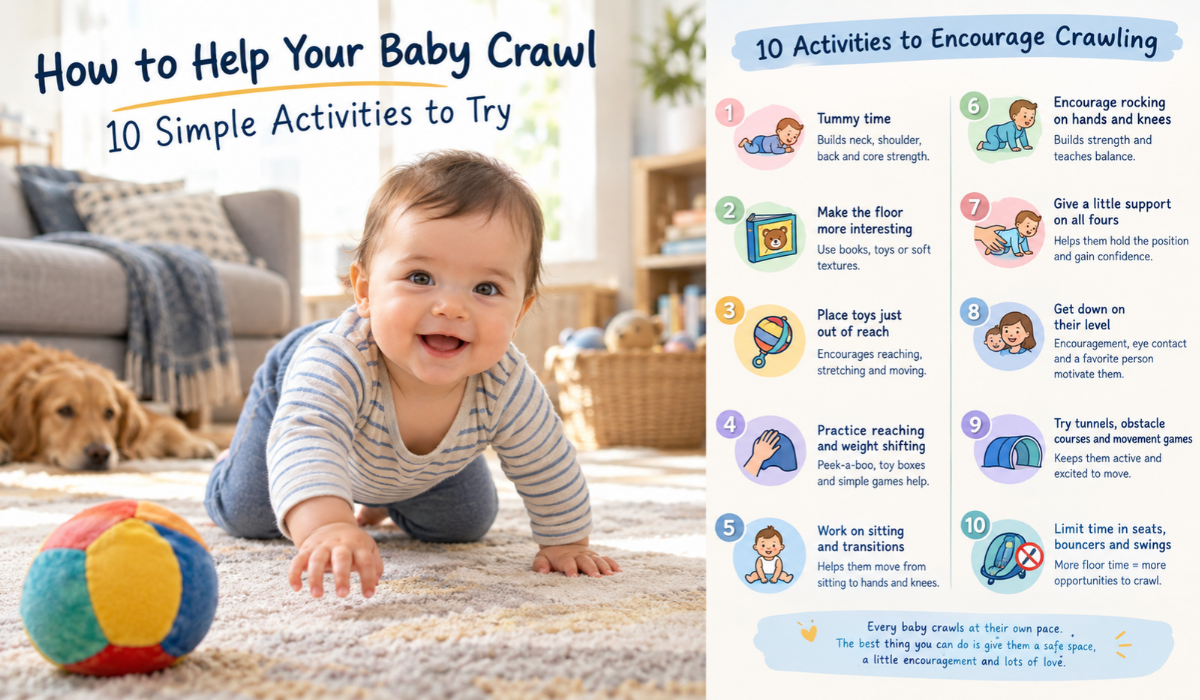
10 Simple Activities to Help Your Baby Crawl
1. Make tummy time a daily habit
If you only do one thing on this list, do this one. Tummy time builds the neck, shoulder, back, and core strength your baby needs to push up and eventually move forward.
Start small. A minute or two, a few times a day, is plenty for a newborn. Stretch it out as they get stronger. Pick a moment when your baby is calm and alert, like after a diaper change or a nap, and skip it right after a feed unless you enjoy laundry. Stay right beside them on a firm, flat surface, and never leave them on their belly alone.
Some fussing is normal, especially early on. But if they’re truly melting down, stop and try again later. You don’t want tummy time to become something they dread. For very young babies, lying on your chest at a slight tilt counts too.
2. Make the floor more interesting
Babies crawl when the floor is more exciting than your arms. Give them something worth looking at while they’re down there: a board book with big pictures, a muffin tin with a few balls sitting in the cups, or an egg carton with scraps of felt, cotton balls, and bubble wrap glued into the bottom. A blanket on the grass works well too, as long as you check for small objects first.
Keep it short and switch things up often. Babies get bored fast.
3. Place toys just out of reach
Here’s the secret to most of this: babies move when they want something. Set a favorite toy a little past their fingertips so they have to stretch and shift their weight to get it.
The catch is not to overdo it. Too far and they’ll just give up and yell at you, which is fair. Start close so they win quickly. Then try moving the toy to one side, then the other, so they practice turning and shifting from arm to arm. When they finally grab it, let them keep it. That’s the reward.
4. Practice reaching and weight shifting
Reaching with one hand while the other arm holds them up is a big crawling skill. Peek-a-boo does a surprising amount of work here. Drape a blanket over your face during tummy time and let them yank it off. You can also tip a toy box on its side, build a block tower for them to knock down (they will never tire of this), or stick a small cloth on a mirror for them to peel off.
5. Work on sitting and transitions
The move from sitting to hands and knees is a milestone people often overlook. Sit your baby on the floor, without a support seat, and put toys just out of reach on either side. They’ll twist, lean, and reach, and eventually some will tip themselves forward onto all fours.
Rolling a ball toward them so they lean in to grab it helps too, as does a gentle tug of war with a soft towel. Songs with hand motions are a good way to keep a wiggly baby sitting a bit longer.
6. Encourage rocking on hands and knees
When your baby pushes up onto hands and knees and starts rocking, get excited. That’s one of the clearest signs crawling is close. Rocking builds shoulder and hip strength and teaches them how to shift weight between arms and legs.
You can steady their hips so they don’t slide into a split. Keep sessions short, maybe 10 to 20 seconds, and make it silly by singing or counting the rocks. Often that rocking turns into a first little lurch forward.
7. Give a little support on all fours
Some babies clearly want to crawl but can’t hold themselves up long enough to figure it out. If that’s yours, slide a hand under their belly or hips to take some of the weight, keep their hands and knees planted, and encourage one small reach forward. Then reset and go again.
Even a few seconds on all fours builds confidence. As they get stronger, ease off your support bit by bit.
8. Get down on their level
Your baby learns a lot by watching you. Lie on the floor face to face, say what they’re doing out loud (“Look at you pushing up!”), and make a fuss over small wins. Then scoot a little way off, pause, and open your arms.
Honestly, one of the best motivators is just wanting to get to a favorite person. If you have older kids, they can help, but give them one simple job, like sitting nearby with a toy or slowly rolling a soft ball. Ask them to keep it calm. A cheering toddler two inches from baby’s face is more likely to cause tears than crawling.
9. Try tunnels, obstacle courses, and movement games
Once your baby is mobile, keep them motivated with games:
- Tunnels: a soft play tunnel or a cardboard box open at both ends. Put a toy or your face at the far end and keep the distance short at first.
- Pillow course: cushions, folded blankets, and towels to climb over and around.
- Zig-zag toy trail: line up colorful toys along a winding path.
- Hide-and-seek: tuck soft or musical toys under blankets, or duck behind the couch. Bonus: it teaches object permanence.
- Crawl tag: crawl away, look back, and let them chase you.
- Bubbles: they love chasing and popping them.
A soft, non-slip play surface makes all of this easier on little hands and knees, whether that’s a play mat or a dedicated crawling track.
10. Limit time in seats, bouncers, and swings
Nobody’s judging you for using baby gear. Sometimes you need to cook dinner. But swings, bouncers, and activity seats keep babies in one position, and their core, shoulders, and hips barely have to work.
The more time on the floor, the more chances to roll, push up, rock, and practice everything that leads to crawling. Try to make the floor the main event, with gear as backup.
Keep Things Safe Once They’re Moving
Get down and look at each room from your baby’s level. You’ll spot things you never noticed. Clear away small objects and loose cords, put gates at the stairs, cover outlets, and anchor furniture that could tip. Stay close during any water play, and never leave a baby alone near water.
When to Talk to Your Pediatrician
A late crawler is usually just a late crawler. Still, bring it up with your pediatrician or a pediatric physical therapist if your baby:
- Shows little interest in moving or exploring
- Has trouble bearing weight on their hands or knees
- Uses one side of the body very differently from the other
- Seems to drag one side when they move
- Isn’t making progress with motor skills over time
Asking is never overreacting. If something is going on, earlier help tends to make things easier.
Relax and Enjoy It
You don’t need a training schedule. Most babies want to move, and your job is mostly to give them safe floor time, a few tempting toys, and plenty of cheering. Crawling will show up when it’s ready.

Dr. Tania Adib is a Board Certified OB/GYN based in the northern suburbs of Chicago. She earned her undergraduate degree from the University of Notre Dame and her medical degree from Georgetown University in Washington, D.C., before completing her residency in Obstetrics and Gynecology at Magee-Womens Hospital, University of Pittsburgh Medical Center. Her clinical interests include full-spectrum obstetrics and gynecology, from the first period through the menopausal years, contraception, and abnormal bleeding.