
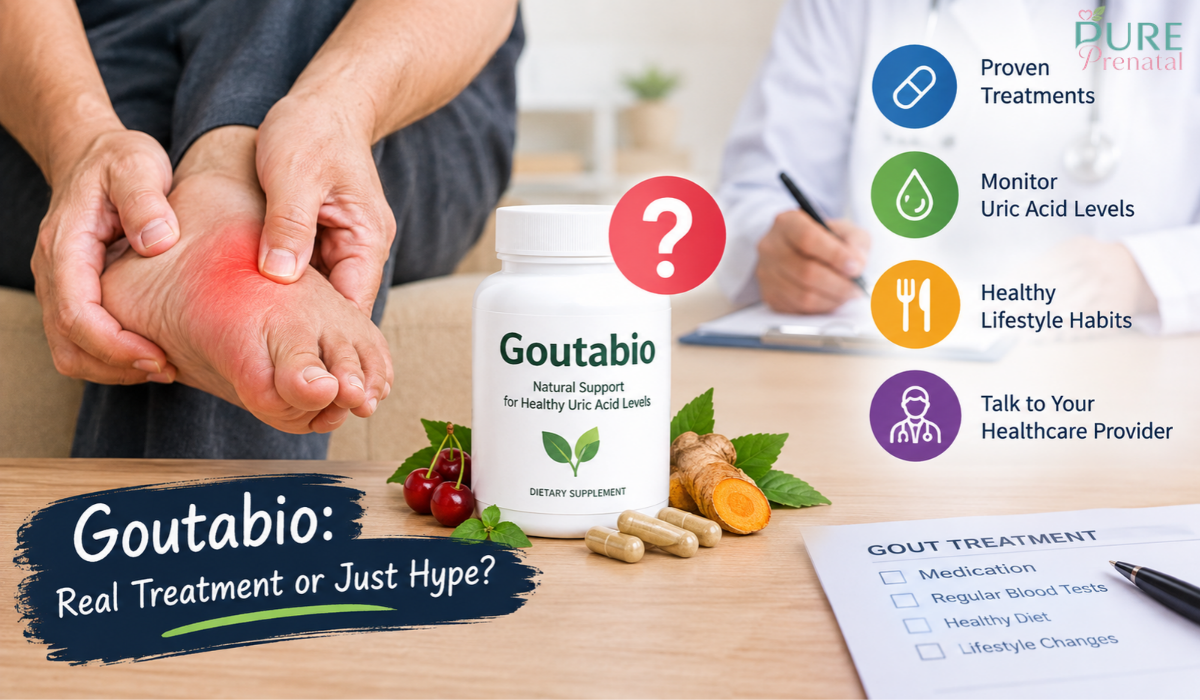
Nobody can confirm a real, verified “Goutabio” gout supplement. The name traces back to a French organic-products shop that was closed through liquidation. The gout claims on newer websites don’t lead to a manufacturer, a product label, or a single clinical trial.
Key Takeaways
- GOUTABIO was a French company selling organic food, cosmetics, and household goods.
- French records (BODACC) show its liquidation closed on February 13, 2025, because there weren’t enough assets left.
- Sites pushing Goutabio as a gout remedy don’t link to any official product record or study.
- If you have gout, the treatments with real evidence are medicines like allopurinol, plus blood tests to track your uric acid.
Why is the name so confusing?
You search “goutabio” and get two stories that don’t fit together. Here’s why.
The older story is the documented one. A French company called GOUTABIO ran an online organic shop with thousands of products: essential oils, skin care, cleaning supplies, wellness items. Its site never calls itself a gout-medicine maker.
The newer story is the one that shows up in supplement reviews. Those pages describe Goutabio as a natural way to bring down uric acid and calm joint inflammation. They list ingredients, suggest doses, and promise benefits. What they don’t do is say who makes it.
Same word, possibly no connection. A closed retailer and a supplement sold under a matching name could be entirely separate operations, and right now there’s no way to tell.
A quick look at what gout is
Gout is a type of arthritis caused by uric acid crystals. Your body makes uric acid when it breaks down purines, which come from your own cells and from certain foods. Your kidneys clear most of it. When levels stay high, sharp crystals can form in a joint, your immune system reacts, and you get sudden swelling, heat, redness, and pain that can be severe. The big toe is the usual spot, but it isn’t the only one.
Here’s a wrinkle that surprises people. A high uric acid result doesn’t prove you have gout, and a normal one doesn’t rule it out. The Arthritis Foundation points out that some people with high levels never get gout, while others have a normal reading in the middle of an attack. It takes a clinician putting the whole picture together.
And a hot, swollen, painful joint can also be an infection. That needs urgent care, so it’s not something to treat at home with a supplement while you wait and see.
What proven treatment looks like
Gout care splits into two jobs.
Flares get treated for pain and inflammation, usually with NSAIDs, colchicine, or corticosteroids, depending on your health and what else you take.
Prevention is a different game. Allopurinol and febuxostat lower uric acid over the long haul. The UK’s NICE guidelines describe a “treat-to-target” plan: start with a low dose, check your blood, adjust, and aim for uric acid under 6 mg/dL for most people on long-term treatment. US rheumatology guidance lands in much the same place, with allopurinol as the common first pick.
Compare that with “supports healthy uric acid levels.” One has a drug, a dose, a goal, and follow-up. The other is a phrase.
What the ingredient lists claim
Review sites say Goutabio contains tart cherry, bromelain, quercetin, celery seed, turmeric, and piperine. Some say it lowers uric acid or cuts attacks. A few present it as a substitute for prescription medication.
We couldn’t match any of that to a real label. So treat those lists as unconfirmed. Supplement formulas change, and unrelated sellers borrow names.
Even if the ingredients were confirmed, there’d still be a gap. A plant compound that shows an effect in a study tells you about that compound, in that study. It doesn’t tell you whether a capsule from a particular company has the same dose, absorbs the same way, or actually helps gout.
What holds up and what doesn’t
| Claim | What we found |
|---|---|
| Goutabio was a French organic-products company | Backed by French commercial records |
| Its liquidation closed in February 2025 | BODACC notice dated February 13, 2025 |
| Goutabio is clinically proven for gout | No product-specific trial found |
| It lowers uric acid | Unverified for any specific product |
| It has one fixed formula | No official label found |
| It can replace allopurinol | No evidence |
| It’s FDA-approved | Not supported; the FDA doesn’t pre-approve supplements |
| It’s safe for everyone | Can’t be judged without knowing the real product |
Can it replace allopurinol?
No evidence says it can. This is the claim that worries me most, so I’ll be blunt.
Allopurinol works because you keep taking it. It cuts how much uric acid your body produces, and the benefit builds over time. The NHS warns against stopping it suddenly without medical advice. If your levels creep back up, crystals can re-form, and flares and joint damage become more likely.
If your medication is bothering you, or you feel like the dose isn’t working, say so at your next appointment. There are usually other options. Quietly swapping it for a product you can’t verify isn’t one of them.
Is it safe?
That depends on what’s really in the bottle, and for Goutabio nobody can say. It’s not a claim that the product is harmful. It’s an admission that there’s nothing solid to evaluate.
Some background helps. The FDA doesn’t approve dietary supplements for safety or effectiveness before they’re sold. Manufacturers are responsible for following the safety and labeling rules. The FDA suggests reading the Supplement Facts panel closely and talking to a healthcare professional first.
Gout adds another layer. Plenty of people with gout also have kidney disease, high blood pressure, diabetes, or heart disease, and they may take several medications. The NHS says there isn’t enough information to call herbal remedies and supplements safe alongside allopurinol.
Before you buy any gout supplement
Turn the bottle around and look for these:
- A complete ingredient list with amounts
- Serving size and directions
- A manufacturer or distributor you can look up
- Lot number and expiry date
- Warnings
- Real contact information
- Research on the exact product, not just its ingredients
If the seller can’t name the manufacturer, or the label leaves things out, that’s your cue to walk away.
Dosing tips copied from a review site are worth ignoring for the same reason. They may not match the product in your hand.
What about reviews and testimonials?
Reviews are fine for shipping speed, taste, or customer service. They can’t tell you whether a product lowers uric acid.
Someone may feel better after a few weeks for plenty of reasons. The flare ran its course. They cut back on beer. They started a prescription. A testimonial can’t sort those out, but a controlled study that tracks blood uric acid and flare counts can.
Habits that do help
Lifestyle changes support treatment, though for many people they won’t replace it. The Arthritis Foundation suggests a Mediterranean or DASH-style way of eating and points to a few specific moves: less alcohol (beer especially), fewer sugary drinks, and less red meat, organ meat, and some seafood. Drinking plenty of water, keeping your weight in a healthy range, and staying active when your joints allow it also help.
Your own risk depends on genetics, kidney function, and medications, so the right advice looks different from person to person. For people with frequent attacks, diet on its own often isn’t enough.
When to call your provider
Check with a doctor or pharmacist before trying any unverified gout supplement if you take prescription drugs, have kidney disease, are pregnant or breastfeeding, have heart disease, get frequent or severe attacks, or have reacted badly to a supplement before.
Get urgent care if a joint turns suddenly hot, swollen, and painful, especially with a fever. Infection is the concern.
Stop the supplement and get help right away for a severe allergic reaction, trouble breathing, chest pain, unusual bleeding, or vomiting or diarrhea that won’t quit. You can report serious reactions to the FDA.
A specialist referral makes sense if your diagnosis is unclear, you have advanced kidney disease, you have tophi (visible urate lumps), or you’ve had an organ transplant.
Questions worth bringing to the visit:
- What’s my current uric acid level?
- Do I need long-term urate-lowering treatment?
- Could this supplement interact with my medications?
- Could something other than gout be causing this?
Goutabio: FAQs
Was Goutabio a real company?
Yes. A French company named GOUTABIO sold organic products, and its liquidation closed in February 2025.
Is Goutabio FDA-approved?
No approval could be confirmed. The FDA doesn’t approve supplements before they’re marketed, so a page claiming otherwise is a red flag.
Does it lower uric acid?
No product-specific evidence shows that. Some ingredients have been studied on their own, which doesn’t prove a finished product works.
Is there a clinical trial on it?
None turned up. If a page says “clinically proven,” look for a link to a study of the actual product.
Can I take it with allopurinol?
Without knowing the true ingredients, no one can say. Tell your doctor or pharmacist about everything you take, supplements included.
What should I do during a flare?
Call your provider, especially if it’s your first attack or the joint is very hot and swollen. They can rule out infection and pick a treatment that fits you.
Bottom Line
Goutabio isn’t a verified gout treatment. The name belongs to a documented French retailer that closed in 2025, and the supplement claims using it don’t trace back to any manufacturer, label, or trial. If you have gout, what works is a proper diagnosis, treatment for flares, and long-term uric acid lowering that’s checked with blood tests. Healthy habits help alongside that. And if a supplement still tempts you, read the label, find the maker, and ask your pharmacist or doctor before you buy.

Dr. Tania Adib is a Board Certified OB/GYN based in the northern suburbs of Chicago. She earned her undergraduate degree from the University of Notre Dame and her medical degree from Georgetown University in Washington, D.C., before completing her residency in Obstetrics and Gynecology at Magee-Womens Hospital, University of Pittsburgh Medical Center. Her clinical interests include full-spectrum obstetrics and gynecology, from the first period through the menopausal years, contraception, and abnormal bleeding.