

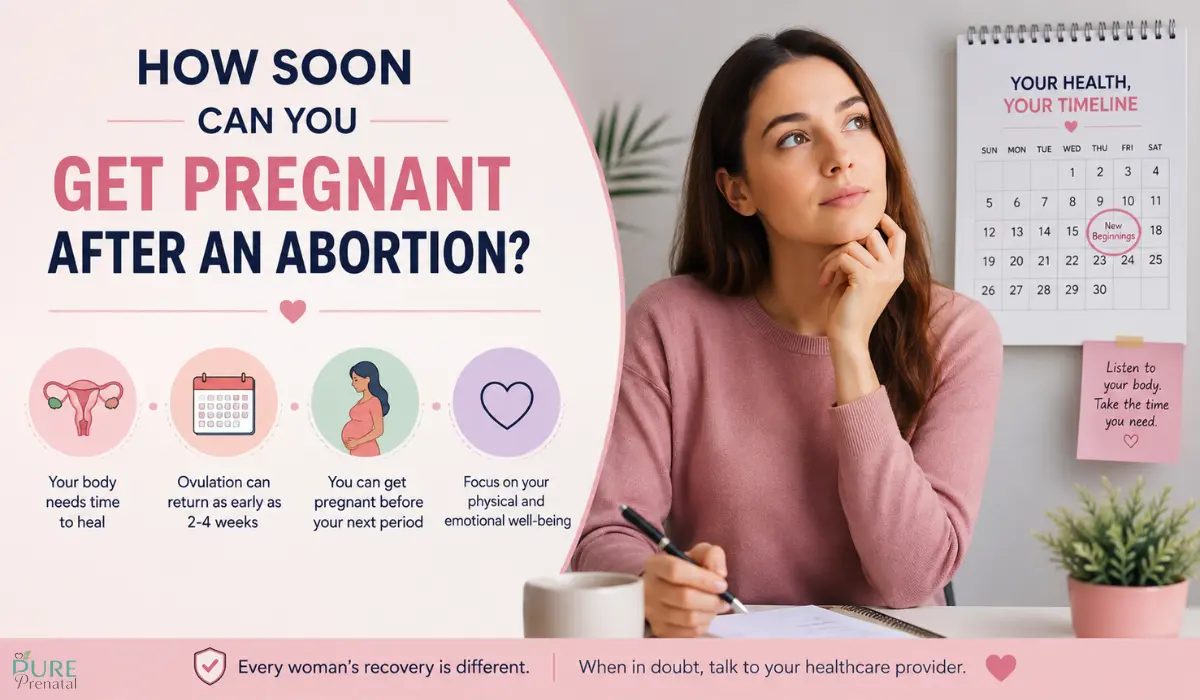
There’s a question that tends to surface pretty quickly after an abortion, once the immediate physical side of things has settled: how soon could you actually get pregnant again? A lot of people assume there’s some kind of built-in pause, weeks where it simply isn’t possible. That assumption is wrong more often than not, and it’s worth knowing that early on, because it changes what you do next.
The short version is this. Ovulation, the moment your body releases an egg again, can return within about eight days to three weeks of an abortion. That’s true for both medical and surgical procedures. And because ovulation happens before a period, not after, pregnancy can be possible well before your cycle gives you any visible sign it’s back.
Why fertility comes back so quickly
An abortion ends a pregnancy. It doesn’t switch off your reproductive system or put it into standby. Your ovaries and hormones are already wired to start up again once a pregnancy is over, the same way they do after a birth or a miscarriage.
The main thing your body needs to do first is clear hCG, the pregnancy hormone, out of your system. Once that’s gone, the usual signalling between your brain and ovaries picks back up, an egg starts developing, and eventually gets released. That release is ovulation, and it’s the point where pregnancy becomes possible again.
For most people that lands somewhere between two and three weeks after the procedure. Shorter natural cycles can mean it happens sooner, sometimes in as little as eight to ten days. A period usually follows four to six weeks out, though that number moves around a lot from person to person.
The gap between those two milestones is really the whole point here. Ovulation tends to arrive first, often by a couple of weeks, so your fertility is genuinely back before there’s any bleeding to tell you.
Does the type of abortion change anything?
Not by much. Whether it was medical (the abortion pill) or surgical, fertility tends to come back on roughly the same timeline either way. What actually shifts things more is how far along the pregnancy was when it ended.
Earlier abortions usually mean hormone levels fall away faster, so ovulation tends to return sooner. Later ones can mean pregnancy hormones linger a bit longer in your system, which can push ovulation and your next period back by a few extra weeks.
Either way, a single uncomplicated abortion isn’t generally thought to have any lasting effect on fertility. If you’re wondering whether this will make it harder to get pregnant down the line, the current evidence doesn’t support that concern for a straightforward procedure.
Can you get pregnant before your period even comes back?
Yes, and this is where a lot of confusion sets in. There’s a common assumption that no period means no risk. It’s actually the other way round. Ovulation happens roughly two weeks ahead of a period, so unprotected sex just a week or so after an abortion can genuinely lead to pregnancy, long before any bleeding pattern would tip you off.
It’s the main reason providers tend to recommend starting contraception right away instead of waiting to “see what your cycle does.” Waiting for a period as your cue means waiting too long.
What about sex? How long should you actually wait?
This is a separate question from fertility, worth pulling apart on its own. Most clinics suggest waiting until bleeding has settled and you feel physically ready, often somewhere around one to two weeks, though it depends on the type of abortion and whether there were any complications. The reasoning here isn’t really about fertility, it’s about infection risk, since the cervix can stay slightly open while the uterus heals.
Here’s the part that trips people up though: those two timelines don’t line up. You can still be in the healing window while your fertility has already returned underneath it. So once sex does happen again, contraception matters from the very first time, not from whenever it starts to feel like a “safe” point.
Starting contraception without waiting
There is at least one piece of straightforwardly good news here. You don’t need to wait to start contraception. Most methods can begin the same day as the abortion, and guidance from bodies like the NHS and the American College of Obstetricians and Gynecologists (ACOG) is consistent on that point. There’s no reason to hold off.
| Contraceptive method | When it can typically start | Notes |
|---|---|---|
| Copper IUD | Immediately | Effective straight away, no hormonal lag |
| Hormonal IUD | Immediately | May need backup contraception for 7 days |
| Contraceptive implant | Immediately | Backup contraception advised for 7 days |
| Combined pill, patch, or ring | Immediately | Backup contraception advised for 7 days |
| Progestogen-only pill | Immediately | Usually effective within 48 hours |
| Contraceptive injection | Immediately | Backup contraception advised for 7 days |
| Condoms | Immediately | No delay, though effectiveness relies on correct use |
Your midwife, GP, or the clinic that carried out the abortion can talk through which option makes sense, especially if there’s ongoing bleeding or anything in your history worth factoring in.
If you’re actually hoping to get pregnant again
Not everyone reading this is trying to avoid pregnancy. Some people want one again, sometimes soon, and that’s just as valid a place to be after an abortion. Biologically, conceiving again quickly is entirely possible. Even so, a lot of providers still suggest waiting for one full, normal cycle before trying on purpose.
That’s less about fertility and more about a few practical things. It gives your body real time to recover, particularly after a surgical procedure. It also makes a future pregnancy easier to date accurately, since irregular bleeding in the early weeks can throw off ultrasound estimates. And honestly, it gives you a bit of room to check in with how you’re feeling emotionally, which matters just as much as the physical side.
None of that is a hard rule, though. Plenty of healthy pregnancies start sooner than one cycle later. If that happens and you want to continue, get in touch with a midwife or GP as early as you can so your care gets set up properly from the start.
Signs your cycle is back, even before a period shows up
Since a missed period isn’t always the earliest clue, it helps to know what else to watch for. Cervical mucus tends to change around ovulation, becoming clearer and more stretchy. Some people notice a mild, one-sided twinge low in the pelvis around the same time. Familiar premenstrual symptoms, tender breasts, mood shifts, can also show up again before the period itself does.
If pregnancy-type symptoms turn up in the weeks after your abortion, tenderness, nausea, unusual fatigue, a home test can help clear things up. One thing worth knowing though: hCG from the abortion can occasionally still be detectable for a short while afterward, so an early result isn’t always as clean as you’d want it to be.
When it’s worth calling your doctor or midwife
Most people recover without any issues, but a few things are worth flagging rather than waiting out on your own:
- No period at all within 6 to 8 weeks of the abortion
- Bleeding that’s heavy or getting worse instead of gradually settling
- Severe pelvic pain or a fever
- A positive pregnancy test you weren’t expecting, so it can be confirmed and properly dated
- Signs of infection, like unusual discharge or generally feeling unwell
A late period on its own doesn’t automatically mean a new pregnancy. Sometimes your body is just still finding its footing again. Either way, getting it checked beats sitting with the uncertainty.
FAQs
Can I get pregnant the same week as my abortion, or even a week after?
Conceiving in the first couple of days is unlikely, but ovulation can start as early as 8 to 10 days later for some people. So yes, pregnancy a week or two after an abortion is genuinely possible, well before a period would normally return.
Can you get pregnant straight after an abortion, right after the procedure itself?
Pregnancy in the first day or two is very unlikely, but the fertile window opens faster than most people expect, so unprotected sex from around the end of that first week onward does carry real risk.
Are you more fertile after an abortion than usual?
Not more fertile, just back to your normal baseline. It can feel sudden after weeks of pregnancy, but it’s a return to your usual pattern rather than any kind of boost above it.
How do I know if I’m pregnant again, rather than just still clearing hormones from the last pregnancy?
Because hCG can linger for a while, a doctor may suggest a blood test instead of relying on a home test alone if you think you could be pregnant again soon after the abortion.
Do I have to wait for a period before trying to conceive again?
Not medically, no. Many providers still recommend waiting one cycle, mainly to help with accurate dating later on and to give your body a bit more time to recover.
How long after an abortion can you have sex?
Usually around one to two weeks, or once bleeding has settled. That’s mostly about reducing infection risk while the uterus heals, and it’s a separate timeline from fertility, which tends to come back sooner.
Is it normal to go weeks without a period afterward?
Yes, up to a point. Periods often return somewhere between 4 and 8 weeks. If it’s been longer than that with nothing happening, it’s worth checking in with your GP or midwife.
In summary
Fertility tends to come back fast after an abortion, usually before a period does, which is exactly why unprotected sex in the following weeks can lead to pregnancy with no real warning sign. Whether the goal is avoiding pregnancy for now or trying again soon, the next useful step is the same either way: a conversation with your midwife, GP, or the clinic that treated you, so the guidance you get actually fits your situation instead of a generic timeline.

Dr. Tania Adib is a Board Certified OB/GYN based in the northern suburbs of Chicago. She earned her undergraduate degree from the University of Notre Dame and her medical degree from Georgetown University in Washington, D.C., before completing her residency in Obstetrics and Gynecology at Magee-Womens Hospital, University of Pittsburgh Medical Center. Her clinical interests include full-spectrum obstetrics and gynecology, from the first period through the menopausal years, contraception, and abnormal bleeding.