

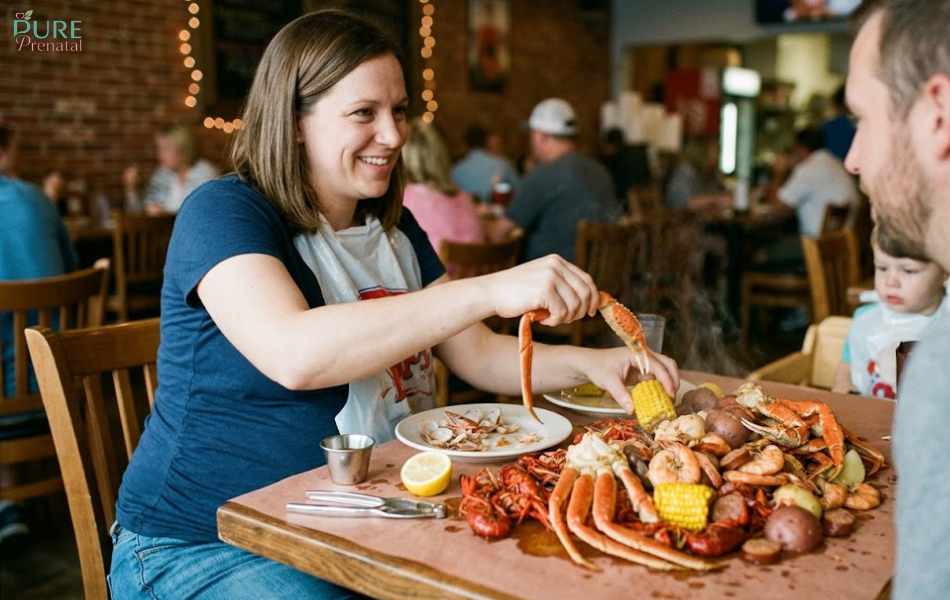
Seafood boils have a way of turning dinner into an occasion. The pot goes on the stove, the whole kitchen starts smelling like Old Bay or Cajun spice, and at some point it all gets dumped out over newspaper in the middle of the table, shrimp, crab, crawfish, corn, potatoes, everything mixed together and eaten with your hands. If you’re pregnant and one of these has been on your mind, the short answer is you’re probably fine to have it. The longer answer has more to do with how it was cooked than with the seafood boil itself.
The Seafood Isn’t Really the Problem, the Cooking Is
Shellfish tends to come up a lot in pregnancy food conversations, and most of that caution boils down to one thing: was it cooked properly. Shrimp, crab, crawfish, mussels, clams, all of it is considered fine to eat during pregnancy once it’s been thoroughly cooked. What you want to avoid is raw shellfish, oysters on the half shell, ceviche, anything like that, because raw seafood is more likely to carry bacteria or viruses that can lead to food poisoning.
So the seafood itself usually isn’t what you need to worry about. It’s more about how boils tend to get made, particularly outside your own kitchen. When you’re cooking a huge batch at once, it’s easy for a few pieces buried in the middle of the pot to come out less done than everything else. A shell that never pops open during cooking is one to leave alone rather than force. And at a busy restaurant, or a backyard party where food’s been sitting under the sun for a couple of hours, things can slip in ways that have nothing to do with the shellfish itself.
None of that means skip the invite. It just means paying a bit more attention than you normally would.
What Actually Makes It Safer
A few checks make a real difference here, and they’re not complicated. Shrimp and crawfish should look opaque and pinkish once cooked, not that grey, translucent look they have raw. Crab needs to hit an internal temperature of at least 63°C, and the flesh should feel firm, not glassy or soft. Mussels and clams are honestly the easiest to judge, since they open up on their own when they’re done. If one stays shut, that’s your answer, it goes in the bin.
Temperature after cooking matters too, maybe more than people realize. Seafood that’s been sitting out, whether that’s a buffet table or a boil that’s been going for a while at an outdoor gathering, can pick up bacteria even if it was cooked correctly to start with. If you’re out somewhere and unsure, just ask whether the boil was made fresh or reheated from earlier. Nobody’s going to think it’s a strange question. And if you’re the one cooking, giving each type of shellfish its full time and checking a piece from a couple of different spots in the pot is really all it takes to feel confident.
So How Much Can You Actually Eat
Here’s some genuinely good news on this one. Shrimp, crab, crawfish, mussels and clams are all naturally low in mercury, so they’re not in the same category as tuna, which has limits, or shark and swordfish, which get avoided altogether. A boil built around these ingredients doesn’t need to be rationed the way some seafood does.
That said, a boil is usually rich. Butter, sausage, a fair amount of salt. Treating it as something you have now and then rather than a weekly thing makes sense, but that’s more of a general nutrition point than anything specific to pregnancy.
There’s Actually Some Nutrition in There
It’s easy to write a seafood boil off as just an indulgent meal, but there’s more going on nutritionally than people give it credit for. Shrimp, crab and crawfish bring decent protein, plus zinc, iron and vitamin B12, all things your baby’s growth depends on. Mussels specifically carry a bit of omega-3, which factors into brain development. Even the corn and potatoes are doing something, adding fibre, potassium, a bit of vitamin C.
What’s Genuinely Worth Avoiding
The list here is short. Raw or undercooked shellfish is the main one, and that includes any raw oysters served on the side rather than in the pot itself. Leftovers that sat out at room temperature for more than a couple of hours are better left in the fridge, or the bin, rather than reheated. If you’re eating seafood caught locally, it’s worth a quick check on whether there are any water quality advisories for that area, since those can affect mercury or other contaminants. And if heartburn or blood pressure is already something you’re managing, a very spicy or heavily salted boil might not sit as well, though that’s a comfort issue more than a safety one.
| Ingredient | Pregnancy consideration | Safer preparation | Key note |
|---|---|---|---|
| Shrimp | Low mercury, safe if cooked | Opaque and pink throughout | Avoid if translucent or grey |
| Crab | Low mercury, safe if cooked | Internal temp of at least 63°C | Discard if flesh looks glassy |
| Crawfish | Low mercury, safe if cooked | Fully opaque, no undercooked centre | Common in bulk boils, check thoroughly |
| Mussels/clams | Safe if cooked and shells open | Discard any that stay closed | Higher food poisoning risk if raw |
| Sausage (if included) | Safe if fully cooked | No pink in the centre | Treat like any processed meat |
If You’re Ever Unsure
A few small habits take most of the guesswork out. Asking for your portion straight from the pot rather than a batch that’s been sitting is a completely fair thing to ask a server. Sticking with shrimp and crab over raw bar extras keeps things simple. And honestly, if a piece just looks wrong to you, undercooked, off colour, whatever it is, there’s no harm in leaving it on the plate. Making the boil yourself is the way to have the most control, since you’re the one timing it.
When It’s Worth Calling Someone
If you eat a seafood boil and end up with a fever, vomiting, diarrhoea or stomach cramps afterward, call your midwife or GP. Food poisoning gets taken more seriously in pregnancy than it would otherwise, so don’t talk yourself out of getting checked. If you have a condition that affects your immune system, or you’re regularly eating locally caught seafood and aren’t sure about advisories in your area, that’s also worth a conversation with a professional rather than guessing your way through it.
FAQ
Can pregnant women eat seafood boil?
Yes, generally speaking. A boil made with properly cooked shrimp, crab, crawfish, mussels and clams is considered safe in pregnancy, as long as nothing on the plate is raw or undercooked.
Is crawfish safe to eat while pregnant?
It is, once it’s fully cooked. Same as any shellfish, really, it’s not the crawfish that’s the issue, it’s whether it was prepared properly.f
Can I eat the sausage that often ends up in a seafood boil?
Yes, as long as it’s cooked all the way through with no pink left in the middle.
What if a mussel or clam in my boil didn’t open?
Leave it out. A shell that stays shut after cooking shouldn’t be pried open and eaten.
Are seafood boil leftovers safe the next day?
They can be, provided they went in the fridge fairly quickly and get reheated until steaming hot all the way through. Anything left out at room temperature for more than a couple of hours is safer skipped.

Dr. Tania Adib is a Board Certified OB/GYN based in the northern suburbs of Chicago. She earned her undergraduate degree from the University of Notre Dame and her medical degree from Georgetown University in Washington, D.C., before completing her residency in Obstetrics and Gynecology at Magee-Womens Hospital, University of Pittsburgh Medical Center. Her clinical interests include full-spectrum obstetrics and gynecology, from the first period through the menopausal years, contraception, and abnormal bleeding.