

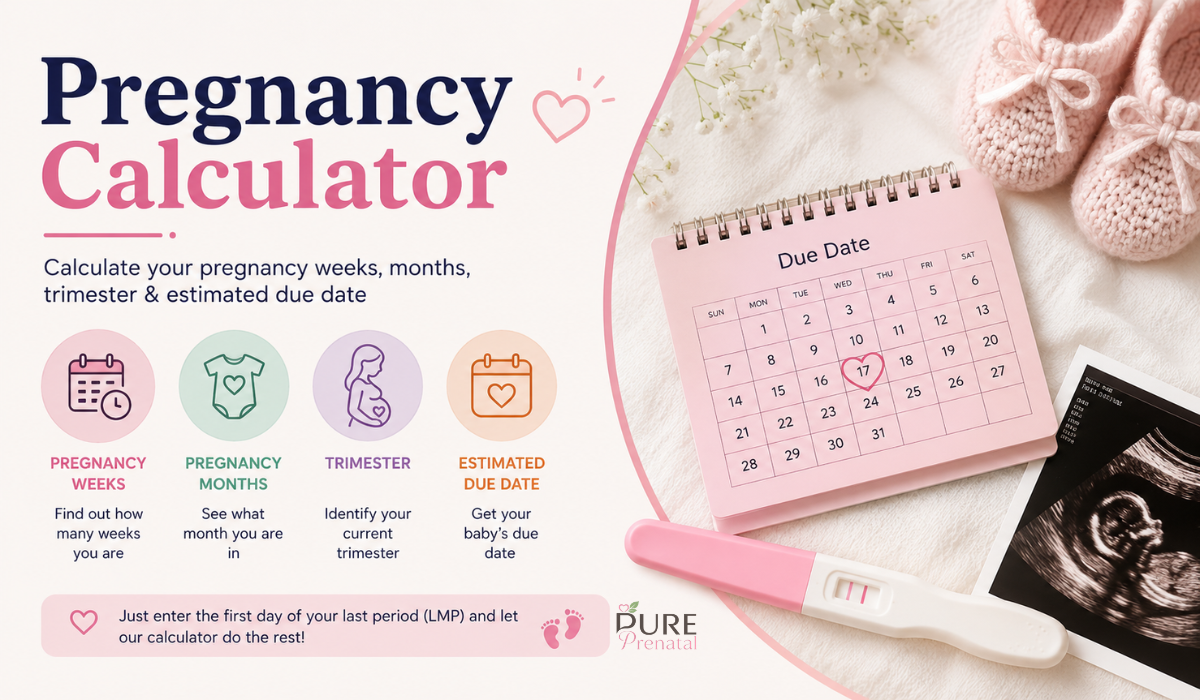
If you’ve just found out you’re pregnant, chances are one of your first Google searches was some version of “pregnancy calculator.” It seems like it should be a straightforward tool type in a date, get an answer back. But then you look at the result and it says you’re “6 weeks pregnant,” and somehow that doesn’t line up with what you’d expect if you just divided nine months by anything. So what’s actually going on here?
I want to walk through this properly, not just throw numbers at you. By the end, you should understand not just what a pregnancy calculator tells you, but why it works the way it does including the weeks-to-months conversions that trip almost everyone up at some point.
So, What Exactly Does a Pregnancy Calculator Do?
Want to see this in action? Enter the first day of your last period below and get your current week, month, trimester, and estimated due date instantly.
At its core, a pregnancy calculator takes one piece of information usually the first day of your last menstrual period (LMP) and uses it to work out three things: how far along you are right now, which trimester you’re in, and roughly when your baby is due.
Here’s the part that surprises a lot of people: pregnancy is dated from your last period, not from the day you actually conceived. That feels a bit odd when you first hear it, since technically you’re not pregnant yet at that point. But there’s a practical reason for it almost nobody knows the exact day they conceived, while most people can pin down their LMP fairly reliably. Conception itself usually happens about two weeks after that date, give or take, depending on your cycle.
So when a calculator says you’re “8 weeks,” it really means eight weeks have gone by since your last period started. Your baby, biologically speaking, is closer to six weeks old. It’s a small distinction, but it explains a lot of the confusion people run into later.
From there, the calculator does a bit of straightforward math:
- It counts the days from your LMP to today to figure out your current week
- It adds roughly 280 days (40 weeks) to your LMP to estimate your pregnancy due date.
- It slots you into the correct trimester based on where you land
- It converts that week count into an approximate month, which is honestly the messiest part of the whole process
This is essentially the same method your doctor or midwife will use at your first appointment, so don’t be surprised if the numbers line up almost exactly though an early scan can occasionally shift things by a few days.
Why Weeks and Months Never Quite Match Up
This is the bit nobody explains well, and it’s worth slowing down on. We grew up hearing pregnancy described as “nine months.” But every appointment, every app, every calculator talks in weeks. Why the disconnect?
It comes down to a simple calendar problem. A week is always seven days, no exceptions. A month, on the other hand, wobbles between 28 and 31 days depending on which one you’re in. So there’s no clean, universal way to say “X weeks equals exactly Y months.” What most calculators (and most doctors, informally) do instead is use an average: about 4.3 weeks per month, rather than a flat four.
That extra 0.3 doesn’t sound like much, but stack it up over 40 weeks, and it changes your answer meaningfully. Here’s how some of the most commonly searched conversions actually shake out:
How many weeks are in 3 months? Roughly 13 weeks. This also happens to be right around where the first trimester wraps up, which isn’t a coincidence it’s why “first trimester” and “first three months” get used almost interchangeably, even though they’re not perfectly identical.
How many weeks for a month, generally speaking? About 4.3 weeks on average. Not four. This one trips people up constantly because four is just the easier number to remember.
5 months, how many weeks is that? Somewhere around 21 to 22 weeks. A lot of people hit their anatomy scan right around here, which is often when the pregnancy starts to feel “real” in a new way.
15 weeks in months comes out to about 3.5 months you’re just past the first trimester at this point.
16 weeks in months is roughly 3.7 months. Energy levels often start climbing back up around here for a lot of people, though obviously everyone’s experience is different.
18 weeks in months works out to about 4.2 months. This is frequently when people find out whether they’re having a boy or girl, assuming they want to know.
26 weeks in months lands at almost exactly 6 months you’re closing out the second trimester and the third is right around the corner.
None of these numbers are exact down to the day, and honestly, they’re not meant to be. Think of them as a rough map rather than a precise ruler. Your provider will always go by weeks for anything clinical.
The Three Trimesters, Briefly
Pregnancy gets split into three trimesters, each about 13 weeks:
- First trimester: weeks 1 through 13. This is where most of the early symptoms nausea, exhaustion, general disorientation tend to be strongest.
- Second trimester: weeks 14 through 27. Often called the easier stretch, since a lot of the first-trimester symptoms fade and energy tends to come back.
- Third trimester: weeks 28 through 40. The home stretch, focused on growth and getting ready for labor.
Knowing your trimester gives context to your week count in a way that the number alone doesn’t.
What About a Specific Future Date, Like “27 Weeks From Today”?
Sometimes you’re not asking where you are right now you want to know what a future point will look like. Say you want to know your status 27 weeks from today. That’s 189 days out (27 times 7), and you can add that directly to today’s date using any calendar app, or let a pregnancy calculator do it for you.
This is genuinely useful for things like:
- Figuring out roughly when to book a specific scan
- Working out when the third trimester will start relative to today
- Planning maternity leave timing
- Setting a mental checkpoint for a milestone appointment
Where Ovulation and Period Tracking Fit In
Since the whole calculation hinges on your last period, understanding your cycle actually matters more than people expect and it matters even more if you’re trying to conceive rather than already pregnant.
A calculator for periods does something similar in reverse: instead of counting forward from a known pregnancy, it looks at your past cycle lengths and predicts when your next period is likely to start. Useful for conceiving, and honestly just useful for general health tracking too.
How to know when you’re ovulating is a question with a few different, layered answers, because no single sign is fully reliable on its own. Ovulation usually happens somewhere between 12 and 16 days before your next period, which for a textbook 28-day cycle puts it around day 14. In practice, people look for:
- A small uptick in basal body temperature, though this confirms ovulation after the fact rather than predicting it
- Cervical mucus becoming clearer, thinner, and more stretchy
- A mild, sometimes barely noticeable twinge on one side of the pelvis
- A positive ovulation predictor kit result, which picks up the LH hormone surge
The honest truth is that these signs work far better in combination than alone. If your cycle isn’t a neat 28 days and plenty of people’s aren’t day 14 is just a starting guess, not a rule.
Why the Numbers Are Estimates, Not Guarantees
It’s worth saying plainly: even a well-built pregnancy calculator is working off averages. Ovulation doesn’t land on day 14 for everyone. Cycles shift month to month. Two people at “8 weeks” by LMP dating can be at genuinely different points biologically. This is exactly why an early ultrasound, usually done sometime in the first trimester is often used to confirm or nudge the due date that was originally calculated from LMP alone.
So rather than treating the calculator’s output as gospel, it’s more useful to treat it as a reasonable starting point. Something to orient yourself with, plan around loosely, and then let your provider refine as things progress.
Wrapping Up
A pregnancy calculator takes a single date and turns it into a full picture current week, trimester, rough month, estimated due date. Once you understand that weeks and months were never going to line up perfectly to begin with, conversions like how many weeks are in 3 months, what 18 weeks looks like in months, or how many weeks 5 months actually represents stop feeling like arbitrary trivia and start making sense as part of a bigger, fairly logical system. Add a basic understanding of ovulation and cycle tracking on top of that, and you’ve got a much clearer read on your own timeline whether you’re trying to conceive, newly pregnant, or just trying to make sense of what your app is telling you.
Frequently Asked Questions
How accurate is a pregnancy calculator, really?
It’s a solid estimate as long as your last period date and cycle are fairly regular. Irregular cycles or later-than-average ovulation can shift the true due date by anywhere from a few days to a couple of weeks, which is part of why early ultrasounds exist.
How many weeks in 3 months of pregnancy?
About 13 weeks on average roughly the point where the first trimester ends.
How many weeks for a month during pregnancy?
Around 4.3 weeks, not an even 4. It’s a small difference that adds up over the full 40 weeks.
When does the second trimester actually start and end?
Weeks 14 through 27, sitting between the first and third trimesters.
Do I need to know my exact conception date to calculate anything? No. Almost every calculator only asks for the first day of your last period, since conception date is rarely known for certain anyway.
How do I figure out ovulation if my cycle isn’t regular?
Track more than one sign temperature, cervical mucus, and an ovulation kit over a couple of cycles rather than relying on the calendar alone.
Is 26 weeks second trimester or third?
Still second trimester. Third trimester doesn’t begin until week 28.

Dr. Tania Adib is a Board Certified OB/GYN based in the northern suburbs of Chicago. She earned her undergraduate degree from the University of Notre Dame and her medical degree from Georgetown University in Washington, D.C., before completing her residency in Obstetrics and Gynecology at Magee-Womens Hospital, University of Pittsburgh Medical Center. Her clinical interests include full-spectrum obstetrics and gynecology, from the first period through the menopausal years, contraception, and abnormal bleeding.