

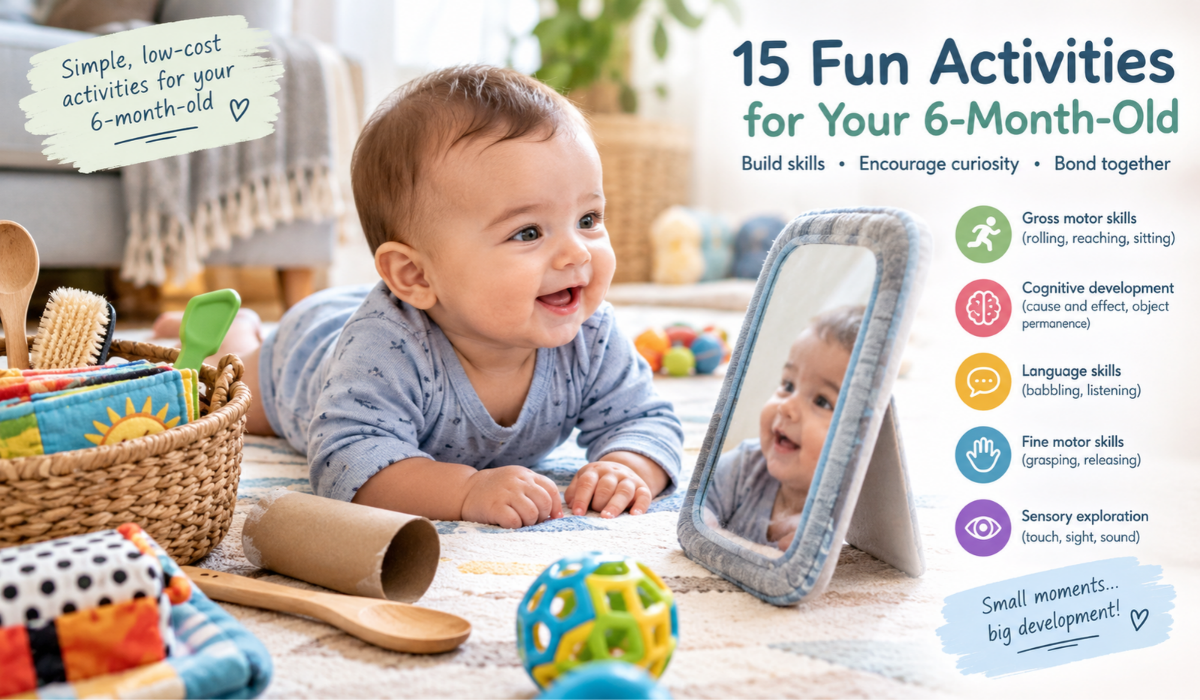
A wooden spoon can hold a 6-month-old’s attention for a surprisingly long time. So can a crinkly paper bag, your car keys (supervised, and they will absolutely be licked), and the cardboard tube from a finished roll of paper towels. Nobody tells you that before the baby arrives.
So if you’re hunting for 6-month baby activities and feeling pressure to buy something with batteries, take a breath. The fifteen ideas below are cheap or free. They also happen to match what your baby is working on right now: rolling, reaching, propping up to sit, babbling, and discovering that things fall when you let go.
Where Your Baby Is Right Now
The CDC’s milestone checklist for this age is short and friendly. Most babies at 6 months recognize the people they know, love peering at themselves in a mirror, and trade sounds back and forth with you. Many blow raspberries. They roll from tummy to back, push up on straight arms when they’re on their tummies, and lean on their hands when you sit them up. They reach for what they want, and whatever they get goes in the mouth.
There’s no crawling on that list. No sitting completely unassisted, and no real words either. If your baby isn’t there, that’s normal. Those skills usually show up later.
Also Read: Baby Development by Month: What to Expect at Every Stage
The Full List at a Glance
| Activity | Main skill it builds | What you need |
|---|---|---|
| 1. Tummy time with a mirror | Gross motor, neck and back strength | Baby-safe mirror |
| 2. Reach-and-roll toy game | Rolling, reaching | One favourite toy |
| 3. Supported sitting play | Core strength, balance | Pillows, your lap |
| 4. Airplane and gentle bounce | Head control, vestibular sense | Just you |
| 5. Peekaboo | Object permanence, social skills | Cloth or your hands |
| 6. Drop and retrieve | Cause and effect | Soft toys, a tray |
| 7. Treasure basket | Sensory exploration | Safe household items |
| 8. Texture tape pull | Fine motor, sensory | Masking tape |
| 9. Bubble watching | Visual tracking | Bubble solution |
| 10. Back-and-forth babble chats | Language development | Your voice |
| 11. Raspberries and silly sounds | Oral motor, imitation | Just you |
| 12. Reading board books | Listening, language | Board books |
| 13. Songs and finger rhymes | Rhythm, bonding | Just you |
| 14. Pat-a-cake and clapping | Imitation, hand awareness | Just you |
| 15. New-view tour of the house | Curiosity, vocabulary | Just you |
Big-Muscle Play
This is the gross motor group, the stuff that eventually turns into crawling. Don’t turn it into a race with the baby next door.
1. Tummy Time With a Mirror
Start here. Prop a baby-safe mirror a little in front of your baby and let them stare at the new face. Many babies this age find their reflection fascinating, so they’ll put up with tummy time much longer than usual.
Two or three minutes counts. If they melt down, stop, cuddle, and come back after a nap. Babies who spend very little time on their tummies tend to have a harder time rolling and crawling later, so it’s worth the small daily effort.
2. Reach-and-Roll Toy Game
Place a toy just out of reach and slide it slightly sideways. To get it, your baby has to stretch and twist, and sometimes flop all the way over. Let them try before you help. When they’re about to complain, scoot the toy closer.
3. Supported Sitting Play
Sit your baby between your legs, or wedge pillows on each side, and set a toy in front of them. You’ll see them lean forward on their hands, the “tripod” position, which is typical for this age. Stay close, because the tip-over comes without warning. Play on a soft surface.
4. Airplane and Gentle Bounce
Lie on your back, hold your baby firmly under the arms or tummy, and lift them into flight. Or sit and bounce them gently on your knees with a made-up song. Smooth movements only. Stop if your baby seems unsure, and give them time after a feed.
Brain Games: “Look What I Did!”
Around now, your baby starts to notice that they can cause things. Throwing a spoon is not bad behavior. It’s research.
5. Peekaboo
The classic still works. Hide your face behind your hands or a thin cloth and reappear with a “boo!” Your baby is learning that you haven’t disappeared when you’re out of sight. That’s early object permanence, in case you ever need to impress someone at a party.
Later, drape the cloth over their head and let them yank it off. They’ll start laughing before you even get to the reveal.
6. Drop and Retrieve
They drop the toy. You pick it up. They drop it again. It feels endless, but each drop teaches them something about gravity, sound, and whether you’ll come back with the toy. A baby-toy strap on the highchair saves your back. A soft toy on a tray also works well.
7. Treasure Basket
Put together a shallow basket of safe objects: a wooden spoon, a soft hairbrush, a silicone spatula, a sealed crinkly fabric book, a whisk with a solid handle. Let your baby pick through it.
The safety rule here is a hard one. Nothing small enough to fit through a toilet paper tube goes in. Check every item for splinters and loose parts, and sit beside the basket the whole time.
Sensory Activities for a 6-Month-Old
Hands, mouths, eyes, ears. At this age, that’s how everything gets learned.
8. Texture Tape Pull
Stick strips of masking tape on a tray or table with one end loose. Your baby peels, pulls, and tugs. New feel, new crackle, and practice with grasping and releasing. Watch for tape heading to the mouth.
9. Bubble Watching
Blow bubbles slowly while your baby follows them with their eyes and tries to swat one. It’s good hand-eye practice, and it’s a very reliable cure for a cranky afternoon. Keep the solution out of their eyes and mouth, and look for one labeled baby-safe.
Talk, Sing, Repeat
Your baby understands far more than they can say. These give them plenty to hear and a reason to reply.
10. Back-and-Forth Babble Chats
When your baby makes a sound, say it back. Pause. Wait. Often they answer. That tiny conversation is the heart of language development, sometimes called “serve and return.” If they say something like “ba ba,” you can answer “baby!” without making a big deal of it.
11. Raspberries and Silly Sounds
Blow a raspberry on their tummy, pop your lips, click your tongue. Babies copy, and copying is where speech starts. The giggles are a bonus.
12. Reading Board Books
You don’t need to read every word. Point to a picture, say what it is, turn the page. Pick sturdy books with bold images or plain photos of faces and animals. They’ll gnaw the corners. Let them.
13. Songs and Finger Rhymes
Choose three or four songs and sing them constantly. Familiar tunes let your baby predict what comes next, which feels safe. Slip their name into a verse. Add small hand movements. Nobody’s judging your pitch.
14. Pat-a-Cake and Clapping
Gently clap their hands together as you sing. Before long they’ll try it themselves, with mixed accuracy. It builds body awareness and rhythm, and it quietly becomes your first shared routine.
15. New-View Tour of the House
Walk your baby from room to room and narrate. “That’s the window. This is the fridge. Cold!” Let them touch a leaf, a doorknob, a soft blanket. Even a change of room gives them something new to look at. It’s also the easiest idea here, so it’s the one that survives a bad day.
Safety, in Plain Words
- Stay with your baby. No leaving them alone with objects, tape, or a basket.
- Mind the choking risks. Small items, coins, batteries, and balloons stay out of reach.
- Sleep is separate from play. Floor time is great. For sleep, back on a firm, flat surface, every time.
- Go easy on screens. The CDC’s milestone handout recommends limiting screen time for babies. Real faces beat tablets.
- Learn the “I’m done” signs. Looking away, arching the back, a glazed stare, or fussing.
How Long Is Too Long?
Five to ten minutes on one thing is usually plenty. Then switch, or stop. A realistic day might include a couple of floor sessions after naps, a book at bedtime, and bits of tummy time scattered around.
And you don’t need to perform. If your baby is lying on a mat watching you fold laundry, that counts as play too.
When to Ask Your Pediatrician
Milestones are a guide, not a test. But it’s worth raising at your next visit, or calling sooner, if your baby:
- Doesn’t seem to reach for toys or bring things to their mouth
- Doesn’t respond to sounds or doesn’t make any sounds
- Has stiff, tight muscles or seems very floppy
- Doesn’t push up during tummy time or doesn’t roll in either direction
- Doesn’t show affection for familiar caregivers
- Has lost skills they once had
If something feels off to you, say so. A pediatrician would rather hear from you too soon than too late.
Common Questions About 6 Month Baby Activities
How many activities should we do a day?
There’s no set number. A few short sessions and some floor time are enough. Go with your baby’s mood.
Do I have to buy special toys?
No. Safe household objects, a mirror, a few board books, and your voice cover almost everything above.
Should my 6-month-old be sitting alone yet?
Most babies this age sit with support or prop on their hands. Fully independent sitting usually arrives a few months later.
How much tummy time is enough?
Short stretches through the day. Your pediatrician can suggest a goal that suits your baby.
My baby hates tummy time. Now what?
Try lying on your chest, a rolled towel under their chest, or a mirror in front. Shorter sessions, more often. If it’s a constant fight, mention it at the next checkup.
Are baby apps and videos useful?
Not really. Hands-on play and your face do more.
Can we play right after a feed?
Gentle play is fine. Skip bouncing and tummy time right after a big feed, since it can bring milk back up.
The Bottom Line
The best 6 month baby activities are short, simple, and centred on you. Tummy time, peekaboo, a basket of safe objects, a mirror, a book, and a few songs cover most of what your baby is working on. Keep things safe, follow their cues, and don’t aim for perfect. If you have questions about how your baby is doing, ask your pediatrician.

Dr. Tania Adib is a Board Certified OB/GYN based in the northern suburbs of Chicago. She earned her undergraduate degree from the University of Notre Dame and her medical degree from Georgetown University in Washington, D.C., before completing her residency in Obstetrics and Gynecology at Magee-Womens Hospital, University of Pittsburgh Medical Center. Her clinical interests include full-spectrum obstetrics and gynecology, from the first period through the menopausal years, contraception, and abnormal bleeding.