

It’s 2 a.m. and you’re wide awake, trying to work out how to turn over without gasping. If that sounds familiar, you’re dealing with something a lot of pregnant women quietly struggle with: pelvic girdle pain, often shortened to PGP, or sometimes called symphysis pubis dysfunction (SPD). It’s one of those things nobody really warns you about until you’re lying there at night wondering why simply shifting your weight feels like it’s tearing something apart.
Here’s the reassuring part first: PGP is common, it’s not usually a sign that anything is wrong with your baby, and there’s quite a lot you can actually do about it — especially at night, which tends to be when it hurts most. This isn’t a miracle cure, because for some women PGP just needs to be managed rather than fixed. But small changes to how you position yourself, how you move in bed, and what you do during the day can add up to genuinely better sleep.
So What Is Pelvic Girdle Pain?
Your pelvis is made up of several bones held together by joints and ligaments — mainly the symphysis pubis at the front (where the two halves of your pelvis meet, roughly where your pubic hairline is) and the sacroiliac joints at the back, near those little dimples above your bottom. Normally these joints barely move. During pregnancy, though, your body releases a hormone called relaxin, which loosens ligaments throughout your body to eventually help your baby pass through the pelvis during birth.
That’s a good thing, biologically speaking. The catch is that loosened ligaments mean less stability, and less stability means pain — particularly with movements that ask one side of your pelvis to move differently from the other. Walking, getting out of a car, climbing stairs, rolling over in bed. All of it can set it off.
PGP tends to show up more in the second half of pregnancy, though some women feel it earlier, especially with a second or third pregnancy, twins, or if their joints have always been a bit hypermobile. It’s not the same as ordinary pregnancy back pain, although the two often overlap and get confused with each other.
Why It Gets Worse the Second You Lie Down
A lot of women say the pain is fine, or at least tolerable, during the day, and then it turns vicious the moment they get into bed. There’s a reason for that. During the day, your muscles — core, glutes, hips — are doing quiet work to keep your pelvis stable. Lying down, those muscles switch off. The joint is left to fend for itself. Add in the small, repeated shifting that happens naturally through the night, plus the stiffness that builds up from staying in one spot too long, and you’ve got a perfect setup for pain that peaks right when you’re trying to rest.
The Sleep Positions That Actually Help
Lying on your side, knees together
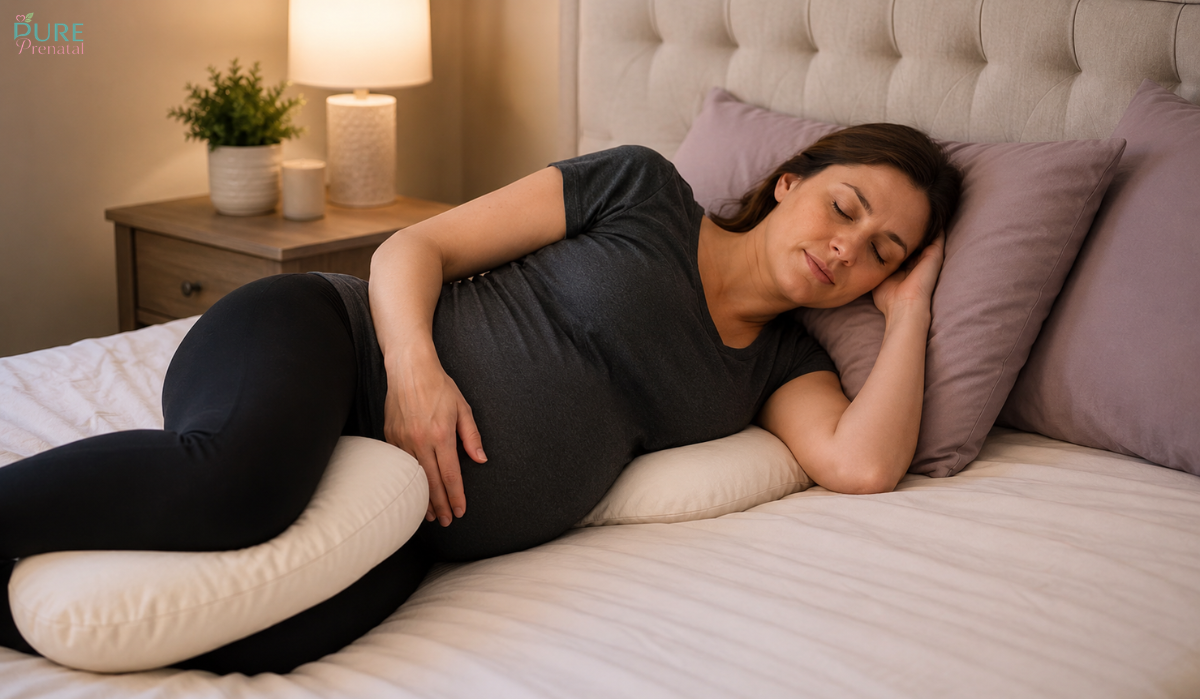
This is the one most women end up settling on. Side-lying — left side is often recommended later in pregnancy for circulation reasons — with a firm pillow wedged between your knees keeps your hips level instead of letting one drop lower than the other and twist the pubic joint. Some women add a second pillow under the bump for extra support, which takes pressure off the lower back too.
A pregnancy pillow, if you can stand the bulk
Full-length body pillows (the C-shaped or U-shaped kind) support your back, belly, and knees all at once, so you’re not constantly rearranging separate pillows every time you shift. Not everyone loves sleeping wrapped around a giant pillow, especially in summer, so a smaller wedge tucked under the belly or lower back is a lighter alternative that still does the job.
What to avoid
Anything that lets your hips twist or your knees drift apart. Lying flat on your back with your legs falling open, or curling one knee up higher than the other, tends to load the pubic joint unevenly. If you’re someone who naturally ends up on your back, propping both knees up together on a pillow keeps things more balanced.
The knees-together trick
If there’s one piece of advice that comes up again and again with SPD specifically, it’s this: before you move at all — rolling over, getting up, shifting position — squeeze your knees and thighs together first. It sounds almost too simple, but it keeps your pelvis moving as one solid unit instead of letting one side slide independently, which is usually what causes that sharp, catching pain.
Getting In and Out of Bed Without It Hurting
How you get into bed matters almost as much as how you lie once you’re there. Sit on the edge of the mattress with your knees pressed together. Then, keeping them together, swing both legs up onto the bed as you lower yourself onto your side in one motion — not leg first, then body. Getting up works the same way in reverse: knees together, swing your legs down, push up with your arms rather than your stomach or one leg. It takes some practice to feel natural, but physiotherapists who work with PGP teach this exact technique because it genuinely reduces the grinding or catching sensation a lot of women describe.
Rolling Over Without Waking the Whole House
Turning over is often the worst part. A few things help take the edge off: Keep your knees glued together and roll as a single unit rather than twisting your top half first and letting your hips follow late. Some women skip rolling altogether and instead sit up, reposition, then lie back down — slower, but far less painful. And this sounds small, but it works: satin or silk sheets, or even just a slippery layer of fabric under your hips, cut down on friction so you glide instead of catch when you move.
Products Worth Considering
None of these replace an actual assessment from a physiotherapist, but they’re commonly recommended and worth knowing about: Pregnancy support belts, sometimes called SI belts, wrap snugly around the hips and give the joints some external stability. A few women wear a lighter version to bed, though it’s worth checking with your midwife or a physio before doing that regularly. A firmer mattress tends to suit PGP better than a soft one, since soft mattresses let the hips sink unevenly. And a simple folded towel under the lower back or bump can fill gaps that a standard pillow doesn’t quite reach.
What You Do During the Day Still Matters at Night
Nighttime pain doesn’t exist in a vacuum — it’s often the tail end of how your pelvis was treated all day. Try to avoid long stretches of standing or walking, and skip the two-stairs-at-a-time habit if that’s ever been yours. Keep your knees together for everyday movements too, not just in bed — getting out of the car, turning while standing at the sink. Gentle, physio-guided exercise can strengthen the muscles that stabilize the pelvis, which tends to translate into calmer nights. A warm bath before bed can loosen tight muscles around the joint. And sitting cross-legged or on the floor is worth avoiding, since it pulls the pubic joint apart unevenly.
Physiotherapy Is Worth Asking About
PGP isn’t something you’re supposed to just white-knuckle through until delivery. Pelvic health physiotherapists deal with this constantly — they can look at your specific pain pattern, teach exercises suited to it, fit a support belt properly if you need one, and sometimes use hands-on techniques to improve how the joint is moving. A lot of women notice a real difference, both in daily function and in how they sleep, after just a handful of sessions. If pain is genuinely disrupting your rest, ask your midwife or GP for a referral — it’s a very normal thing to request.
When It’s More Than “Just” PGP
Most pelvic girdle pain, uncomfortable as it is, isn’t dangerous. That said, get in touch with your midwife or doctor if you notice sudden pain that feels different from your usual PGP, pain alongside fever or bleeding, a noticeable drop in your baby’s movements, or if you genuinely can’t put weight on one leg. Those symptoms need proper checking, not just a new pillow.
Frequently Asked Questions
Does pelvic girdle pain mean something is wrong with my pregnancy?
No. It’s a mechanical issue caused by hormonal loosening of the pelvic ligaments, not a sign of a problem with the baby or the pregnancy itself.
What’s the best sleeping position for symphysis pubis dysfunction?
Side-lying with a pillow between the knees is usually most comfortable. Keeping the knees together, both at rest and while turning over, is the detail that seems to matter most.
Can I still sleep on my back?
Briefly, and with pillows under the knees to keep the pelvis level, some women manage it. Side-lying is generally more comfortable, and later in pregnancy back-sleeping for long periods isn’t usually recommended anyway, for unrelated circulation reasons.
Is a pregnancy pillow actually worth it?
Many women say yes, mainly because it means fewer separate pillows to fumble with mid-sleep and fewer times you fully wake up to reposition everything.
Should I sleep in a support belt?
Some women find it helps overnight, others find it too restrictive to actually sleep in. It really depends on your pain pattern, so it’s worth asking a physiotherapist rather than guessing.
Will this go away after birth?
For most women, yes — pain eases noticeably within the first few weeks postpartum as hormone levels settle and joint stability returns. Some benefit from a bit of physiotherapy afterward to fully resolve things.
Could exercise make it worse?
High-impact or lopsided movements can aggravate it, but gentle, targeted exercise — ideally guided by a pelvic health physiotherapist — tends to help more than it hurts over time.

Dr. Tania Adib is a Board Certified OB/GYN based in the northern suburbs of Chicago. She earned her undergraduate degree from the University of Notre Dame and her medical degree from Georgetown University in Washington, D.C., before completing her residency in Obstetrics and Gynecology at Magee-Womens Hospital, University of Pittsburgh Medical Center. Her clinical interests include full-spectrum obstetrics and gynecology, from the first period through the menopausal years, contraception, and abnormal bleeding.