

Somewhere around week six, you’ll probably catch yourself staring at your baby’s face while they stare right back, and wonder whether they just smiled or whether it was gas. (Honestly, at that point, it might be either.) The first year moves fast, and it can feel like everyone else’s baby is hitting things on a schedule yours didn’t get.
This guide walks through baby development by month, from the newborn stage to the first birthday. It covers what’s typical, what’s coming next, and the handful of situations where a call to your pediatrician is the right move. It’s meant to help you relax a little, not to give you one more thing to measure.
Here’s the most useful thing we can tell you up front: babies don’t read charts. A baby who rolls at four months and a baby who rolls at six can both be exactly on track.
What baby development stages actually mean
Pediatricians talk about developmental milestones, which are skills most babies pick up within a certain window. Smiling, rolling, babbling, sitting, waving. They sort them into four buckets, and it helps to know them because you’ll hear these words at every well-baby visit:
- Social and emotional: smiling, enjoying people, getting upset when you leave the room
- Language and communication: cooing, babbling, reacting to sounds, first words
- Cognitive: curiosity, learning, figuring out how things work
- Movement and physical: head control, rolling, sitting, crawling, walking, using the hands
The CDC revised its milestone checklists in 2022, and the rule behind them changes how you should read any list. A skill goes on the checklist for a given age only if most children (75% or more) can do it by then. That makes a milestone a point most babies have already reached. It isn’t an average, and it isn’t a pass-or-fail test.
The CDC’s official checkpoints in the first year are 2, 4, 6, 9 and 12 months. The months in between (1, 3, 5, 7, 8, 10 and 11) don’t have formal checklists, so for those we’re describing what many babies commonly do, based on general guidance from sources like the American Academy of Pediatrics and Mayo Clinic. Think of those as friendly landmarks, not deadlines.
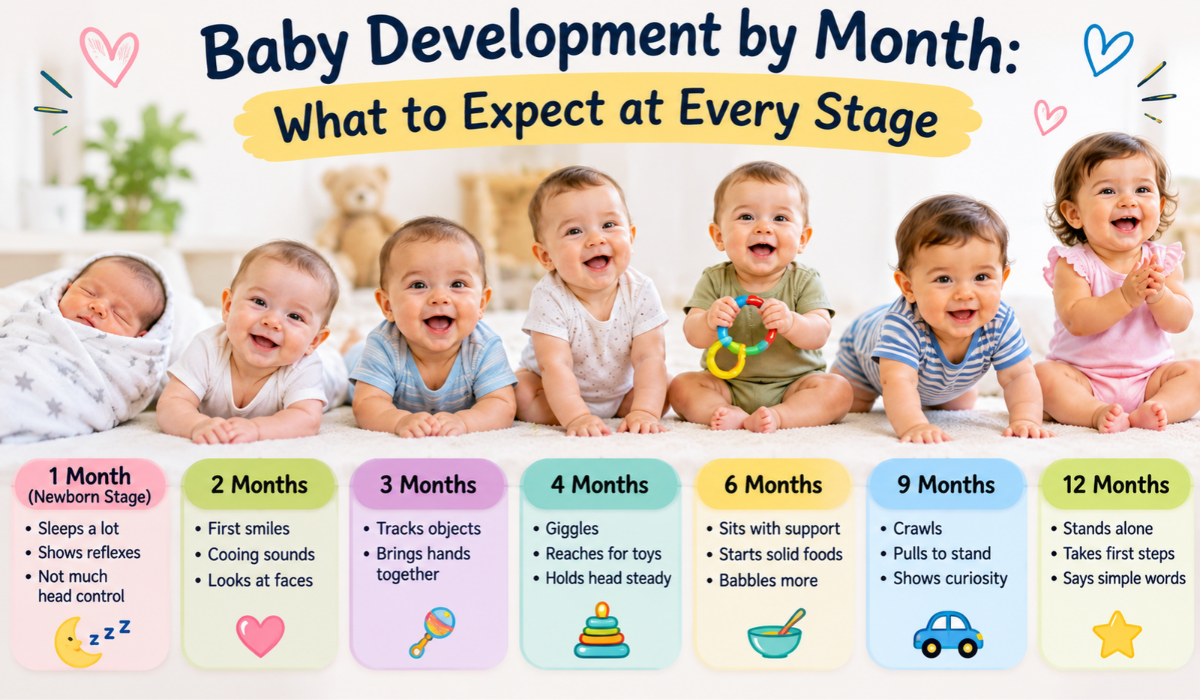
Baby development by month
Month 1: Newborn development and getting to know each other
The first month is mostly sleeping, eating and figuring each other out. Your newborn comes with reflexes that make feeding possible, like rooting (turning toward a touch on the cheek) and sucking. Their eyes can’t focus well beyond a short distance, which is why a newborn tends to lock onto whoever is closest during a feed. That face is yours. It’s the best thing they can see.
Head control isn’t there yet, so support the head and neck whenever you lift or carry your baby. Hands stay mostly in fists. And if it seems like your baby does nothing but eat and sleep, that’s right on schedule. It’s the whole job right now.
Many newborns lose a little weight in the first few days and are back to their birth weight by about two weeks. That’s one of the first things your pediatrician will check.
Try this month: Skin-to-skin time, talking while you change diapers, and a few very short, supervised tummy time sessions on your chest or a firm surface while your baby is awake. Always put your baby down on their back, on a firm, flat sleep surface, for every sleep.
Month 2: First real smiles and the first sounds
This is the month a lot of parents have been waiting for. Around now, your baby starts smiling back on purpose, and it’s a bigger deal than anyone warns you about. The CDC’s 2-month checklist includes:
- Smiles when you talk to them or smile at them
- Calms down when spoken to or picked up
- Looks at your face
- Makes sounds other than crying
- Reacts to loud sounds
- Holds their head up briefly during tummy time
- Moves both arms and both legs, and opens their hands briefly
- Watches you move, and looks at a toy for several seconds
Soft cooing, those little vowel sounds, often shows up around now too. When it does, talk back. It feels silly. It’s also how language begins, because your baby is learning that sounds get a response.
Try this month: Hold a high-contrast toy or your own face about a hand’s length away and slowly move it side to side. Watching your baby’s eyes follow you is a small, lovely thing.
Month 3: Discovering hands and voices
This is the month babies start to feel like little people. The head wobbles less, and many babies find their own hands and study them like they’ve never seen anything so interesting. You may see swatting at a dangling toy, longer stretches of eye contact, and more reaction when they hear a familiar voice.
If your baby is fussy in the evening, you’re in good company. A lot of babies this age go through a stretch of late-day crankiness that eases with time. It’s hard to live through, and it’s usually not a sign that anything’s wrong.
Try this month: Lay your baby on a play mat with a couple of toys within arm’s reach. They don’t need many. They need room to wave their arms and a reason to try.
Month 4: Giggles, reaching and a steadier head
The 4-month checkpoint is where infant development starts to look like personality. According to the CDC milestones, most babies by now:
- Smile on their own to get your attention
- Chuckle or giggle when you try to make them laugh
- Coo with sounds like “ooh” and “aah,” and answer when you talk
- Turn their head toward the sound of your voice
- Hold their head steady without support when you’re holding them
- Reach for and grab toys, and swing at objects
- Prop up on their elbows or forearms during tummy time
- Put things in their mouth and look at their own hands with interest
Some babies roll from tummy to back around now. Many don’t, and nobody hands out prizes either way.
The first real laugh is worth listening for. It’s one of those sounds you won’t forget, and it’s a sign your baby is connecting with you, not just reacting to you.
Try this month: Peekaboo, silly voices and blowing gentle raspberries on a tummy. Whatever makes your baby laugh, do it again.
Month 5: Rolling, reaching and putting everything in the mouth
Month 5 sits between checkpoints, so the timing varies more from baby to baby. A lot of babies are rolling by now, or very close, and their reach is getting sharper. Everything goes straight into the mouth. Babbling gets more varied, and laughs come easier.
Because rolling can start without warning, never leave your baby alone on a bed, couch or changing table, even for a second. The first roll often happens the one time you turned around to grab a wipe.
Try this month: Place a toy just out of reach during tummy time and let your baby work for it. A little frustration at this age builds the muscles, and the determination, that lead to crawling.
Month 6: Sitting up and getting ready for solids
Half a year in, the movement milestones start piling up. By 6 months, the CDC says most babies roll in both directions, sit with support, lean on their hands when sitting, and push up with straight arms during tummy time. Mayo Clinic notes that around this age many babies begin to sit alone once they’ve been propped upright.
Socially, your baby recognizes familiar people, enjoys the mirror, and laughs out loud. Language gets playful too. Expect squealing, blowing raspberries (wet ones, usually at the table) and taking turns making sounds with you, like a very small conversation.
This is also the age the AAP points to for starting solid foods, as long as your baby shows signs of being ready. We cover that in its own section below, because there’s a bit more to it than a date on the calendar.
Try this month: Sit your baby in front of a mirror and let them meet themselves. It’s good for social development, and it’s a cheap way to buy yourself ten minutes of delighted staring.
Month 7: Steadier sitting and busier hands
Sitting gets sturdier, and the hands get a lot busier. Many babies this age pass a toy from one hand to the other, bang things on the highchair tray and turn when you call their name. Babbling starts to include consonant sounds, the early “ba” and “da” that will eventually become words.
This is a great month to read aloud every day. Mayo Clinic points out that reading to a baby supports speech and thinking skills, and at this age it hardly matters what the book says. They’re listening to your voice, the rhythm, and the pause before you turn the page.
Try this month: Sturdy board books, a few household objects that are safe to mouth and shake (a wooden spoon is a classic), and lots of narrating what you’re doing. “Now I’m opening the fridge.” It counts.
Month 8: On the move, and a bit clingy
Mobility takes off in month 8, though it doesn’t look the same for every baby. Some crawl on hands and knees. Some scoot on their bottoms, some roll across the room and some skip crawling altogether. All of that falls within the normal range.
This is also when many babies become wary of strangers and upset when you leave the room. It can feel like a step backward, especially if your baby was cheerfully passed around a few weeks ago. It’s really a sign of progress. Your baby has formed a strong attachment, and they’re starting to understand that you exist even when they can’t see you.
Try this month: Play hide-and-find with a toy under a light cloth. Babies around this age start to figure out that things still exist when they’re out of sight, and they find that endlessly interesting.
Month 9: Mama, bye-bye and peekaboo
Nine months is a CDC checkpoint, and it’s also when your pediatrician typically does a formal developmental screening, usually a short questionnaire you fill out about what your baby is doing. By now, most babies:
- Get into a sitting position without help, and sit without support
- Move things from one hand to the other, and rake food closer with their fingers
- Bang two objects together
- Look for an object that has dropped out of sight
- Make lots of different sounds, like “mamamama” and “bababa”
- Turn when their name is called
- Lift their arms to be picked up
- Smile or laugh during peekaboo
- Show a range of facial expressions, and may be upset when separated from caregivers
Those “mama” and “baba” strings usually aren’t meant as words yet. Treat them like words anyway. Respond like your baby just said something brilliant, because in a way they did.
Try this month: Roll a ball back and forth, stack and knock down soft blocks, and put a few toys in a basket for your baby to dump out. Dumping is a skill, and the mess is the point.
Month 10: Crawling, pulling up and pinching
By now many babies crawl and pull themselves up on furniture. The fine motor skills are sharpening too. Babies start using the thumb and pointer finger to pick up small bits of food, which is why finger foods suddenly become so much more doable. Mayo Clinic notes that most babies from 10 to 12 months can feed themselves finger foods and respond to simple verbal requests.
This is a good week to babyproof, if you haven’t already. Outlets, cords, stairs, low shelves and anything with a tippy base all become fascinating at once. Get down on the floor and look at the room from your baby’s height. It’s humbling.
Try this month: Offer soft, pea-sized finger foods once your baby has started solids, always sitting up and always supervised, and let them practice picking things up. It will be messy. It’s good practice.
Month 11: Cruising and chatting
Your baby may cruise along furniture, stand for a few seconds on their own, and point at things they want. Gestures like waving or shaking the head often show up now. Babbling starts to sound like real conversation, with rhythm and tone, even when none of the words are recognizable.
Expect a lot of dropping things off the highchair tray, over and over. It’s not bad behavior. It’s physics research, and you’re the lab assistant.
Try this month: Name things as you point to them (“cup,” “dog,” “shoe”) and give your baby time to respond with a sound or a gesture before you carry on. That pause is where language grows.
Month 12: First steps and first words
The 12-month checkpoint wraps up the first year. According to the CDC, most babies by now:
- Wave “bye-bye”
- Call a parent “mama,” “dada” or another special name
- Understand “no,” pausing or stopping when you say it
- Play simple games like patty-cake
- Enjoy looking at picture books
- Look for things they’ve seen you hide
- Put an object, like a block, into a container
- Pull themselves up to stand and cruise along furniture
- Pick things up using the thumb and pointer finger
- Drink from an open cup while you hold it
Mayo Clinic says many babies take their first unsupported steps around now, but plenty walk a little later. Both are normal, and the baby who walks at 14 months isn’t behind the baby who walks at 10.
Try this month: Let your baby be barefoot indoors when it’s safe, push a sturdy toy, and cheer for every wobble. A first birthday is a good time to schedule your next pediatric visit and talk through what’s coming in the toddler years.
Baby milestones chart at a glance
Here’s a quick baby milestones chart for the CDC checkpoint months. It’s a snapshot, not a scorecard.
| Age | Movement | Language and communication | Social and cognitive |
|---|---|---|---|
| 2 months | Lifts head briefly on tummy, moves arms and legs | Makes sounds other than crying, reacts to loud sounds | Smiles at you, looks at faces, watches you move |
| 4 months | Holds head steady, reaches and grabs, props on forearms | Coos, answers when you talk, turns toward your voice | Giggles, brings things to mouth, looks at own hands |
| 6 months | Rolls both ways, sits with support | Takes turns making sounds, blows raspberries | Knows familiar faces, laughs, reaches for toys |
| 9 months | Sits without support, passes objects hand to hand | Babbles “mamama” and “bababa,” turns to name | Stranger anxiety, plays peekaboo, finds dropped objects |
| 12 months | Pulls to stand, cruises, pinches with thumb and finger | Waves, says mama or dada, understands “no” | Plays patty-cake, hunts for hidden toys |
Tummy time: the small habit behind almost every milestone
Tummy time is supervised play while your baby is awake and on their stomach. It builds the neck, shoulder and back strength that later shows up as rolling, sitting and crawling, which is why you’ll hear about it at nearly every visit.
The AAP suggests starting in the first days at home, with two or three short sessions a day of about 3 to 5 minutes each. Many pediatric sources then suggest building toward 20 to 30 minutes a day by around 3 or 4 months, and working up to an hour or more of floor time a day by about 6 months, split into small chunks. You don’t have to hit those numbers perfectly. Short and frequent beats long and tearful.
If your baby hates it, you’re not doing it wrong. Try lying face to face with them on the floor, putting a rolled towel under their chest, or doing it on your own chest. Wait a little after a feed. Take a break and try again later.
One safety point matters more than all the others. Stay with your baby during tummy time, and if they fall asleep, move them to their back in their crib.
Sleep, vision and hearing along the way
A few things develop quietly in the background while you’re watching for rolls and smiles.
Sleep. Newborns sleep in short bursts around the clock, and longer nighttime stretches develop gradually over the first several months. Every baby gets there at a different pace, and a rough night, or a rough week, doesn’t mean something’s wrong. What doesn’t change with age is the safe-sleep basics: place your baby on their back, on a firm, flat surface, for every sleep. Once your baby can roll both ways on their own, you don’t need to keep flipping them back, but always start them on their back.
Vision. A newborn sees best at close range, then their focus and tracking improve over the first few months. By 2 months the CDC says most babies watch people as they move and look at a toy for several seconds. Occasional eye crossing is common in the early months, but if one eye turns in or out most of the time, mention it to your pediatrician.
Hearing. Reacting to loud sounds is on the CDC’s 2-month list, and turning toward your voice is on the 4-month list. If you ever suspect your baby isn’t hearing well, say so. Hearing is central to language, and it’s easy to check.
Starting solids and what it has to do with development
Feeding is part of baby development too, and it’s tied to the physical skills above. The AAP recommends starting solid foods around 6 months, and readiness matters more than the date. Signs include sitting with support, good head control, showing interest when you eat, and opening their mouth for a spoon.
Breast milk or formula stays your baby’s main source of nutrition through the first year. Solids start out as the side dish, and a few safety points from pediatric sources are worth keeping in mind:
- Skip honey until after the first birthday, because of the risk of infant botulism
- Hold off on cow’s milk as a drink until 12 months, though yogurt and cheese are fine
- Avoid fruit juice and added salt or sugar in the first year
- Current guidance is to offer common allergens like peanut and egg alongside other solids rather than delaying them, but if your baby has eczema or a known food allergy, talk with your pediatrician before you begin
If your baby gets hives, vomiting or facial swelling after a new food, call your provider. Trouble breathing is an emergency, so call 911.
If your baby was born early: corrected age
If your baby arrived early, a standard milestone list can be misleading, and it’s easy to feel like you’re falling behind when you’re not. Pediatricians use corrected age, also called adjusted age, which counts from your due date instead of the birth date. To work it out, subtract the number of weeks your baby was early from their actual age.
For example, a baby born 8 weeks early who is now 4 months old has a corrected age of about 2 months, so the 2-month milestones are the ones to look for. Corrected age is generally used for the first couple of years. Most premature babies develop as expected. They just may get there a little later than their birth date suggests, and that’s exactly what the adjustment is for.
How to support your baby’s development at home
You don’t need flashcards, apps or a shelf full of educational toys. The things that help most are the ones you’re already doing.
- Talk, sing and narrate. Babies learn language from hearing it, long before they say anything.
- Read every day. Even five minutes counts, and even when they’re chewing the book.
- Respond to them. When your baby coos, smiles or fusses, answering back teaches them that communication works.
- Give them floor time. A safe space to move beats most gadgets, and it keeps babies out of seats and swings for too much of the day.
- Keep play simple. A few safe objects of different textures and sounds are plenty.
- Go to your well-baby visits. They’re where growth, development and screening get checked, and where your questions get answered.
And try not to compare. The baby in your parenting group who crawled early may be the one who talks late, and the reverse is just as common. Each baby has a different order of skills, and it all tends to even out.
When to talk to your pediatrician
This is the part nobody wants to think about, and it’s the part worth getting right. Missing a single milestone by a few weeks is rarely a problem. What deserves a call is a pattern, or anything that just feels off to you.
Contact your baby’s healthcare provider if you notice any of these:
- Your baby loses a skill they previously had, like cooing, smiling or reaching. This is the one to act on quickly, at any age.
- Your baby doesn’t seem to react to loud sounds, or doesn’t follow faces or objects with their eyes
- By around 4 months, your baby isn’t smiling at people, holding their head up or bringing things to their mouth
- By around 6 months, your baby isn’t reaching for toys or showing any interest in people
- By around 9 months, your baby isn’t sitting with support, making any sounds or playing simple games like peekaboo
- By 12 months, your baby isn’t trying to stand with support, using any gestures like waving, or responding to their name
- Your baby seems very stiff or very floppy, or consistently uses one side of the body more than the other
These are reasons to ask, not reasons to panic. A pediatrician can do a proper developmental screening, and if there is a concern, early intervention services are available in every US state. Starting early tends to help, and you don’t need a diagnosis to ask for an evaluation.
Trust your gut as well. You see your baby more than anyone does. If something feels wrong even when a checklist says it shouldn’t, say so at the next visit, or call before then.
FAQs about baby development by month
When do babies start smiling? Most babies smile on purpose around 2 months, often in response to your voice or face. Smiles that start on their own show up by about 4 months.
When do babies roll over? Some babies roll tummy to back around 4 months, and most roll both ways by about 6 months. Timing varies a lot, and an early roller isn’t a more advanced baby.
When do babies sit up on their own? Many babies sit with support by 6 months and sit without support by 9 months. Mayo Clinic notes that some babies sit alone around 6 months once they’ve been placed upright.
Is it normal for a baby to skip crawling? Yes. Some babies scoot, roll, or go straight to pulling up and cruising. What matters more is that your baby is getting around and using both sides of the body.
When do babies say their first words? By 12 months, most babies call a parent mama, dada or another name. Babbling with those sounds usually starts a few months earlier.
When do babies start walking? Cruising along furniture is typical by 12 months, and many babies take their first steps around then. Others walk a few months later and are perfectly healthy.
Are baby milestone charts accurate? They’re good general guides, but they differ slightly between sources, and the CDC itself moved some milestones to different ages in 2022. Use any chart as a starting point for a conversation with your pediatrician, not a verdict.
Do I need to use corrected age for my preemie? In most cases, yes. Compare your baby’s skills to what’s expected for their corrected age, and ask your pediatrician how long to keep using it.
My baby is hitting milestones early. Does that mean anything? Usually not. Early rolling, sitting or crawling doesn’t predict later ability. It just means your baby got there first.
Bottom line
Baby development by month follows a general pattern, but your baby sets the pace. Watch for the big checkpoints at 2, 4, 6, 9 and 12 months, keep up with well-baby visits, offer plenty of tummy time, talk and read to your baby every day, and speak up early if something worries you. That’s honestly most of the job. The rest is enjoying a very fast year.

Dr. Tania Adib is a Board Certified OB/GYN based in the northern suburbs of Chicago. She earned her undergraduate degree from the University of Notre Dame and her medical degree from Georgetown University in Washington, D.C., before completing her residency in Obstetrics and Gynecology at Magee-Womens Hospital, University of Pittsburgh Medical Center. Her clinical interests include full-spectrum obstetrics and gynecology, from the first period through the menopausal years, contraception, and abnormal bleeding.