

Nobody really warns you how strange the first trimester feels. From the outside, nothing has changed. From the inside, everything has. Your energy disappears by mid-morning, smells you never noticed before suddenly turn your stomach, and your body is quietly doing the most important work it will ever do — even though the scale hasn’t budged and there’s no bump to show for it.
This is exactly why a lot of people start looking into morning yoga around this stage. Not because it’s a miracle fix for nausea or exhaustion (it isn’t), but because a slow, deliberate ten minutes before the day gets going can be the one thing that feels calm when everything else feels like it’s shifting under you.
This guide covers what a morning yoga practice can realistically do for you in the first trimester, which poses are considered safe, what to steer clear of, and how to put together a short routine that works even on the mornings when getting out of bed feels like an achievement in itself.
Why Bother With Mornings Specifically?
Hormone levels increase rapidly in the first trimester, from week 1 to roughly week 12. Progesterone and hCG in particular rise sharply, and they’re largely responsible for the fatigue, nausea, and mood swings so many people go through during this window.
A short practice first thing in the morning helps in a few concrete ways:
It gives your nervous system a gentle way to wake up before nausea has a chance to take over the day. Slow movement loosens the stiffness that tends to settle into your lower back and hips overnight. Controlled breathing can lower the release of stress hormones, and for some people, that seems to take a bit of the edge off morning sickness. And honestly, at a stage where so much feels unpredictable, having one small, steady ritual can matter more than people expect.
None of this replaces medical care, and it won’t make first-trimester symptoms disappear. Think of it as support for your body, not treatment for it.
Is Yoga Actually Safe This Early?
For most people with a low-risk, straightforward pregnancy, gentle yoga is generally considered safe during the first trimester. That said, this stage carries the highest natural miscarriage risk of any point in pregnancy — for reasons that have nothing to do with exercise — which is exactly why caution matters more here than it will later on.
A few things worth keeping in mind before you roll out a mat:
Talk to your doctor or midwife first, especially if you’ve had a miscarriage before, any bleeding, or a pregnancy your provider has flagged as higher risk. Skip deep twists and anything that compresses your core. Hot yoga is off the table entirely overheating in early pregnancy has been linked to developmental risks, so heated studios aren’t worth the risk. And if you ever feel dizzy, short of breath, notice spotting, or feel sharp pain, stop right away.
This article is meant as general information, not personal medical advice. Your own doctor knows your pregnancy in a way no article can, so treat this as a starting point for a conversation with them, not a replacement for it.
Poses That Are Generally Safe in the First Trimester
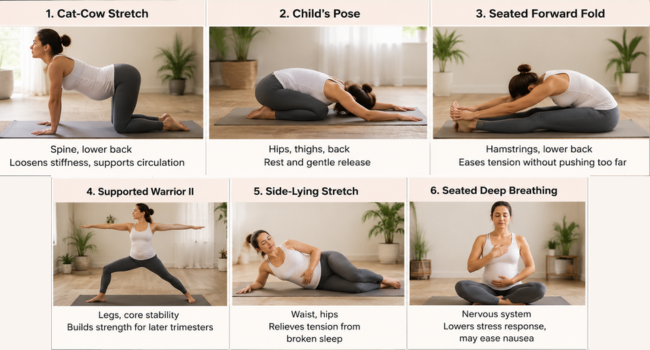
These poses show up again and again in prenatal yoga guidance because they’re low-impact, easy on loosening joints (relaxin, the hormone responsible for that, is already at work early on), and don’t ask much of a body that might be running on empty.
Cat-Cow Stretch (Marjaryasana-Bitilasana)
This tends to be the first pose taught in almost every prenatal class, and it earns that spot. Moving slowly between an arched and rounded spine on hands and knees releases tension along the back and warms up the spine — useful even this early, before circulation changes start pulling on the lower back more noticeably.
Child’s Pose (Balasana)
A resting shape that stretches the hips, thighs, and lower back without asking anything strenuous of you. Before the belly grows, it’s genuinely comfortable to sit in for several slow breaths, and it doubles as a good place to return to whenever the routine feels like too much on a given morning.
Seated Forward Fold (Modified)
Fold forward gently with soft, unlocked knees this isn’t about touching your toes. A light stretch through the lower back and hamstrings is the goal, not depth.
Supported Warrior II (Virabhadrasana II)
Standing poses like this build leg strength and stability, which becomes more useful as pregnancy progresses and your center of gravity shifts. Keep the stance shorter than you might normally take it, and come out before it starts to feel like effort rather than a stretch.
Side-Lying Stretch
Lying on your side with a gentle stretch through the waist and hip can ease tension that builds up from disrupted sleep and disrupted sleep tends to show up early. Avoid lying flat on your back for long stretches, particularly as the weeks go on.
Seated Deep Breathing (Pranayama)
Simple, slow breathing done seated with a tall spine might be the single most useful tool on this list. It costs nothing physically, works even on days when nausea rules out movement entirely, and is genuinely calming.
Poses at a Glance
| Pose | Focus Area | Main Benefit |
|---|---|---|
| Cat-Cow Stretch | Spine, lower back | Loosens stiffness, supports circulation |
| Child’s Pose | Hips, thighs, back | Rest and gentle release |
| Seated Forward Fold | Hamstrings, lower back | Eases tension without pushing too far |
| Supported Warrior II | Legs, core stability | Builds strength for later trimesters |
| Side-Lying Stretch | Waist, hips | Relieves tension from broken sleep |
| Seated Deep Breathing | Nervous system | Lowers stress response, may ease nausea |
What to Skip Early On
Knowing what not to do matters just as much here. In the first trimester, it’s best to avoid:
Deep, closed twists that compress the abdomen — gentle, open twists are fine, but forceful ones aren’t worth it. Backbends that overstretch a core and set of ligaments that are already adjusting to a lot. Inversions like headstands or shoulder stands, unless you were already comfortable with them long before pregnancy. Long stretches lying flat on your back, especially as the weeks add up. Hot or heated yoga, full stop. And fast, jumping transitions common to styles like Vinyasa or Ashtanga.
A decent rule of thumb: if a pose asks you to hold your breath or brace hard through your core, that’s your cue to modify it or skip it entirely.
Putting Together a Simple Morning Routine
A first-trimester practice doesn’t need to be long. Here’s a loose 15-minute structure that works for a lot of people, even on the mornings when energy is running low:
Start with two minutes of seated breathing, just to ease into being awake. Spend three minutes on Cat-Cow to loosen the spine. Move into Child’s Pose for three minutes, breathing slowly. Follow with a gentle three-minute forward fold nothing forced. Hold Supported Warrior II briefly on each side, about two minutes total. Close with two minutes of quiet breathing or simply sitting still.
On the rough mornings and there will be some even just the breathing portion is worth doing. Showing up consistently matters more than how much you manage to do each time.
Trust What Your Body Is Telling You
There’s no version of pregnancy yoga that’s supposed to look “perfect.” Energy in the first trimester swings wildly from one day to the next, and that’s completely normal, not a sign you’re doing something wrong. Some mornings the full routine feels easy. Other mornings, five minutes of breathing is genuinely all you have — and that’s still enough.
If something feels off, stop. Your body is handling something significant that you can’t see happening, and the point of gentle movement is to support that, not compete with it.
Frequently Asked Questions
Is it safe to do yoga every morning during the first trimester?
For most low-risk pregnancies, yes — a short daily practice of gentle, prenatal-appropriate yoga is generally considered safe. Still, confirm this with your own healthcare provider, especially if there are any complications involved in your pregnancy.
Can yoga actually help with morning sickness?
Some people notice that slow breathing and gentle movement take the edge off nausea, likely because it lowers stress hormone levels. It’s not a guaranteed fix, and how much it helps varies a lot from person to person.
How long should a session be in the first trimester?
There’s no strict rule here. Many people start with 10 to 15 minutes and adjust from there based on how they feel. Shorter sessions done consistently tend to be more sustainable than long ones done rarely.
Can I keep up my regular yoga practice if I was already doing it before pregnancy?
If you were already experienced, many instructors suggest modifying rather than stopping entirely cutting out deep twists, backbends, inversions, and anything heated. Talk this through with your doctor before continuing.
When should I skip yoga altogether in early pregnancy?
If your provider has flagged your pregnancy as high-risk, or you’ve had a miscarriage, unexplained bleeding, or any condition they’ve raised concerns about, check with them before starting or continuing any exercise, yoga included.
Do I need any special equipment to get started?
Not really. A mat and comfortable clothing cover the basics. A cushion or folded blanket can make seated and kneeling poses more comfortable as your body starts to change.

Dr. Tania Adib is a Board Certified OB/GYN based in the northern suburbs of Chicago. She earned her undergraduate degree from the University of Notre Dame and her medical degree from Georgetown University in Washington, D.C., before completing her residency in Obstetrics and Gynecology at Magee-Womens Hospital, University of Pittsburgh Medical Center. Her clinical interests include full-spectrum obstetrics and gynecology, from the first period through the menopausal years, contraception, and abnormal bleeding.