

So you’ve decided to get a yoga ball for pregnancy — good move. But the second you start browsing, you hit a wall: these things come in every size from 45cm to 85cm, and nobody tells you which one is actually meant for you. Grab the wrong size and instead of easing your back pain, you might end up making it worse.
Here’s the thing — sizing one of these balls really isn’t complicated. It mostly comes down to your height. Below, I’ll walk you through a simple chart, show you how to double-check the fit once it’s in front of you, and answer the questions I get asked most often about using these balls during pregnancy.
Why Does the Size Even Matter?
You’d think a ball is a ball, right? Not quite. When you sit on one that’s too small, your knees end up higher than your hips, and that puts extra strain on your lower back — exactly what you’re trying to avoid. Go too big, and your feet can’t sit flat on the floor anymore, which makes it harder to stay balanced. That’s a bigger deal once your bump starts changing your center of gravity.
Get the size right, though, and it actually helps:
- Takes pressure off your lower back and pelvis
- Makes it easier to sit with good posture as your bump grows
- Helps with gentle hip movements some mums use to encourage baby into position
- Gives you a stable base for light stretches and labor prep
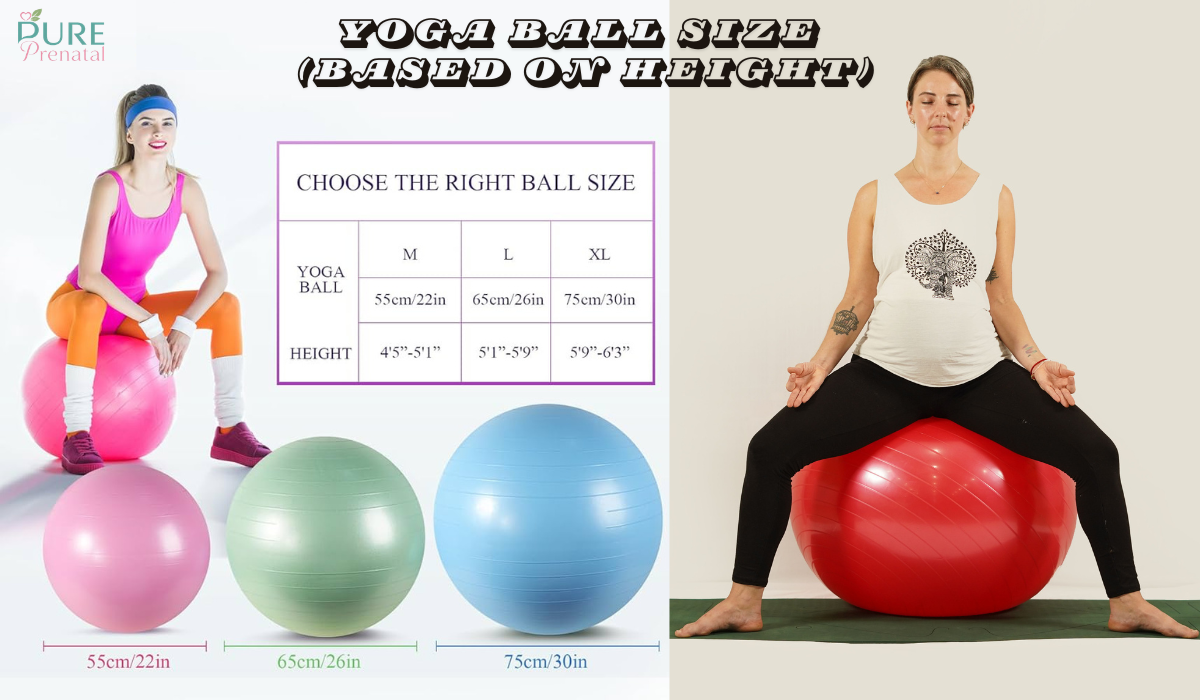
Yoga Ball Size Chart for Pregnancy (Based on Height)
This is the same sizing logic used for regular exercise balls — pregnancy doesn’t change your body’s basic proportions, so there’s no need to overthink it.
| Your Height | Recommended Ball Size |
|---|---|
| Under 4’6″ (137 cm) | 45 cm |
| 4’6″ – 5’0″ (137–152 cm) | 55 cm |
| 5’1″ – 5’7″ (155–170 cm) | 65 cm |
| 5’8″ – 6’1″ (173–185 cm) | 75 cm |
| 6’2″ and above (188 cm+) | 85 cm |
If you’re right on the border between two sizes — say 5’7″ and a bit — and you’re planning to use it through labor too, going with the slightly bigger size usually works out more comfortably.
How to Tell If You Got the Right Size
Charts are a good starting point, but nothing beats actually sitting on the thing. Once you do:
- Your hips should sit a little higher than your knees, or roughly level
- Feet flat on the floor, about hip-width apart
- Knees bent at close to a 90-degree angle
- No tipping forward, no straining to keep upright
Knees higher than your hips? Too small. Feet barely reaching the ground? Too big. It’s really that simple to spot once you know what you’re checking for.
Does the Right Size Change as Pregnancy Progresses?
Honestly, no — your height stays the same, so whatever size worked in month three will still work in month eight. What tends to shift is how firm you keep it. A lot of women prefer a bit more air in the ball later on, since balance gets trickier once the bump is fully grown and your sense of stability changes.
Yoga Ball, Birthing Ball, Exercise Ball — Same Thing?
Pretty much. You’ll see all three names used, and honestly the sizing advice doesn’t change no matter which label is on the box.
- Exercise ball / stability ball: The general fitness world’s name for it
- Yoga ball: Usually how it’s marketed for prenatal stretching
- Birthing ball: Same ball, just aimed at the labor-support crowd
Don’t let the name on the packaging steer your decision. Check the size guide against your height, and make sure it’s anti-burst material — that matters more than what it’s called.
Before You Start Using One
A few things worth keeping in mind:
- Inflate it to the firmness the manufacturer recommends — under-inflated balls are wobblier and less stable than you’d expect
- Use it on carpet or a non-slip mat, never on a slick hard floor
- Keep a wall, sturdy chair, or another person close by, especially as you get further along
- If anything feels off — dizzy, unsteady, uncomfortable — stop and reassess
Questions People Actually Ask
I’m 5’4″ — what size should I get?
That puts you in the 65cm range, which covers most people between 5’1″ and 5’7″.
I’m 5’6″ — can I get away with a 55cm ball?
You could, but it’ll probably sit too low and push your knees above hip level. A 65cm would likely feel a lot more natural.
Does a bigger ball automatically mean safer?
Not really. Go too big and your feet won’t reach the floor properly, which throws off your balance. The goal isn’t “biggest possible” — it’s matching the ball to your actual height.
When’s a good time to start using one?
Plenty of women start in the second trimester for gentle sitting and stretching, though there’s nothing wrong with starting earlier if it feels good. Just run it by your doctor first, particularly if there’s anything complicated going on with your pregnancy.

Dr. Tania Adib is a Board Certified OB/GYN based in the northern suburbs of Chicago. She earned her undergraduate degree from the University of Notre Dame and her medical degree from Georgetown University in Washington, D.C., before completing her residency in Obstetrics and Gynecology at Magee-Womens Hospital, University of Pittsburgh Medical Center. Her clinical interests include full-spectrum obstetrics and gynecology, from the first period through the menopausal years, contraception, and abnormal bleeding.