

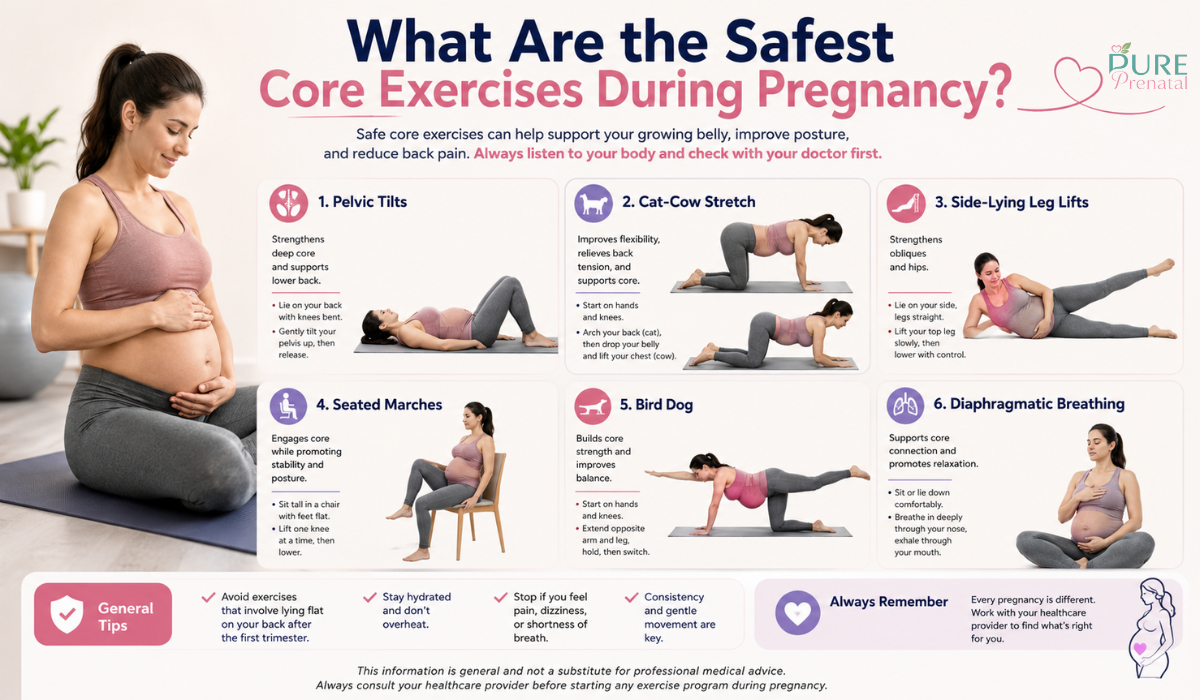
Pregnancy changes almost everything about how your body moves, balances, and holds itself upright, and your core is right at the center of that shift. So it makes sense that one of the most common questions expecting mothers ask is about safe core exercises during pregnancy, which ones actually help, which ones to avoid, and whether working your abs is even a good idea once you have a baby on board.
The short answer is yes, core work can be safe and genuinely beneficial throughout pregnancy, but the way you train your midsection needs to change as your body changes. This guide walks through what’s safe trimester by trimester, which movements to skip, and how to build a simple, low impact pregnancy workout routine that supports your changing body instead of straining it.
Is It Okay to Do Core Workouts While Pregnant?
Yes — for most healthy pregnancies, core exercises are not only okay but encouraged. A strong, well-functioning core helps support your growing belly, protects your lower back from the extra load it’s carrying, and can make daily movements like standing up, rolling over in bed, and eventually pushing during labor noticeably easier.
The key word here is “well-functioning.” Pregnancy core work isn’t about chasing a six-pack or doing hundreds of crunches. It’s about training the deep stabilizing muscles — particularly the transverse abdominis and pelvic floor — so they can do their job of supporting your spine and pelvis as your center of gravity shifts forward.
That said, every pregnancy is different. If you’re dealing with complications such as placenta previa, preeclampsia, a history of preterm labor, or any condition your doctor has flagged, core exercise guidelines may look different for you. Always get the green light from your healthcare provider before starting or continuing any pregnancy workout plan, especially if you weren’t active before conceiving.
Why Core Strength Matters So Much in Pregnancy
As your uterus expands, your abdominal muscles stretch to accommodate it, and a condition called diastasis recti — a separation of the two sides of the rectus abdominis muscle — becomes increasingly common, especially in the second and third trimesters. This is a completely normal part of pregnancy for many women, but the exercises you choose can either support healthy healing afterward or make the separation more pronounced.
This is exactly why traditional ab exercises like full sit-ups, crunches, and double leg raises are generally discouraged once you’re visibly pregnant. These movements increase pressure on an already-stretched abdominal wall and can worsen doming or bulging along the midline. Safer alternatives work the deep core without that forward-crunching motion, which is the main principle behind almost every recommendation in this article.
Safe Core Exercises by Trimester
Ab Exercises for Pregnancy: First Trimester
In the first trimester, your bump likely isn’t showing yet, and many women can continue much of their pre-pregnancy core routine with a few adjustments. This is actually a great window to build foundational strength before your belly grows.
Good options during this stage include:
- Deep belly breathing (diaphragmatic breathing): Lie or sit comfortably, inhale into your belly, and gently draw your navel toward your spine as you exhale. This activates the transverse abdominis, the deep muscle layer that acts like a natural corset.
- Modified planks: A standard plank is usually fine early on if you feel stable, but keep your hips level and stop if you notice any doming down the middle of your abdomen.
- Bird dogs: On hands and knees, extend one arm and the opposite leg while keeping your spine neutral. This builds core and back stability together.
- Pelvic tilts: Gently rock your pelvis forward and back to mobilize the lower back and engage the lower abs.
Even in this early stage, avoid lying flat on your back for extended periods if it causes dizziness or discomfort, and skip any exercise involving jerky, high-impact movement.
Second Trimester Pregnancy Exercise Adjustments
By the second trimester, your bump is more noticeable, your ligaments are loosening due to the hormone relaxin, and your balance starts to shift. This is the point where most experts recommend moving away from any exercise done lying flat on your back for more than a few minutes, since the weight of the uterus can compress a major blood vessel and reduce blood flow.
Safe and effective options for this stage include:
- Standing pelvic tilts and wall sits: These keep your spine supported while still activating your core.
- Side-lying leg lifts with core engagement: Great for working the obliques without any twisting motion.
- Seated or standing torso stabilization holds: Using a stability ball or simply your own body weight to challenge balance while keeping your core braced.
- Modified bird dogs and cat-cow stretches: Both continue to be excellent for spinal mobility and gentle core activation.
- Kneeling or incline planks: As a regular plank becomes harder to hold with good form, switching to an incline version against a wall or bench keeps the movement safe and effective.
If you notice any bulging or doming along your midline during any of these moves, ease off the intensity or switch to a gentler variation.
Safe Core Exercises During Pregnancy Third Trimester
The third trimester is when many women feel the most pressure on their pelvic floor and lower back, so the focus shifts even more toward gentle stabilization rather than strength-building intensity. Balance also becomes a bigger consideration, since your center of gravity has moved significantly.
Recommended movements at this stage include:
- Seated deep breathing with pelvic floor engagement: Combining breath work with a gentle pelvic floor lift helps prepare the body for labor.
- Standing marches with core bracing: Lift one knee at a time while keeping your torso stable, which mimics the stability needed for everyday movement late in pregnancy.
- Supported side planks (modified, on the knees): These target the obliques with minimal strain and can be done against a wall or with a partner for balance support.
- Cat-cow and gentle spinal rotations: These relieve lower back tension while keeping the core gently engaged.
Avoid any exercise that requires lying flat on your back, deep twisting through the spine, or anything that leaves you breathless or lightheaded. Listening to your body matters more in this trimester than in any other.
Building a Low Impact Pregnancy Workout Routine
A well-rounded pregnancy workout plan doesn’t need to be complicated. Most healthcare providers recommend around 20 to 30 minutes of moderate activity most days of the week, assuming there are no medical restrictions. A simple structure might look like this:
- Warm-up (5 minutes): Gentle walking in place or marching, plus a few pelvic tilts.
- Core and stability work (10–15 minutes): Choose two or three exercises appropriate for your current trimester from the lists above.
- Low impact cardio (10–15 minutes): Walking, swimming, or stationary cycling are all considered safe, low-impact ways to keep your heart rate up without jarring your joints.
- Cool-down and stretching (5 minutes): Focus on the hips, lower back, and chest, which tend to carry the most tension during pregnancy.
Consistency matters far more than intensity. Three or four shorter sessions a week, done with proper form, will generally serve you better than occasional intense workouts that leave you exhausted or sore.
General Safety Guidelines for Core Work During Pregnancy
A few principles apply across every trimester:
- Stop if you feel pain, dizziness, or shortness of breath. These are signals to slow down or stop entirely.
- Watch for doming or bulging along the midline of your belly — a sign the exercise may be too intense for your current core strength.
- Avoid lying flat on your back for extended periods after the first trimester.
- Stay hydrated and avoid overheating, especially in warmer climates or heated studios.
- Skip any exercise involving a risk of falling or abdominal trauma, such as contact sports or exercises requiring sharp changes in direction.
- Check in with your healthcare provider regularly, particularly if you’re increasing intensity or trying new movements.
Frequently Asked Questions
Is it okay to do core workouts while pregnant?
For most healthy pregnancies, yes. The key is choosing exercises that engage the deep core muscles without excessive strain, such as pelvic tilts, modified planks, and bird dogs, rather than traditional crunches or sit-ups.
Can core exercises help prevent diastasis recti?
Gentle, controlled core work that avoids forward-crunching motions may help support the abdominal wall as it stretches, but diastasis recti can still occur even with careful exercise, since it’s largely driven by the physical growth of the uterus. Working with a physical therapist after delivery can help with recovery.
When should I stop doing core exercises during pregnancy?
Rather than stopping altogether, most women simply modify their core routine as pregnancy progresses, shifting away from back-lying positions and high-intensity movements in favor of gentler, more stabilizing exercises, particularly in the third trimester.
How often should I do core exercises while pregnant?
Three to four sessions per week of ten to fifteen minutes each is a reasonable starting point for most healthy pregnancies, though this should always be adjusted based on your energy levels and your provider’s guidance.
Can I start core exercises if I wasn’t active before pregnancy?
Yes, but it’s best to start slowly with gentle movements like breathing exercises and pelvic tilts, and to get clearance from your healthcare provider first, especially if you’re new to exercise altogether.
Do core exercises help with labor and delivery?
A strong, coordinated core and pelvic floor can support better body positioning and control during labor, and many women find that the breathing and bracing techniques practiced during pregnancy carry over usefully into the delivery room.

Dr. Tania Adib is a Board Certified OB/GYN based in the northern suburbs of Chicago. She earned her undergraduate degree from the University of Notre Dame and her medical degree from Georgetown University in Washington, D.C., before completing her residency in Obstetrics and Gynecology at Magee-Womens Hospital, University of Pittsburgh Medical Center. Her clinical interests include full-spectrum obstetrics and gynecology, from the first period through the menopausal years, contraception, and abnormal bleeding.