

If you’ve got an 18-month-old tearing through the house, pointing at everything, and testing out new words (and new tantrums), you’re right in the middle of one of the most exciting stretches of early childhood. This age brings a burst of growth across the board — your toddler is walking with more confidence, picking up new words almost daily, and starting to show a personality all their own.
Every child develops at their own pace, and there’s a wide range of what’s considered typical at this stage. This guide walks you through what most 18-month-olds are doing, what to keep an eye on, and when it might be worth checking in with your pediatrician.
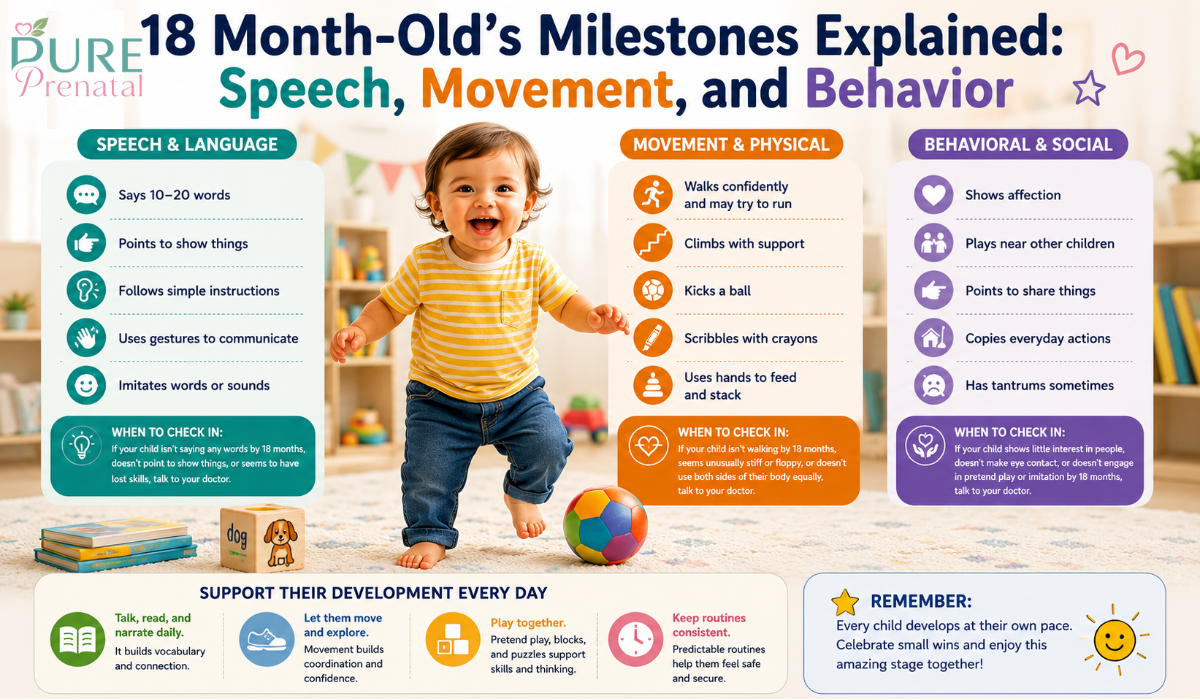
Speech and Language Milestones at 18 Months
Language often takes off around this age, though some toddlers are talkers early and others hang back before their words come tumbling out later.
By 18 months, most toddlers can:
- Say around 10 to 20 words, even if they’re not all pronounced clearly
- Point to a few familiar objects, people, or body parts when asked
- Follow simple one-step instructions, like “give me the ball” or “come here”
- Use gestures like waving, pointing, or shaking their head to communicate
- Imitate words or sounds they hear from you
Some toddlers combine gestures with sounds to get their point across long before they have the words for it — pointing at the fridge and grunting counts as communication too. If your child isn’t saying many words yet but is clearly trying to communicate in other ways, that’s often a normal part of the process.
When to check in with your doctor: If your toddler isn’t saying any words by 18 months, doesn’t point to show you things, or seems to have lost skills they once had, it’s worth mentioning at your next appointment. Early support can make a real difference, and your pediatrician can help you figure out whether a speech evaluation makes sense.
Movement and Physical Milestones at 18 Months
This is the age where “toddler” starts to really earn its name — most kids are past the tentative first steps and into that half-run, half-stumble gait that makes you want to keep a hand nearby at all times.
Around 18 months, you’ll likely see your child:
- Walking confidently and attempting to run (even if it looks more like controlled falling)
- Climbing onto the couch, or trying to tackle a few stairs with a hand to hold
- Kicking a ball forward without toppling over
- Scribbling if you hand them a crayon
- Stacking a few blocks before knocking them down, obviously
- Feeding themselves with their fingers, maybe attempting a spoon with mixed results
Fine motor skills are coming along too — turning board book pages, pulling off their own socks at the worst possible moment, pointing with real precision instead of a general wave in a direction.
When to check in with your doctor: If your child isn’t walking independently by 18 months, seems unusually stiff or floppy, or doesn’t use both sides of their body equally, bring it up with your pediatrician. These are worth a conversation, not a source of worry on their own.
Behavioral and Social Milestones at 18 Months
This is where things get interesting. Somewhere around 18 months, the baby you knew starts turning into an actual little person with opinions, preferences, and a growing sense of independence — which, let’s be honest, comes with more meltdowns too.
Common behaviors at this stage include:
- Genuine affection toward the people they’re close to, like unprompted hugs
- Playing near other kids, even without much direct interaction yet
- Pointing at something just to share it with you, not only to ask for it
- Copying everyday actions, like pretending to sweep or talk on the phone
- Having occasional tantrums when things don’t go their way
Emotional ups and downs are completely normal here. Your toddler is dealing with big feelings and limited ways to express them, which often shows up as frustration. This isn’t a sign of bad behavior; it’s a sign of a developing brain.
When to check in with your doctor: If your child shows little interest in people, doesn’t make eye contact, or doesn’t engage in any pretend play or imitation by 18 months, it’s a good idea to raise this with your pediatrician at your next well-child visit.
Supporting Your 18 Month-Old’s Development
You don’t need special programs or flashcards to support your toddler at this age. Everyday moments do most of the work:
- Talk, narrate, and read together. Describing what you’re doing, even something as simple as making lunch, helps build vocabulary.
- Let them move. Time to walk, climb, and explore safely builds coordination and confidence.
- Follow their lead in play. Pretend play, stacking toys, and simple puzzles support both motor skills and thinking.
- Stay consistent with routines. Predictable mealtimes, naps, and bedtimes help toddlers feel secure, which supports emotional development too.
Frequently Asked Questions
How many words should an 18-month-old be saying?
Most toddlers say somewhere between 10 and 20 words by this age, though the range is wide. Some say more, some say fewer but understand a great deal.
Is it normal for an 18-month-old to have tantrums?
Yes. Tantrums are a normal part of development at this age, driven by big emotions and limited communication skills, not by intentional misbehavior.
Should my 18-month-old be running yet?
Many toddlers are attempting to run by 18 months, though balance and coordination are still developing. A steady walk with occasional running attempts is typical.
What if my toddler isn’t hitting these milestones?
Development varies quite a bit from child to child. If you notice a few missed milestones, especially around speech or social engagement, it’s worth mentioning at your next pediatrician visit rather than waiting it out on your own.

Dr. Tania Adib is a Board Certified OB/GYN based in the northern suburbs of Chicago. She earned her undergraduate degree from the University of Notre Dame and her medical degree from Georgetown University in Washington, D.C., before completing her residency in Obstetrics and Gynecology at Magee-Womens Hospital, University of Pittsburgh Medical Center. Her clinical interests include full-spectrum obstetrics and gynecology, from the first period through the menopausal years, contraception, and abnormal bleeding.