
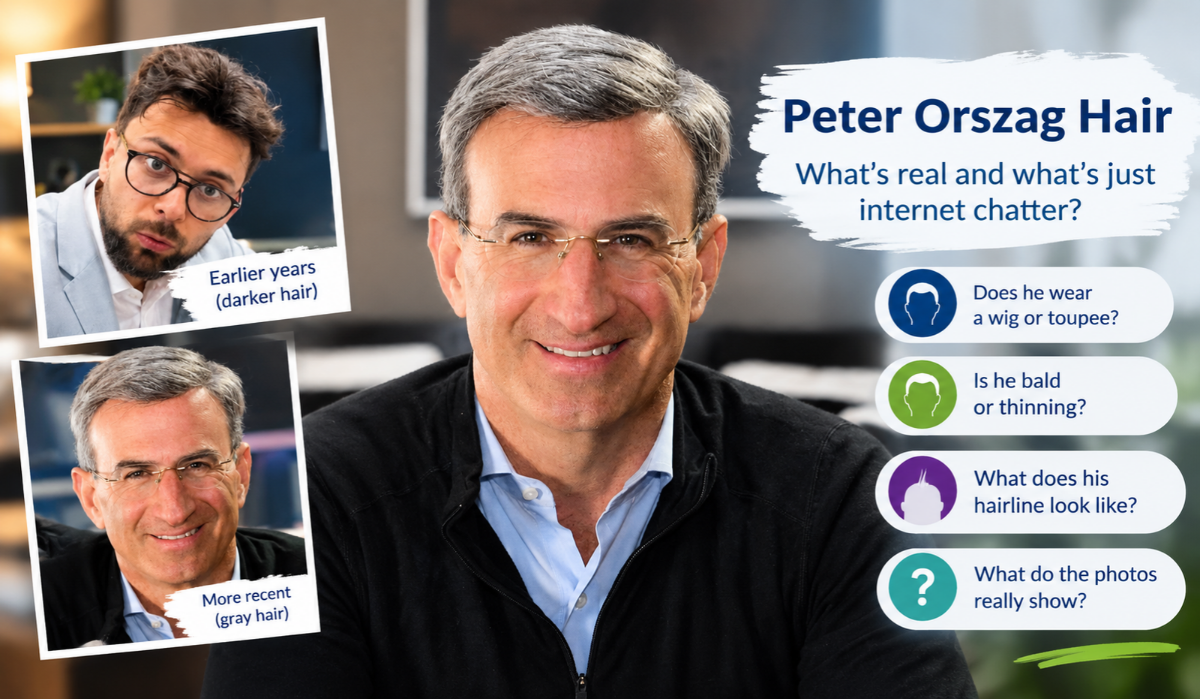
Search for Peter Orszag and Google will often offer to finish your sentence with a question about his hair. That’s a odd legacy for someone who ran the Congressional Budget Office, directed the Office of Management and Budget, and now leads Lazard. But people are curious, so let’s sort out what’s actually known about Peter Orszag’s hair and what’s just internet chatter.
A quick look at who he is
Peter Orszag was born in Boston in 1968. He graduated summa cum laude from Princeton, then earned his Ph.D. in economics at the London School of Economics as a Marshall Scholar. He worked in the Clinton administration, took over the Congressional Budget Office in 2007, and later became Obama’s budget director at OMB.
After government he went into finance. He joined Lazard in 2016, became CEO of its Financial Advisory business in 2019, and moved into the top job on October 1, 2023. The chairman title followed in January 2025, and as of 2026 he holds both.
Why does that matter for a hair article? Because a career like that leaves a huge photo trail. Congressional hearings, White House briefings, TV interviews, conference stages, official portraits. Very few executives have been photographed under so many kinds of lighting over so many years, and that trail is where the whole Peter Orszag hairstyle debate comes from.
What his hair actually looks like
Pretty ordinary, honestly. It’s short, tidy, and conservative, the kind of cut you’d expect on someone who spends his days in boardrooms. The sides are neat and the top is kept under control. He has never chased a trend.
The one obvious change is color. Older photos show darker hair, and recent ones show quite a bit more gray. That’s just age, but it affects how the hair reads on camera. Gray catches light differently than dark hair does, and dark hair against pale skin creates a sharp contrast that gray doesn’t. So the same haircut can look noticeably different in two photos taken ten years apart.
Is Peter Orszag bald?
Nothing in the public record says so. Recent official photos, including the images in Lazard’s 2026 proxy materials, show a full head of short hair. “Bald” just doesn’t describe what you see.
“Balding” is a slippery word too. People use it for everything from a slightly higher hairline to advanced hair loss, and nobody can diagnose that from a magazine photo. All anyone outside his doctor’s office can honestly say is that he has visible hair.
Does Peter Orszag have thinning hair?
Most talk about Peter Orszag hair loss or thinning starts with a specific photo where more scalp seems to show. But scalp visibility depends on a lot of things: the lighting, which way the hair is brushed, the hair color, the camera angle, and how sharp the image is. Bright lights overhead can make almost anyone look thinner on top, while soft light from the front does the opposite. As his hair has grayed, it also bounces light differently, which can suggest a change in density when the haircut hasn’t changed at all.
A photograph captures one moment. It isn’t a medical exam.
Does Peter Orszag wear a wig or toupee?
This is the rumor behind most of the searching, so here’s the straight answer: there’s no reliable public confirmation that he wears a wig, toupee, or any other hairpiece.
Here’s the part people skip, though. Nobody can prove he doesn’t, either. Some sites flatly declare that he has never worn a hairpiece, and they can’t back that up any more than the sites hinting the opposite can. Both sides are guessing.
You can see how these rumors grow. Someone says a hairline “looks like a toupee.” A second site repeats it. A third summarizes the second. Pretty soon an offhand comment reads like reporting. But ten pages saying the same thing isn’t ten pieces of evidence. It’s usually one unsupported remark, copied. When you ask what the original evidence was in this case, the answer is nothing.
Why his hair can look like a hairpiece in photos
A handful of very normal things explain most of the “that looks fake” reactions:
- A tidy shape. A well-kept short haircut can look almost too uniform on camera. That’s what a good barber is supposed to deliver.
- Studio lighting. TV sets use lights from the front, sides, top, and back. Overhead light exposes scalp, and front light makes hair look thicker.
- Camera height. A lens a little above eye level shows a very different hairline than one at eye level.
- Gray hair. In bright light, gray strands can nearly disappear, and in other shots they stand out.
- Length and styling. A few weeks of growth or a different part can change how dense hair appears.
- Image quality. Screenshots from video lose fine detail fast, and hair is one of the first things to go.
None of that requires a wig, a transplant, or any kind of secret.
The Peter Orszag hairline
His hairline sometimes looks sharply defined, and people take that as a red flag. It shouldn’t be. A clean cut and careful styling give plenty of men a crisp hairline, and forehead visibility, lighting, and hair direction all change how the front looks. No reliable source offers a medical or cosmetic explanation for his hairline, so anything you read claiming one is speculation.
Has Peter Orszag had a hair transplant?
There’s no credible public confirmation that he has. Modern transplants can look very natural, so photos can’t prove or rule one out. Anyone claiming to know either way is going beyond the evidence.
Wig, toupee, hair system, transplant: what’s the difference?
These terms get tossed around as if they mean the same thing, so briefly:
- A wig covers most or all of the scalp.
- A toupee is a smaller piece that covers one area, usually the top or front.
- A hair system is a newer, broader term for partial or full coverage designed to blend with existing hair.
- A hair transplant isn’t a hairpiece at all. It’s surgery that moves follicles from one part of the scalp to another.
Lumping them together is a big reason online discussions get so confused.
How his hair has changed over the years
The real story is aging. The cut has barely changed, while the color has shifted from darker to much grayer. And there’s a funny side effect: because his style has stayed so consistent, people have a fixed point to compare against, so small differences in light or angle get noticed. Someone who changes hairstyles every couple of years gives viewers nothing to compare.
The executive haircut effect
There’s a practical takeaway here. In finance, law, government, and consulting, the best haircut is usually the one nobody mentions. It works in formal and semi-formal settings, photographs the same way every time, and doesn’t compete with a suit. Orszag’s look fits that description. It’s understated and neat without being fashionable, and it works equally well in a TV interview or on a conference stage.
If you want something similar, don’t ask your barber to copy his cut exactly. Hair density, texture, and hairline are personal. Ask for a classic short professional cut with tidy sides, a soft taper instead of a skin fade, and enough length on top to hold a controlled shape. A little light product and a natural finish will get you closer than anything glossy. Bring a reference photo and let your barber adjust it to your own hair.
Peter Orszag’s net worth in 2026
People who look up his hair often end up wondering about his money too. No reliable public source gives a verified 2026 net worth, so any specific number you see is an estimate.
What’s documented is his pay. Lazard’s 2026 proxy statement lists $15 million in total awarded compensation for 2025: a $900,000 salary, a $3.9 million cash incentive, and a $10.2 million long-term incentive award. That isn’t net worth, which also depends on investments, property, equity, debts, and other private assets. For context, Lazard reported $3.099 billion in net revenue for 2025 and said its Financial Advisory business had record revenue that year.
Peter Orszag’s wife and family
Orszag married journalist Bianna Golodryga in 2010, and Lazard’s official biography confirms it. Public biographical sources say they have two children together, and that Orszag has other children from earlier relationships, for five in all. Since these are private individuals, it’s best to stick to the basics.
Why hair rumors about public figures spread
Hair ties into age, health, confidence, and identity, so people can’t help commenting on it. The cycle is easy to recognize. Someone compares an old photo with a new one and spots a difference. Search engines link that question to related ones about wigs, transplants, and hair loss, and every new article gives people another reason to search. After that, confirmation bias takes over: once you’re expecting a wig, normal variation starts to look like proof.
Isolated photos are weak evidence. Imagine one shot indoors in soft light and another outdoors in harsh sun, or one professionally retouched and the other a blurry video grab. Comparing those tells you almost nothing.
FAQ
Does Peter Orszag wear a wig?
There’s no reliable public evidence that he does. Photos can’t settle it either way.
Does Peter Orszag wear a toupee?
No verified source says so. His neat, consistent style has fueled the talk, but consistency isn’t proof.
Is Peter Orszag bald?
No. Current public photos show plenty of visible hair.
Has Peter Orszag had a hair transplant?
There’s no credible public confirmation of one.
What is Peter Orszag’s net worth?
It isn’t publicly verified. His 2025 awarded compensation at Lazard was $15 million, which is a different thing.
Who is Peter Orszag married to?
Journalist Bianna Golodryga, since 2010.
What does Peter Orszag do now?
He’s CEO and Chairman of Lazard.
Conclusion
Peter Orszag’s hair is a short, tidy, conservative cut that has stayed consistent for years while turning from dark to gray. Nothing in the public record supports a wig, toupee, or transplant, and nothing rules them out, because photographs can’t answer that question. What is documented is his career: CBO Director, OMB Director under Obama, and now CEO and Chairman of Lazard.