
I get asked about newborn quilt patterns more than almost anything else here at Toad & Sew, and honestly, I get it. There are a lot of options out there, and when you’re staring down your first baby quilt project (or your fiftieth), it helps to have someone walk you through the basics instead of just handing you a pattern and wishing you luck.
Baby quilts have always been one of my favorite things to make. Part of it is practical — with somewhere between 9 and 11 million active quilters across the U.S. and Canada, baby quilt patterns are one of the most popular corners of this hobby, and for good reason. They’re small. They come together fast. And unlike a queen-size bed quilt that can eat up your evenings for months, you can finish a crib quilt in a weekend if you plan it right. So whether you’re brand new to sewing or you’ve got a stash of fabric collections waiting for the right project, let’s talk through what actually goes into making a good newborn quilt.
So, What Size Should a Newborn Quilt Actually Be?
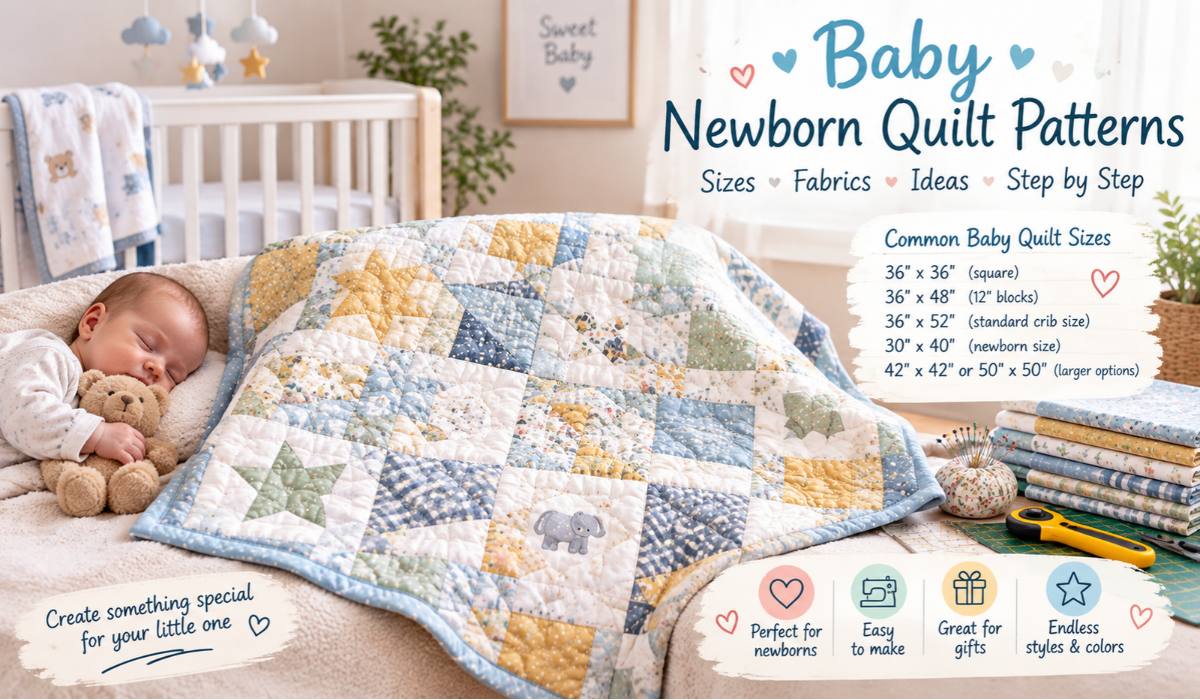
This is usually the first thing people ask, and the honest answer is: it depends on what you want the quilt for. Baby quilts give you way more wiggle room than adult bedding does. A few sizes I come back to again and again:
- 36″ x 36″ — a square quilt, simple to piece, and a good one if you’re newer to this.
- 36″ x 48″ — works nicely with 12″ blocks, three across and four down.
- 36″ x 52″ — this is more or less the “standard” crib quilt size if you had to pick one.
- 30″ x 40″ — a smaller newborn size that’s easy to wash and easy to tote around.
- 42″ x 42″ or 50″ x 50″ — a bit bigger, and common in strip-pieced or precut-friendly designs.
Here’s a tip that took me embarrassingly long to figure out on my own: if you keep your quilt under 38″ wide, you can cut it from standard 42″-wide fabric without piecing extra panels together. It saves yardage, and it saves you money, especially if you’re working from a fabric collection you love and don’t want to buy three yards of.
What People Actually Do With Baby Quilts
Baby quilts don’t just sit in a crib. I’ve seen them used a dozen different ways, and honestly, that’s part of what makes them such a fun project.
The most obvious one is a baby blanket quilt — something soft to keep a newborn warm, made from flannel or double gauze if you want that extra-cozy feel. But I’ve also had customers turn their baby quilt into a nursery wall hanging, which is a sweet way to decorate a room without buying artwork that means nothing to anyone. And as kids grow out of the crib, a lot of these same patterns shrink down (or scale up, depending on how you look at it) into a lap quilt for car rides, reading nooks, or that one blanket every toddler refuses to be without.
Then there are the sentimental ones — rag quilts, with their soft, frayed seams, and onesie quilts, made from a baby’s actual outfits. I always tell people that if they’ve got a box of newborn clothes they can’t bring themselves to donate, an onesie quilt is probably the best use of that fabric you’ll ever find.
How a Newborn Quilt Actually Comes Together
If you’ve never made one before, here’s roughly how it goes:
Get your supplies together first. Sewing machine, fabric, a good rotary cutter, a cutting mat, a quilting ruler, pins, binding clips, and an iron. You’ll add more tools as you go, but that’s the core kit.
Pick a pattern that matches your patience level. If this is your first quilt, go simple. Save the intricate star layouts for later, once you’ve got a few finishes under your belt and know how your machine behaves.
Don’t overthink the fabric. Quilting cotton is the classic choice, but flannel, double gauze, and even knits show up in a lot of modern baby quilt patterns now. Fat quarters are great here too — you get a bunch of coordinating prints without committing to yards and yards of anything.
Piece it, then quilt it. Once your top is sewn together, you layer it with batting and backing and quilt the whole thing. “Stitch in the ditch” is about as beginner-friendly as quilting techniques get, and it works great on simpler patterns.
Trim and bind. Last step. Or, if quilting your own top isn’t appealing yet, send it to a longarm quilter, or rent time on a longarm at your local shop. Both are completely normal ways to finish a quilt, and there’s zero shame in it.
If You’re Short on Time: Easy Patterns Worth Trying
Not every baby quilt needs to be complicated to look good. Some of the nicest ones I’ve seen are just bold, simple shapes — diagonal stripes, oversized geometric blocks — done well. These tend to be forgiving for beginners and still look intentional and modern, which makes them great for a baby shower gift you’re finishing the night before.
For the Fat Quarter Hoarders
If you’re anything like me, you’ve got a drawer somewhere stuffed with fat quarters you couldn’t resist buying. Patterns built around fat quarters — things with overlapping shapes or a more travel-inspired layout — are a great excuse to finally use them instead of letting them sit there looking pretty.
Star Patterns Never Really Go Out of Style
There’s a reason star blocks show up in baby quilts generation after generation. A big, bold star design has real visual impact without being hard to sew, and a more scattered, “nebula-style” star layout gives you something a little more artistic if you want to push past the basics. Both work well whether you’re going for something more traditional or leaning modern.
On Baby Boy, Baby Girl, and Gender-Neutral Designs
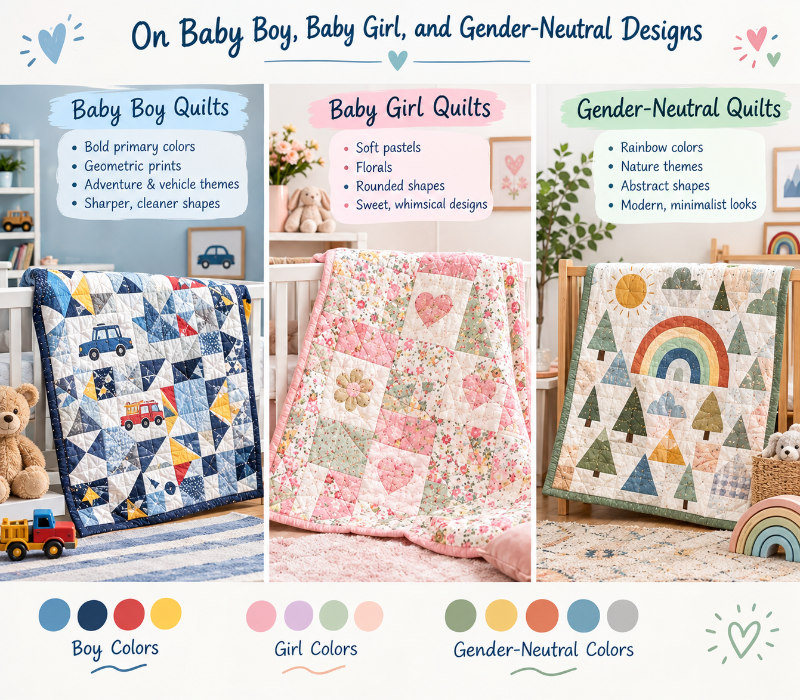
A lot of childrens quilt designs are made to work for any baby, but color is usually where boy and girl quilts start to diverge. Soft pastels, florals, and rounded shapes tend to show up more in baby girl quilt patterns, while bold primary colors and sharper geometric prints lean more toward baby boy quilt patterns. That said, I’m seeing more and more parents skip the traditional palette entirely — rainbow colors, nature themes, abstract shapes — and honestly, some of the nicest modern baby quilts I’ve seen recently don’t try to signal “boy” or “girl” at all.
Where to Find Free Patterns
Free patterns are a genuinely good way to test out a new technique before you commit real time and fabric to something bigger. A house-motif design with a cozy, welcoming feel is a nice example — offered free in the baby size, with a larger version available if you fall in love with it. Beyond individual designers, a few places I’d point you toward for free downloads:
- American Patchwork & Quilting — a big library of free digital patterns.
- Quilting Daily — solid beginner and intermediate options.
- Missouri Star Quilt Company — simple precut strip patterns, including a 42″ x 42″ design and a 50″ x 50″ version if you want something slightly bigger.
- The Polka Dot Chair — lots of free, large-block tutorials that come together quickly.
A Few Go-To Beginner Patterns
If you want a short list to actually start from, these are the ones I keep recommending:
- Half-Square Triangles (HSTs): A classic, and endlessly rearrangeable into new layouts.
- Fast Four-Patch: Genuinely a one-day project if you use precut squares.
- Precut-Friendly Designs: Anything built around 10″ layer cake squares cuts your prep time way down.
- Strip-Set Blocks: Quick to assemble using 2.5″ precut strips.
Last Thought
There’s no single “right” newborn quilt pattern — it really comes down to how much time you have, what fabric you’re drawn to, and who you’re making it for. Whether you end up with a two-color beginner square, a fat-quarter star design, or a onesie quilt stitched together from a stack of outgrown baby clothes, the fact that you made it by hand is what makes it worth keeping.
If you want help picking a pattern, it helps to know three things: your skill level (beginner, intermediate, advanced), whether you prefer precuts or scraps, and roughly what size you’re aiming for.

Dr. Tania Adib is a Board Certified OB/GYN based in the northern suburbs of Chicago. She earned her undergraduate degree from the University of Notre Dame and her medical degree from Georgetown University in Washington, D.C., before completing her residency in Obstetrics and Gynecology at Magee-Womens Hospital, University of Pittsburgh Medical Center. Her clinical interests include full-spectrum obstetrics and gynecology, from the first period through the menopausal years, contraception, and abnormal bleeding.
 Jess Klintan