

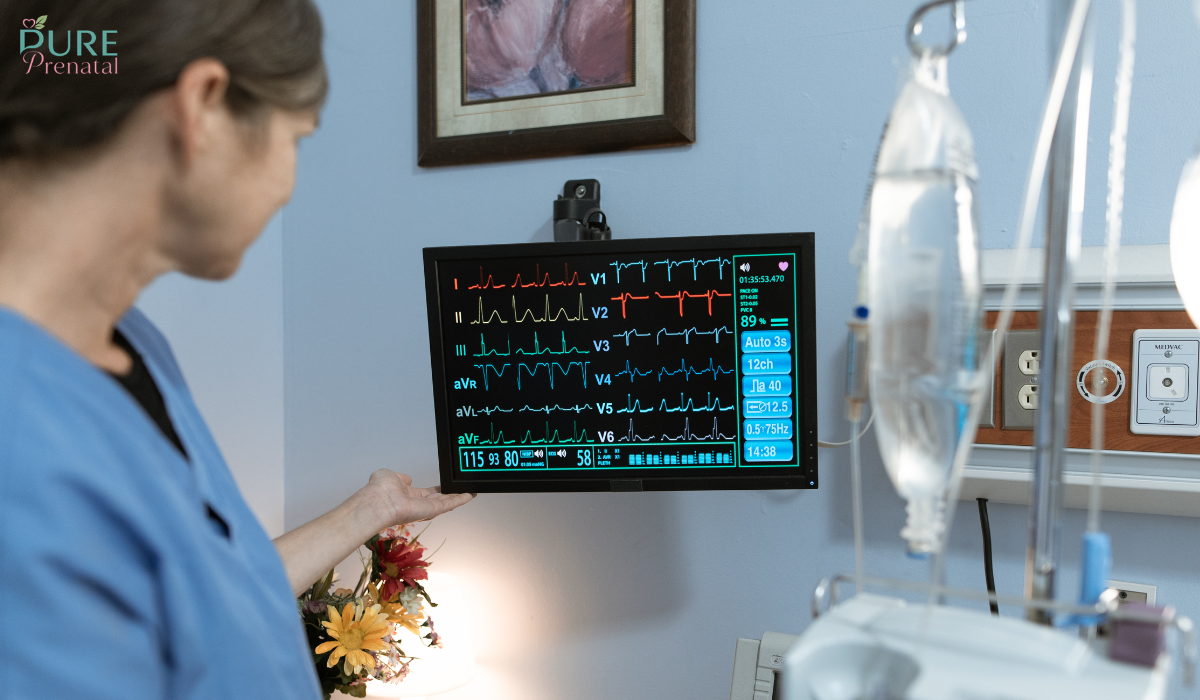
As your due date approaches, every tightening of your abdomen can make you wonder whether labor has finally started. For many expectant mothers, one of the biggest questions is whether they’re experiencing Braxton Hicks contractions or real labor contractions. If you’re being monitored at a hospital or clinic, seeing contractions appear on the screen can make the situation even more confusing.
A contraction monitor records uterine activity, but it cannot always tell whether you’re in true labor. Healthcare providers interpret the monitor alongside your symptoms, cervical changes, and your baby’s condition before deciding whether labor has actually begun.
Understanding Braxton Hicks vs real contractions on a monitor can help you feel more confident during the final weeks of pregnancy and know when it’s time to contact your healthcare provider.
Quick Answer
A contraction monitor can detect both Braxton Hicks contractions and real labor contractions, but it cannot determine on its own whether labor has started. The biggest difference is that true labor causes progressive cervical dilation and effacement, while Braxton Hicks contractions usually do not. Doctors combine monitor readings with a physical examination and your symptoms to confirm active labor.
What Are Braxton Hicks Contractions?
Braxton Hicks contractions are often called practice contractions or false labor contractions. They help prepare the uterus for labor but do not cause the same cervical changes as true labor.
Many women begin noticing them during the second trimester, although they usually become more common during the third trimester.
Typical features include:
- Irregular timing
- Tightening rather than severe pain
- Mild or moderate discomfort
- Usually felt in the front of the abdomen
- Often stop after resting, drinking water, or changing positions
- Do not become progressively stronger
Braxton Hicks are a normal part of many healthy pregnancies and don’t necessarily mean labor is about to begin.
What Are Real Labor Contractions?
Real labor contractions are different because they work together to help your baby move through the birth canal. Unlike practice contractions, they gradually become stronger, longer, and closer together.
True labor contractions typically:
- Follow a regular pattern
- Increase in intensity
- Last 30–90 seconds
- Continue despite movement or rest
- Cause cervical dilation and effacement
- Become increasingly difficult to talk through
These contractions indicate that labor is progressing.
How Does a Contraction Monitor Work?
A contraction monitor measures the tightening of your uterus during pregnancy and labor. It is commonly used during a non-stress test (NST), labor assessment, or continuous fetal monitoring.
External TOCO Monitor
The most common device is the tocodynamometer (TOCO), which is placed around your abdomen with an elastic belt.
It records:
- Contraction timing
- Frequency
- Duration
- Uterine activity
However, it cannot accurately measure the true strength of contractions because readings are affected by the mother’s body position, movement, and body type.
Internal Pressure Catheter (IUPC)
During active labor, healthcare providers may insert an intrauterine pressure catheter (IUPC) if more accurate information is needed.
Unlike the external monitor, this device measures the actual pressure inside the uterus, giving a clearer picture of contraction strength.
Braxton Hicks vs Real Contractions on Monitor
One of the most common misconceptions is that a hospital monitor can automatically distinguish false labor from true labor.
In reality, the monitor simply records uterine contractions. The healthcare team must interpret the tracing along with other clinical findings.
Comparison Table
| Feature | Braxton Hicks | Real Labor Contractions |
|---|---|---|
| Timing | Irregular | Regular |
| Frequency | Unpredictable | Gets closer together |
| Intensity | Usually stays the same | Progressively stronger |
| Duration | Often under one minute | Usually 30–90 seconds |
| Cervical changes | None or minimal | Progressive dilation and effacement |
| Stops with rest | Often | Rarely |
| Hydration helps | Frequently | Usually no |
| Monitor appearance | Irregular waves | Consistent repeating waves |
Can Braxton Hicks Show Up on a Monitor?
Yes.
Braxton Hicks contractions commonly appear on both hospital contraction monitors and NST monitors because the equipment records uterine tightening, not whether labor is progressing.
This is why many women are surprised when they see contractions on the screen but are told they are not yet in labor.
Healthcare providers understand that monitor readings alone cannot diagnose labor.
What Do Real Contractions Look Like on a Monitor?
On a CTG monitor or TOCO monitor, true labor contractions often appear as smooth wave-like peaks that:
- Rise gradually
- Reach a peak
- Return to baseline
- Repeat at regular intervals
As labor progresses, the waves usually become:
- More frequent
- More consistent
- Closer together
- Longer lasting
However, monitor patterns alone are not enough to confirm labor because some Braxton Hicks contractions can produce a similar appearance.
Why Doctors Don’t Rely on the Monitor Alone
Even experienced obstetricians and midwives know that contraction monitors tell only part of the story.
To determine whether labor has truly begun, they also evaluate:
- Cervical dilation
- Cervical effacement
- Baby’s position
- Baby’s heart rate
- Frequency of contractions
- Strength of contractions (if internally monitored)
- Rupture of membranes (water breaking)
- Maternal symptoms
This comprehensive assessment provides a much more accurate picture than the monitor alone.
Signs You’re Probably Having Braxton Hicks
You may be experiencing Braxton Hicks if your contractions:
- Feel irregular
- Don’t steadily become stronger
- Improve after drinking water
- Ease when you change positions
- Stop after resting
- Occur mainly in the front of your abdomen
- Are triggered by physical activity or a full bladder
Many pregnant women notice these contractions after a busy day, exercise, or mild dehydration.
Signs You’re More Likely in True Labor
Real labor becomes more obvious over time.
Signs include:
- Contractions occurring at regular intervals
- Increasing pain or pressure
- Contractions becoming closer together
- Pain spreading from the lower back toward the abdomen
- Bloody show
- Water breaking
- Persistent contractions despite walking or resting
- Increasing pelvic pressure
If these symptoms occur, it’s important to contact your maternity care provider for guidance.
Can Dehydration Trigger Braxton Hicks Contractions?
Yes. Dehydration is one of the most common reasons Braxton Hicks contractions become more noticeable. When your body doesn’t have enough fluids, the uterus can become more irritable and tighten more frequently.
To reduce practice contractions, try:
- Drinking plenty of water throughout the day.
- Resting on your left side.
- Emptying your bladder regularly.
- Avoiding overexertion.
- Taking breaks if you’ve been standing for long periods.
If the contractions continue despite hydration and rest, contact your healthcare provider for advice.
How Do Healthcare Providers Confirm True Labor?
A contraction monitor is only one piece of the puzzle. To confirm active labor, healthcare providers combine several findings rather than relying on the monitor alone.
They may assess:
- Cervical dilation
- Cervical effacement
- Contraction pattern
- Baby’s position
- Fetal heart rate on the CTG monitor
- Whether your waters have broken
- Your pregnancy history
- Changes over time
For example, two women may have very similar contraction monitor readings, yet only one is actually in labor because her cervix is continuing to dilate.
When Should You Go to the Hospital?
Every pregnancy is different, so always follow the advice of your maternity team. In general, you should contact your healthcare provider or maternity unit if:
- Contractions become regular and continue getting stronger.
- Your contractions are about five minutes apart (or according to the instructions you’ve been given).
- Your water breaks.
- You notice vaginal bleeding.
- Your baby’s movements decrease.
- You experience severe abdominal pain.
- You have a severe headache, vision changes, or swelling, which could indicate a pregnancy complication.
If you’re unsure whether you’re experiencing Braxton Hicks or true labor, it’s always safer to ask for medical advice.
Tips for Managing Braxton Hicks at Home
If your healthcare provider has confirmed that you are not in labor, these simple strategies may help relieve Braxton Hicks contractions:
- Drink plenty of water.
- Change your position.
- Rest if you’ve been physically active.
- Walk gently if you’ve been sitting for a long time.
- Take a warm (not hot) shower or bath if approved by your provider.
- Practice slow, controlled breathing.
- Empty your bladder regularly.
- Avoid becoming overheated.
Many women notice that these contractions become less frequent after resting or rehydrating.
Common Myths About Contraction Monitors
Myth 1: Every contraction on the monitor means labor has started.
Fact: A monitor records uterine tightening, including Braxton Hicks contractions.
Myth 2: Strong peaks always mean strong labor.
Fact: External TOCO monitors do not accurately measure contraction strength.
Myth 3: If contractions are visible, your cervix must be dilating.
Fact: Cervical dilation can only be confirmed through a clinical examination.
Myth 4: Braxton Hicks never appear regularly.
Fact: They can sometimes seem regular for a short time but usually do not become progressively stronger or closer together.
Understanding CTG and NST Monitoring
Many pregnant women hear the terms CTG monitor and NST monitor without knowing the difference.
CTG (Cardiotocography)
A CTG monitor records:
- Your baby’s heart rate.
- Uterine contractions.
It is commonly used during labor and when there are concerns about fetal well-being.
NST (Non-Stress Test)
A Non-Stress Test focuses mainly on monitoring the baby’s heart rate while also recording uterine activity. It helps healthcare providers check how your baby responds to movement during pregnancy.
Both tests provide valuable information but cannot independently diagnose active labor.
Key Takeaways
When comparing Braxton Hicks vs real contractions on a monitor, it’s important to remember that the monitor only records uterine activity. It cannot determine whether labor has truly begun.
Braxton Hicks contractions are generally irregular, often improve with rest or hydration, and do not cause progressive cervical changes. Real labor contractions become stronger, longer, and closer together while leading to cervical dilation and effacement.
If you’re uncertain about what you’re experiencing, always contact your healthcare provider. It’s better to seek reassurance than to ignore signs of labor or a possible pregnancy complication.
Frequently Asked Questions
Can Braxton Hicks appear on a contraction monitor?
Yes. Braxton Hicks contractions can appear on both hospital contraction monitors and NST monitors because they detect uterine tightening.
Can a contraction monitor tell if I’m in labor?
No. A contraction monitor cannot diagnose labor on its own. Healthcare providers also assess cervical dilation, effacement, symptoms, and labor progression.
What is the biggest difference between Braxton Hicks and real contractions?
The main difference is that real labor contractions cause progressive cervical dilation and become stronger and more regular over time, while Braxton Hicks usually do not.
Do Braxton Hicks become closer together?
They may occasionally seem close together for a short period, but they usually remain irregular and do not continue progressing like true labor contractions.
What do contractions look like on a CTG monitor?
Both Braxton Hicks and real labor contractions appear as wave-like patterns. True labor contractions usually become more regular and consistent, but cervical changes are still needed to confirm labor.
Can dehydration cause Braxton Hicks contractions?
Yes. Mild dehydration can increase uterine irritability and make Braxton Hicks contractions more noticeable. Drinking water often helps reduce them.
Does walking stop Braxton Hicks?
Sometimes. Braxton Hicks contractions may lessen or stop after changing activity or resting, whereas true labor contractions generally continue regardless of movement.
Should I go to the hospital if I see contractions on a home monitor?
Home monitors should never replace professional medical assessment. If your contractions become regular, painful, or are accompanied by your water breaking, bleeding, or reduced fetal movement, contact your healthcare provider promptly.
Conclusion
Knowing the difference between Braxton Hicks vs real contractions on a monitor can help you feel more prepared as your due date approaches. While contraction monitors are useful for tracking uterine activity, they cannot determine whether labor has truly started without considering cervical changes and your overall clinical picture.
Practice contractions are a normal part of pregnancy for many women, but true labor follows a predictable pattern that becomes stronger and more regular over time. If you ever feel unsure, trust your instincts and speak with your maternity care provider. Prompt medical advice is always the safest choice for you and your baby.

Dr. Tania Adib is a Board Certified OB/GYN based in the northern suburbs of Chicago. She earned her undergraduate degree from the University of Notre Dame and her medical degree from Georgetown University in Washington, D.C., before completing her residency in Obstetrics and Gynecology at Magee-Womens Hospital, University of Pittsburgh Medical Center. Her clinical interests include full-spectrum obstetrics and gynecology, from the first period through the menopausal years, contraception, and abnormal bleeding.