
You just ate dinner and now there is this searing sensation coming up behind your breastbone and it won’t go away. If you’re pregnant and this is new for you, welcome to a club nobody warns you about ahead of time. It tends to show up around the second trimester and, for a lot of women, sticks around — or gets worse — right through the third.
It’s annoying, sometimes miserable, but almost never dangerous. The good news is that effective heartburn during pregnancy remedies exist, and most of them are simple things you can start tonight — once you understand what’s causing it in the first place.
So Why Does This Happen Now?
Heartburn, at its core, is just stomach acid making its way somewhere it shouldn’t — up into the esophagus, where it irritates the lining and produces that burning sensation. What’s different about pregnancy is that two separate things are working against you at once.
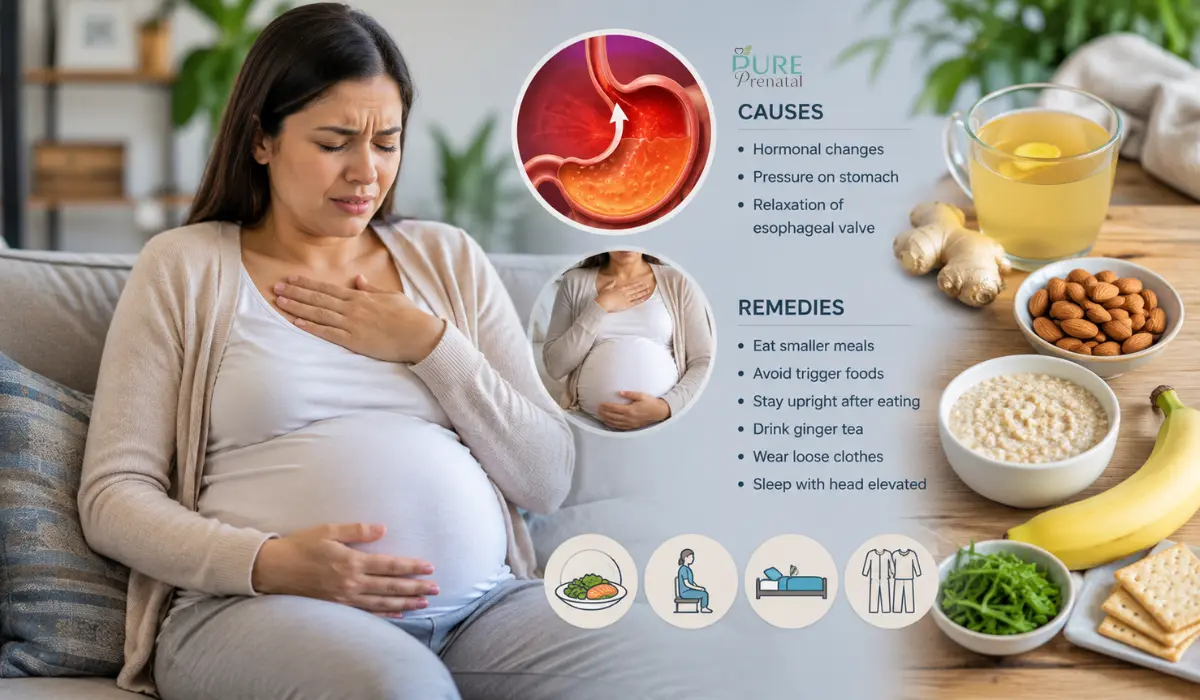
First, there’s progesterone. Your body ramps it up steadily through pregnancy, mostly to keep your uterus relaxed, but it doesn’t really discriminate — it also loosens the valve between your stomach and esophagus. Loosen that valve even a little and acid has an easier time sneaking past it.
Second — and this one’s just physics, really — your growing uterus is taking up space that used to belong to other organs. Your stomach is getting squished and pushed around and that pressure might drive the acid up more easily. That’s a huge one for making third trimester heartburn feel so much worse than you’ve experienced previously, even if you’ve never had reflux before in your life.
Heartburn During Pregnancy Remedies That Tend to Actually Help
There’s no magic fix here, honestly. Most women end up piecing together a few small habits that, together, make things noticeably more bearable.
Smaller, more frequent meals are probably the single biggest one. Three big meals a day puts a lot of pressure on a stomach that’s already cramped for space — five or six smaller ones tend to sit much easier.
Try not to lie down right after eating. Give it two or three hours if you can. And if bedtime rolls around before that, an extra pillow (or a wedge, if you want to get fancy about it) to prop yourself up a little can keep things from creeping upward overnight.
A lot of women swear by ginger — tea, candies, whatever form works for you. It’s an old remedy, but it holds up reasonably well for both nausea and reflux. Chewing sugar-free gum after meals is another one worth trying; it gets your saliva going, which helps neutralize the acid.
And this sounds small, but loosen up what you’re wearing. Anything tight at the waist is basically adding insult to injury.
The Foods That Usually Set People Off
Everybody’s different here, but the repeat offenders are pretty consistent: spicy or fried food, citrus, tomato sauce, chocolate, caffeine, anything carbonated, and — oddly enough — peppermint. If you can’t pin down your own triggers just by thinking about it, keeping a rough note of what you ate before a bad flare-up, even for a week or two, usually makes the pattern obvious.
When You Need Something Stronger Than Willpower
Sometimes the lifestyle stuff only gets you partway there, and that’s completely normal — it’s not a sign you’re doing anything wrong. Certain antacids, particularly the calcium carbonate kind, are generally considered fine to use during pregnancy. But “generally fine” isn’t a blanket pass, and dosing can matter more than people expect. Run it by your doctor, midwife, or pharmacist before you make anything a regular habit, rather than just assuming.
When It’s Worth Making a Call
Most of the time, this is just an uncomfortable part of pregnancy and nothing more. But a few things go beyond ordinary heartburn and are worth flagging to your provider:
- Nothing you try seems to touch it, home remedies or over-the-counter treatment included
- Swallowing hurts, or feels difficult
- You’re losing weight without meaning to
- You’re vomiting blood, or something that looks like coffee grounds
- Abdominal pain that’s severe or won’t let up
- Chest pain, shortness of breath, or pain spreading into your arm or jaw showing up alongside the burning — this one needs prompt attention, since it can occasionally point to something other than reflux
None of these are common. But it’s better to know what they look like than to spend a night wondering.
Things Women Actually Ask About This
Does bad heartburn mean something’s wrong with my pregnancy?
No — it’s one of the more universal side effects of the hormonal and physical changes going on, and for most women it clears up on its own after delivery.
Why did this suddenly get so much worse?
That timeframe is when the second and third trimesters hit, when your uterus is actually starting to apply substantial pressure on your stomach for the first time.
Can I just take antacids whenever I want?
Occasional use is generally fine. If you notice you’re reaching for them every day, though, that’s worth mentioning to your provider rather than just working around it.
Is it true that bad heartburn means the baby will have a lot of hair?
It’s an old wives’ tale that, interestingly, does have a sliver of research behind it — a couple of small studies noticed a loose correlation. But it’s far too unreliable to mean anything specific for your pregnancy, and it shouldn’t factor into how you handle your symptoms.
Will this eventually go away?
Yes, for the vast majority of women, pretty quickly after delivery. Once your hormones settle back down and there’s no more uterus crowding your stomach, the reflux usually resolves on its own.

Dr. Tania Adib is a Board Certified OB/GYN based in the northern suburbs of Chicago. She earned her undergraduate degree from the University of Notre Dame and her medical degree from Georgetown University in Washington, D.C., before completing her residency in Obstetrics and Gynecology at Magee-Womens Hospital, University of Pittsburgh Medical Center. Her clinical interests include full-spectrum obstetrics and gynecology, from the first period through the menopausal years, contraception, and abnormal bleeding.