

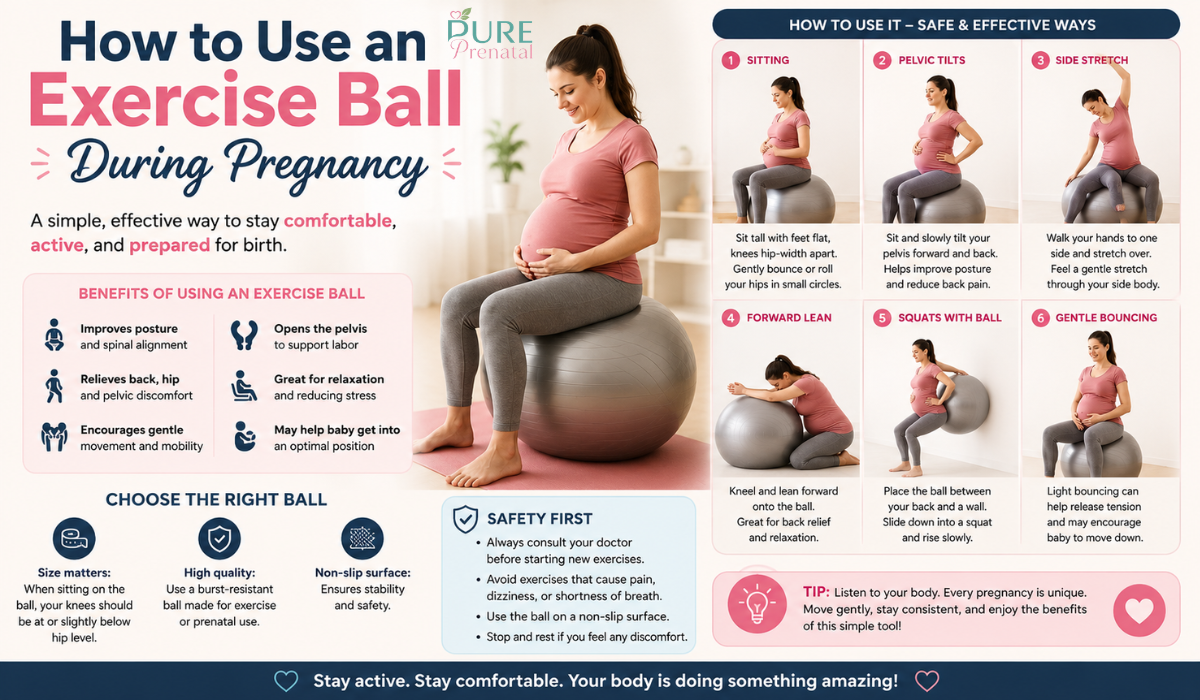
If you’ve spent any time researching prenatal fitness, you’ve probably come across pregnancy exercise ball workouts more than once. That’s not by accident. A birthing ball, also called a Swiss ball, stability ball, or gym ball, is one of the simplest, most affordable tools you can add to your pregnancy routine, and it’s one that midwives and physiotherapists genuinely recommend, not just influencers.
Unlike a lot of pregnancy fitness trends, this one isn’t about intensity. It’s about gentle movement, better posture, and giving your body a way to stay comfortable as your center of gravity keeps shifting. Whether you’re newly pregnant or counting down the final weeks, an exercise ball can be adapted to wherever you are.
This guide walks you through how to choose the right ball, when to start using it, and exactly how to do the most common and effective fitness ball exercises for pregnancy, safely, step by step.
Why an Exercise Ball Works So Well During Pregnancy
As your bump grows, your posture changes, your ligaments loosen (thanks to a hormone called relaxin), and your balance shifts. Regular gym equipment or floor exercises don’t always account for that. An exercise ball does.
Sitting or moving on an unstable surface gently engages your core and pelvic floor without you having to think about it too hard. That’s a big part of why balance ball pregnancy exercises are so often recommended, they build stability and strength in a low-impact, joint-friendly way.
Some of the general benefits reported by women who use a ball regularly during pregnancy include:
- Reduced lower back and hip discomfort
- Improved posture, especially as the belly grows heavier
- Better pelvic floor awareness and engagement
- Encouraged optimal fetal positioning in later pregnancy
- A sense of active preparation for labor
It’s worth saying clearly: an exercise ball isn’t a medical treatment, and it won’t guarantee an easier birth. But as part of a broader routine of movement, it’s a low-risk, high-comfort addition that many pregnant women find genuinely helpful.
Can I Use an Exercise Ball While Pregnant?
Yes, in most low-risk pregnancies, using a stability ball is considered safe throughout all three trimesters. It’s one of the gentlest forms of prenatal movement available, which is exactly why it shows up in so many pregnancy exercise classes.
That said, “safe for most people” isn’t the same as “safe for everyone.” You should check in with your midwife or doctor before starting if you have any of the following:
- A high-risk pregnancy or history of preterm labor
- Placenta previa or other placental complications
- Persistent dizziness, balance issues, or low blood pressure
- Any condition where your provider has already advised limiting physical activity
If you get the go-ahead, start slowly, keep movements controlled, and always have something nearby, a wall, chair, or partner, for support, especially in the third trimester when your balance is most affected.
Choosing the Right Ball Size
Getting the size right matters more than people expect. A ball that’s too small or too large will throw off your posture instead of improving it.
A simple general guide:
- Under 5’4″ (162 cm): 55 cm ball
- 5’4″ to 5’11” (162–180 cm): 65 cm ball
- Over 5’11” (180 cm): 75 cm ball
When you sit on it, your hips should be level with or very slightly higher than your knees, feet flat on the floor. If your knees are higher than your hips, size up.
Look for a ball labeled “anti-burst,” which deflates slowly if punctured rather than popping suddenly, an important safety feature once you’re relying on it for balance.
When Should You Start Using a Birthing Ball in Pregnancy?
There’s no strict rule, but here’s how it typically breaks down:
First trimester: Gentle seated bouncing, pelvic tilts, and posture work are generally fine if you’re feeling well and have no complications.
Second trimester: This is often when women start using the ball more purposefully, for posture, gentle core work, and easing early back discomfort as the bump grows.
Third trimester: This is when the birthing ball becomes especially popular, particularly from around 32–36 weeks onward. Many women use pregnancy ball exercises to turn baby into a more favorable position and to prepare the pelvis and hips for labor. Some continue using it right through early labor at home, and many hospitals or birth centers even provide one on the ward.
There’s no single “correct” week to begin. The right time is whenever you feel ready and have medical clearance to move comfortably.
Step-by-Step: Safe Pregnancy Exercise Ball Workouts
Move slowly through each exercise, breathe naturally, and stop if anything feels sharp, painful, or dizzying.
1. Pelvic Tilts (Seated)
- Sit tall on the ball with feet flat, hip-width apart.
- Gently rock your pelvis forward (arching your lower back slightly) and then backward (rounding it slightly).
- Repeat slowly for 8–10 rounds.
This is one of the most recommended pelvic floor exercises in pregnancy because it teaches awareness of the pelvic region without strain.
2. Hip Circles
- Sit on the ball, hands resting on your thighs or the ball itself.
- Slowly circle your hips in one direction, like drawing a large circle with your tailbone.
- Do 5–6 circles each direction.
This helps loosen the hips and lower back and is a favorite in pregnancy ball exercises to turn baby into an optimal position in the third trimester.
3. Wall Squats with the Ball
- Place the ball between your lower back and a wall.
- Feet shoulder-width apart, slightly in front of you.
- Slowly bend your knees into a shallow squat, letting the ball roll with you, then rise back up.
- Repeat 8–10 times.
This builds leg strength while the wall and ball provide extra stability and back support.
4. Seated Marching
- Sit tall on the ball, hands on hips or holding the sides for balance.
- Lift one foot slightly off the floor, then alternate.
- Continue for 20–30 seconds, focusing on staying steady and upright.
A simple way to engage the core and improve balance, a cornerstone of most balance ball pregnancy exercises.
5. Gentle Bouncing
- Sit tall, feet flat, and gently bounce up and down using small movements.
- Keep it low-impact; this isn’t about height, just rhythmic movement.
- Continue for 1–2 minutes.
Often used in later pregnancy, gentle bouncing can help encourage the baby into a head-down position and ease pelvic pressure discomfort.
6. Pilates-Style Pelvic Floor Squeeze
- Sit on the ball with good posture.
- Inhale to prepare, then exhale as you gently squeeze and lift your pelvic floor muscles (as if stopping the flow of urine).
- Hold for 3–5 seconds, then release slowly.
- Repeat 8–10 times.
This is a classic among pilates ball pregnancy exercises and directly supports pelvic floor strength for labor and postpartum recovery.
7. Cat-Cow Stretch with Ball Support
- Kneel on the floor with your hands resting on the ball in front of you.
- Inhale, gently arch your back (cow), then exhale and round your spine (cat), using the ball for arm support.
- Repeat slowly for 6–8 rounds.
A gentle way to relieve mid and lower back tension that builds up as the bump grows.
Is an Exercise Ball Good for Scoliosis?
Many people with scoliosis find that gentle ball-based exercises help with posture awareness, core support, and reducing muscular tension around the spine, and this can carry over well into pregnancy, when spinal alignment is already under extra strain.
However, scoliosis varies a lot from person to person in terms of curve severity and location. If you have scoliosis and are pregnant, it’s best to get individual guidance from your physiotherapist or doctor before starting a routine, so movements can be tailored to your spine rather than following a generic plan.
What Exercises to Do on a Birthing Ball?
To bring it all together, a well-rounded pregnancy ball routine usually includes a mix of:
- Pelvic tilts for lower back relief and pelvic floor awareness
- Hip circles for hip mobility and encouraging optimal fetal positioning
- Wall squats for leg and glute strength
- Seated marching for balance and gentle core engagement
- Gentle bouncing for comfort and labor preparation
- Pelvic floor squeezes for postpartum-focused strength
- Cat-cow stretches for spinal relief
You don’t need to do all of them every day. Even 10–15 minutes, three or four times a week, can make a noticeable difference in comfort and mobility.
A Few Safety Reminders
- Always use a stable, non-slip surface and wear supportive footwear or go barefoot.
- Keep a wall, sturdy chair, or another person nearby for balance, especially later in pregnancy.
- Avoid any exercise that involves lying flat on your back for extended periods after the first trimester.
- Stop immediately if you feel dizzy, short of breath, or experience any pain, cramping, or unusual symptoms.
- Stay hydrated and avoid overheating during your session.
Should You Join a Pregnancy Exercise Class?
If you’re unsure about doing this on your own, structured pregnancy exercise classes, whether in-person or online, are a great option. Instructors trained in prenatal fitness can guide you through proper form, adjust exercises to your trimester, and often incorporate the birthing ball alongside other safe movements like prenatal yoga or light strength training.
Frequently Asked Questions
When should you start using a birthing ball in pregnancy?
There’s no fixed week. Many women start in the second trimester for comfort and posture support, while others begin more intentionally around 32–36 weeks to help with positioning and labor preparation. Start whenever you feel ready, with your provider’s approval.
Can I use an exercise ball while pregnant?
Yes, for most low-risk pregnancies, it’s considered a safe and gentle form of exercise throughout all three trimesters. Always check with your midwife or doctor first if you have any pregnancy complications.
Is an exercise ball good for scoliosis?
It can help with posture and core support for some people with scoliosis, but the right approach depends on your specific curve and symptoms. Speak with a physiotherapist for personalized advice, especially during pregnancy.
What exercises to do on a birthing ball?
Common options include pelvic tilts, hip circles, wall squats, seated marching, gentle bouncing, pelvic floor squeezes, and cat-cow stretches. Together, these support posture, balance, pelvic floor strength, and labor preparation.

Dr. Tania Adib is a Board Certified OB/GYN based in the northern suburbs of Chicago. She earned her undergraduate degree from the University of Notre Dame and her medical degree from Georgetown University in Washington, D.C., before completing her residency in Obstetrics and Gynecology at Magee-Womens Hospital, University of Pittsburgh Medical Center. Her clinical interests include full-spectrum obstetrics and gynecology, from the first period through the menopausal years, contraception, and abnormal bleeding.